Showing posts with label dash-if. Show all posts

Tuesday, June 13, 2023

DASH-IF awarded Excellence in DASH award at ACM MMSys 2023

Vancouver, June 9, 2023


The DASH Industry Forum Excellence in DASH Award at ACM MMSys 2023 acknowledges papers substantially addressing MPEG-DASH as the presentation format and are selected for presentation at ACM MMSys 2023. Preference is given to practical enhancements and developments which can sustain future commercial usefulness of DASH. The DASH format used should conform to the DASH-IF Interoperability Points as defined by http://dashif.org/guidelines/. It is a financial prize as follows: first place – €750; second place – €500; and third place – €250. The winners are chosen by a DASH Industry Forum-appointed committee, and the results are final.

This year's award goes to the following papers:

First Place

Latency Target based Analysis of the DASH.js Player
by
Piers O’Hanlon and Adil Aslam

Abstract: We analyse the low latency performance of the three Adaptive Bitrate (ABR) algorithms in the dash.js Dynamic Adaptive Streaming over HTTP (DASH) player with respect to a range of latency targets and configuration options. We perform experiments on our DASH Testbed which allows for testing with a range of real world derived network profiles. Our experiments enable a better understanding of how latency targets affect quality of experience (QoE), and how well the different algorithms adhere to their targets. We find that with dash.js v4.5.0 the default Dynamic algorithm achieves the best overall QoE. We show that whilst the other algorithms can achieve higher video quality at lower latencies, they do so only at the expense of increased stalling. We analyse the poor performance of L2A-LL in our tests and develop modifications which demonstrate significant improvements. We also highlight how some low latency configuration settings can be detrimental to performance.

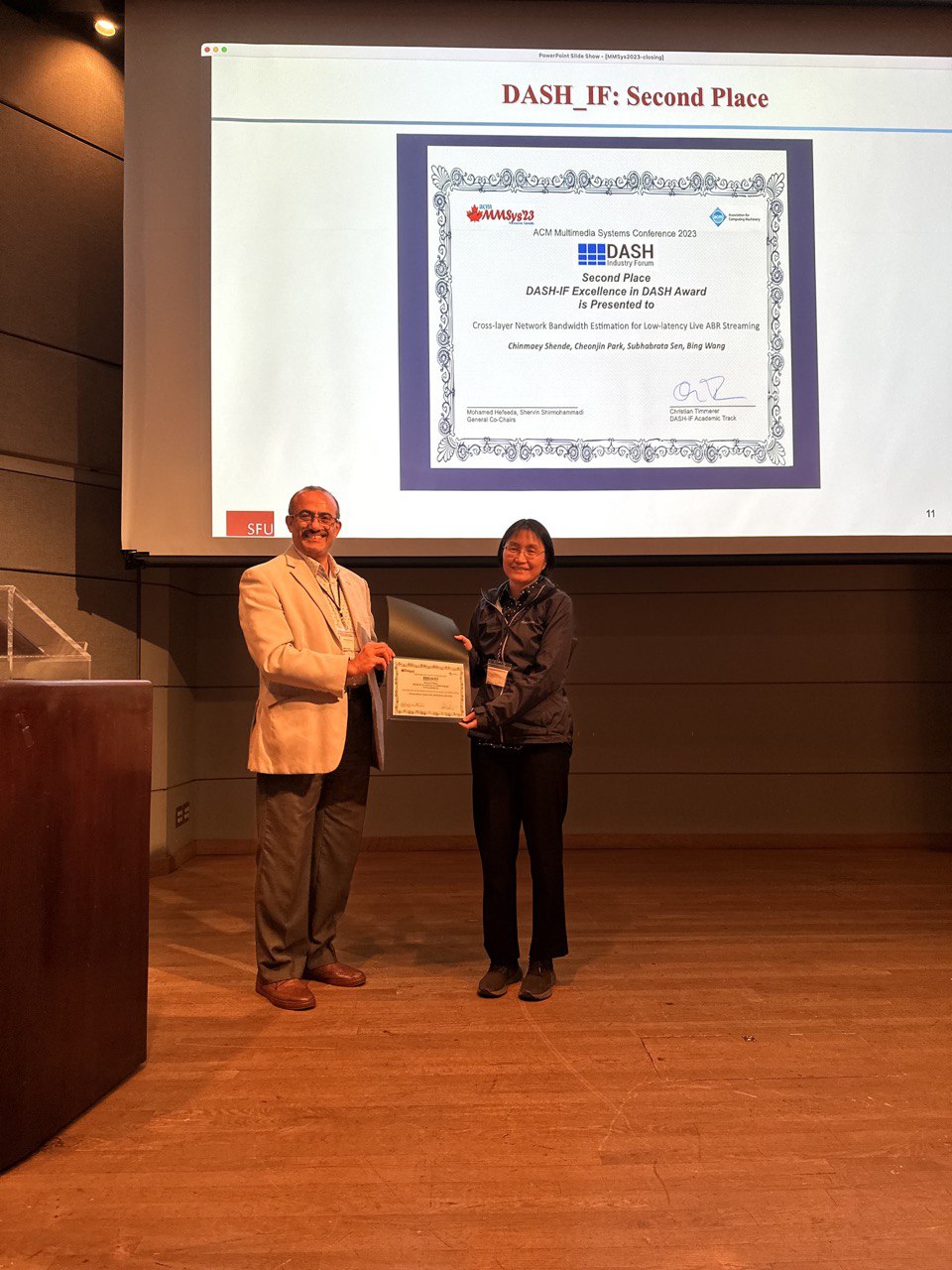
Second Place

Cross-layer Network Bandwidth Estimation for Low-latency Live ABR Streaming
by
Chinmaey Shende, Cheonjin Park, Subhabrata Sen, Bing Wang

Abstract: Low-latency live (LLL) adaptive bitrate (ABR) streaming relies critically on accurate bandwidth estimation to react to dynamic network conditions. While existing studies have proposed bandwidth estimation techniques for LLL streaming, these approaches are at the application level, and their accuracy is limited by the distorted timing information observed at the application level. In this paper, we propose a novel cross-layer approach that uses coarse-grained application-level semantics and fine-grained kernel-level packet capture to obtain accurate bandwidth estimation. We incorporate this technique in three popular open-source ABR players and show that it provides significantly more accurate bandwidth estimation than the state-of-the-art application-level approaches. In addition, the more accurate bandwidth estimation leads to better bandwidth prediction, which we show can lead to significantly better quality of experience (QoE) for end users.

Third Place

TASQ: Temporal Adaptive Streaming over QUIC
by
Akram Ansari, Yang Liu, Mea Wang, Emir Halepovic

Abstract: Traditional Adaptive BitRate (ABR) streaming faces a challenge of providing smooth experience under highly variable network conditions, especially when low latency is required. Effective adaptation techniques exist for deep-buffer scenarios, such as streaming long-form Video-on-Demand content, but remain elusive for short-form or low-latency cases, when even a short segment may be delivered too late and cause a stall. Recently proposed temporal adaptation aims to mitigate this problem by being robust to losing a part of the video segment, essentially dropping the tail of the segment intentionally to avoid the stall. In this paper, we analyze this approach in the context of a recently adopted codec AV1 and find that it does not always provide the promised benefits. We investigate the root causes and find that a combination of codec efficiency and TCP behavior can defeat the benefits of temporal adaptation. We develop a solution based on QUIC, and present the results showing that the benefits of temporal adaptation that still apply to AV1, including reduced stall time up to 65% compared to the original TCP-based approach. In addition, we present a novel way to use the stream management features of QUIC to benefit Quality-of-Experience (QoE) and reduce wasted data in video streaming.


The DASH-IF congratulates all winners and hopes to see you next year at ACM MMSys 2024.

Monday, June 12, 2023

DASH-IF awarded Best PhD Dissertation on Algorithms and Protocols for Adaptive Content Delivery over the Internet

Vancouver, June 9, 2023


The DASH Industry Forum (DASH-IF) is set to honor the most outstanding PhD dissertation on Algorithms and Protocols for Adaptive Content Delivery over the Internet during the ACM Multimedia Systems 2023. The winner of the award will be selected by a committee composed of DASH-IF members. All dissertations that fall within the scope and have been successfully defended in 2021, 2022 or 2023 (before the May 1, 2023 submission deadline) are qualified for nomination. The recipient of the award will receive 750 USD.

And the winner is

Dr. Mehmet N. Akcay
for his dissertation on
Server and Client-side Algorithms for Enhancing Adaptive Streaming


Abstract: HTTP adaptive video streaming is a technique widely used on the internet today to stream live and on-demand content. Server and client-side algorithms play an important role in improving user experience in terms of metrics such as latency, rebufferings, and rendering quality. After explaining the commonly used metrics, the author analyzed four main aspects of video streaming (i) bandwidth prediction accuracy, (ii) utilization of playback speed, (iii) adaptive streaming for content-aware-encoded videos, and (iv) head motion awareness for 360-degree videos. 360-degree video streaming requires much higher bandwidth compared to conventional video streaming. The author demonstrates that most of the algorithmic improvements achieved for video streaming can also be applied to Viewport Dependent Streaming (VDS) for 360-degree videos. It is also important that in 360-degree video streaming, we have a Head Mounted Display (HMD) device that is capable of pointing the viewport orientation of the user. We also investigate and improve the rate-adaptation algorithms for 360-degree videos by developing several new algorithms using the HMD. The new algorithms proposed in this thesis are Low-on-Latency (LoL), Low- on-Latency+ (LoL+), Bang-on-Bandwidth (BoB), Size-aware Rate Adaptation (SARA), Content-aware Playback Speed Control (CAPSC), Head-motion-aware Viewport Margins (HMAVM). We evaluate the proposed new algorithms using the objective metrics discussed in detail and show significant contributions for these new algorithms including up to 91% decrease in rebuffering duration for on-demand streaming, a 61.9% decrease in rebuffering duration, and an 8.1% decrease in latency compared to L2A for low-latency live streaming, 81.3% bandwidth prediction accuracy for interactive streaming, lastly 20% improvement in viewport quality and 50% reduction in motion- to-high-quality delay for 360-degree video streaming.

The DASH-IF congratulates the winner and hopes to see you next year at ACM MMSys 2024.

Thursday, June 11, 2020

DASH-IF awarded Excellence in DASH awards at ACM MMSys 2020

The DASH Industry Forum Excellence in DASH Awards at ACM MMSys 2020 acknowledges papers substantially addressing MPEG-DASH as the presentation format and are selected for presentation at ACM MMSys 2020. Preference is given to practical enhancements and developments which can sustain future commercial usefulness of DASH. The DASH format used should conform to the DASH-IF Interoperability Points as defined by http://dashif.org/guidelines/. It is a financial prize as follows: first place – €1000; second place – €500; and third place – €250. The winners are chosen by a DASH Industry Forum appointed committee and results are final.

This year's award goes to the following papers (Two first places, and one third):

1. Susanna Schwarzmann, Nick Hainke, Thomas Zinner, Christian Sieber, Werner Robitza, Alexander Raake. Comparing Fixed and Variable Segment Durations for Adaptive Video Streaming – A Holistic Analysis

1. Tomasz Lyko, Matthew Broadbent, Nicholas Race, Mike Nilsson, Paul Farrow, Steve Appleby. Evaluation of CMAF in Live Streaming Scenarios

3. Nan Jiang, Yao Liu, Tian Guo, Wenyao Xu, Viswanathan Swaminathan, Lisong Xu, Sheng Wei. 

The DASH-IF would like to congratulate all winners and hope to see you next year at ACM MMSys 2021.

Saturday, July 6, 2019

DASH-IF sponsored ice cream social event at ACM MMSys 2019

The DASH-IF sponsored the ice cream social event at ACM MMSys 2019 which allowed for networking and discussions. Here are some impressions from this unique event...


Monday, July 1, 2019

DASH-IF Interoperability Documents for Community Review

Community Review documents are published on the DASH-IF website in order to get feedback from the industry on tools and features that are documented for improved interoperability. For each of the documents, comments may be submitted on the technologies itself, on specific features, etc. These documents are only published temporarily for community review and will be replaced by a full version after the commenting period has closed and the comments have been addressed.

LOW-LATENCY DASH

The change request against IOP v4.3 for Community Review is accessible here. This change provides a new clause for live services that addresses specification updates as well as implementation guidelines to support Low-Latency DASH services addressing the requirements above. Community review is open until July 31st, 2019. Addition to IOP is expected by Q3/2019. Comments may be submitted through the github or public bugtracker.

LIVE MEDIA INGEST

The new draft specification is accessible here and a pdf version. This document specifies protocol interfaces for live ingest/egress of media content. It can be used between live ABR encoders, streaming origins, packagers and content delivery networks. It features support for redundant workflows with failover support and timed metadata. Community review is open until July 31st, 2019. Publication is expected by Q3/2019. Comments may be submitted through the github or public bugtracker.

Friday, June 21, 2019

DASH-IF awarded Best PhD Dissertation on Algorithms and Protocols for Adaptive Content Delivery over the Internet

For the first time, the DASH Industry Forum (DASH-IF) awarded the best PhD dissertation on algorithms and protocols for adaptive content delivery over the internet at ACM MMSys 2019. After a public call, the DASH-IF received a good number of nominations from all around the world to pick one winner. Due to the high number and quality of nominations (and since it's the first time), the DASH-IF decided to award also the second and third best dissertation; increasing its financial prize as follows: first place – $750; second place – $500; and third place – $250. The winners are chosen by a DASH Industry Forum appointed committee and results are final.

And the winner is...

First place
Dr. Abdelhak Bentaleb (National University of Singapore)
for the dissertation
Enabling Optimizations of Video Delivery in HTTP Adaptive Streaming
(From left to right): R. Zimmermann (supervisor), A. Bentaleb, A. Giladi (DASH-IF); (c) Ishita Dasgupta

Second place
Dr. Jeroen van der Hooft (Ghent University), Low-Latency Delivery of Adaptive Video Streaming Services
(From left to right): Jeroen van der Hooft, A. Giladi (DASH-IF); (c) Ishita Dasgupt

Third place
Dr. Jonathan Kua (Swinburne University of Technology), Achieving High Performance Content Streaming with Adaptive Chunklets and Active Queue Management

The DASH-IF would like to congratulate all winners and hope seeing you next year at ACM MMSys 2020.

DASH-IF awarded Excellence in DASH award at ACM MMSys 2019

The DASH Industry Forum Excellence in DASH Award at ACM MMSys 2019 acknowledges papers substantially addressing MPEG-DASH as the presentation format and are selected for presentation at ACM MMSys 2019. Preference is given to practical enhancements and developments which can sustain future commercial usefulness of DASH. The DASH format used should conform to the DASH-IF Interoperability Points as defined by http://dashif.org/guidelines/. It is a financial prize as follows: first place – €1000; second place – €500; and third place – €250. The winners are chosen by a DASH Industry Forum appointed committee and results are final.

This year's award goes to the following papers (Two first places, and one third):

1. Stefan Pham, Patrick Heeren, Daniel Silhavy, Stefan Arbanowski, Evaluation of shared resource allocation using SAND for ABR streaming
(From left to right): S. Pham, A. Giladi (DASH-IF); (c) Ishita Dasgupta


1. Abdelhak Bentaleb, Christian Timmerer, Ali C. Begen, Roger Zimmermann, Bandwidth prediction in low-latency chunked streaming
(From left to right): A. Bentaleb, A. Giladi (DASH-IF); (c) Ishita Dasgupta


3. Xing Liu, Bo Han, Feng Qian, Matteo Varvello, LIME: understanding commercial 360° live video streaming services
(From left to right): X. Liu, A. Giladi (DASH-IF); (c) Ishita Dasgupta

The DASH-IF would like to congratulate all winners and hope seeing you next year at ACM MMSys 2020.

Sunday, December 23, 2018

What happened in multimedia communication in 2018?

In January 2018 I wrote a blog post entitled "What to care about in multimedia communication in 2018?" and I think it's worth looking back to see what actually happened with respect to next generation video coding formats and adaptive streaming techniques.

In April 2018, the responses to the call for proposals for the next standard in video compression have been evaluated and a first working draft and test model for the Versatile Video Coding (VVC) standard have been approved. At this point already, some proposals demonstrated compression efficiency gains of typically 40% or more when compared to using HEVC. Currently, working draft 3 and test model 3 of VVC (VTM 3) are available and we may certainly expect compression efficiency gains well-beyond the targeted 50% for the final standard. An overview about VVC can be found here (by C. Feldmann) and here (by M. Wien). The licensing issues have been acknowledged and, thus, the Media Coding Industry Forum (MC-IF) has been established.

At the beginning of 2018, everyone was also very curious about AOMedia and AV1. Version 1 of the specification has been finally become available and in the meantime it is implemented/deployed on both content provisioning/encoding (e.g. Bitmovin) and content consumption/decoding (e.g., Chrome, Firefox). In this context, we also published a multi-codec DASH dataset comprising AVC, HEVC, VP9, and AV1 (VVC will be added at a later stage). In general, however, we are entering the era of multiple video codecs deployed in products and services whereby this trend is also confirmed by Bitmovin's latest video developer survey.

MPEG-DASH 3rd edition has been approved and is awaiting publication but I expect this to happen in 2019 though. An overview of the MPEG-DASH status is shown in the figure below.
In this context, the DASH-IF produced various vital assets such as interoperability guidelines (latest v4.3, content protection, ATSC 3.0, SAND), test vectors, conformance tools, and a reference client. For informative aspects of MPEG-DASH such as the bitrate adaptation schemes the interested reader is referred to our survey. This survey gives an overview about existing techniques (see figure below) and also outlines future research. It is available for free for everyone (open access).


Finally, I mentioned a couple of scientific events in 2018 including QoMEX, MMSys (NOSSDAV, PV), ICME, ICIP, PCS, and MIPR. I have attended all of the them (except PCS), each showing advances in their respective field. These events are probably worth to attend also in 2019 but I will certainly blog about this early next year. However, I'd like to hear your opinion of what happened in 2018 and what we may expect in 2019...

Thursday, July 26, 2018

DASH-IF awarded Grand Challenge on Dynamic Adaptive Streaming over HTTP at IEEE ICME 2018

July 25, ICME 2018, San Diego, CA, USA

DASH-IF awarded Grand Challenge on Dynamic Adaptive Streaming over HTTP at IEEE ICME 2018

Real-time entertainment services such as streaming video and audio are currently accounting for more than 70% of the Internet traffic during peak hours. Interestingly, these services are all delivered over-the-top (OTT) of the existing networking infrastructure using HTTP. The MPEG Dynamic Adaptive Streaming over HTTP (DASH) standard enables smooth multimedia streaming towards heterogeneous devices.

The MPEG DASH standard provides an interoperable representation format but deliberately does not define the adaptation behavior for the client implementations, which is left open for research and industry competition. In a typical deployment, the encoding itself is optimized for the respective delivery channels but - as the content is delivered over the top without any guarantees - various issues during the streaming (e.g., high startup delay, stalls/re-buffering, high switching frequency, inefficient network utilization, unfairness to competing network traffic, etc.) may limit the quality of experience (QoE) as perceived by the viewers.

The aim of this grand challenge is to solicit contributions addressing end-to-end delivery aspects that will help improve the QoE while optimally using the network resources at an acceptable cost. Such aspects include, but are not limited to, content preparation for adaptive streaming, delivery in the Internet and streaming client implementations.

A special focus of 2018’s grand challenge will be related to immersive media applications and services including omnidirectional/360-degree videos.

The winner will be awarded  €750 and the runner-up €250.

Each submission has been presented at IEEE ICME 2017 within an oral session, which was attended very well.

  
(photos by C. Timmerer)

This year's award goes to the following papers:

WINNER: "Game Theory Based Bitrate Adaptation for dash.js Reference Player" by Abdelhak Bentaleb, Ali Begen, Roger Zimmermann


Christian Timmerer (left), Abdelhak Bentaleb, Vasudev Bhaskaran, Lei Zhang.

RUNNER-UP: "Tile-based QoE-driven HTTP/2 Streaming System for 360 Video" by Zhimin Xu, Yixuan Ban, Kai Zhang, Lan Xie, Xinggong Zhang, Zongming Guo, Shengbin Meng, Yue Wang

Christian Timmerer (left), Zongming Guo, Vasudev Bhaskaran, Lei Zhang.

We would like to congratulate all winners. 

Friday, June 15, 2018

DASH-IF awarded Excellence in DASH award at ACM MMSys 2018

The DASH Industry Forum Excellence in DASH Award at ACM MMSys 2018 acknowledges papers substantially addressing MPEG-DASH as the presentation format and are selected for presentation at ACM MMSys 2018. Preference is given to practical enhancements and developments which can sustain future commercial usefulness of DASH. The DASH format used should conform to the DASH-IF Interoperability Points as defined by http://dashif.org/guidelines/. It is a financial prize as follows: First place – €1000; Second place – €500; and Third place – €250. The winners are chosen by a DASH Industry Forum appointed committee and results are final.

Christian Timmerer (left) and Viswanathan (Vishy) Swaminathan (right)

The winners are chosen by a DASH Industry Forum appointed committee and results are final.

This year's award goes to the following papers (Two first places, one second, and one third):

1. Kevin Spiteri, Ramesh Sitaraman, Daniel Sparacio. From Theory to Practice: Improving Bitrate Adaptation in the DASH Reference Player

Christian Timmerer (from left to right), Kevin Spiteri, Ramesh Sitaraman, and Viswanathan (Vishy) Swaminathan
1. Abdelhak Bentaleb, Ali C. Begen, Roger Zimmermann, Saad Harous. Want to Play DASH? GTA: A Game Theoretic Approach for Adaptive Streaming over HTTP

Christian Timmerer (from left to right), Roger Zimmermann, Abdelhak Bentaleb, Ali C. Begen, and Viswanathan (Vishy) Swaminathan
2. Savino Dambra, Giuseppe Samela, Lucile Sassatelli, Romaric Pighetti, Ramon Aparicio Pardo, Anne-Marie Pinna-Déry. Film Editing: New Levers to Improve VR Streaming

Christian Timmerer (from left to right), Lucile Sassatelli, and Viswanathan (Vishy) Swaminathan
3. S. Silva, J. Bruneau-Queyreix, M. Lacaud, D. Négru, L. Réveillère, MUSLIN: Achieving High, Fairly Shared QoE Through Multi-Source Live Streaming

Christian Timmerer (from left to right), Simon Da Silva, and Viswanathan (Vishy) Swaminathan
We would like to congratulate all winners and hope seeing you next year at ACM MMSys 2019.

Saturday, January 6, 2018

What to care about in multimedia communication in 2018?

In the past days/weeks you may have witness a high number of forecasts/predictions for 2018, like this one here. I'm not so good at predictions and we all learned these days to be careful about speculation. Thus, my focus here is on things to care about in 2018.

MPEG and VCEG are working towards a new video coding standard (naming, number scheme yet to be defined) and the call for proposals is out. Responses will be evaluated by the 122nd MPEG meeting in April 2018 (San Diego, CA, USA) and a new standard is expected to be available in late 2020. The main focus of the CfP is (i) 360-degree omnidirectional video, (ii) high-dynamic range (HDR), (iii) wide colour gamut (WCG), and (iv) conventional standard-dynamic-range camera content. The goal is -- simple, as usual -- compress digital video content, i.e., twice as much as you did before with the same video quality, e.g., as HEVC, or get higher quality with the same number of bits (or a combination thereof). Initial, preliminary results indicate this goal is feasible and everyone is looking forward to the MPEG meeting in April; certainly a place to be.

In addition to what MPEG/VCEG is doing, the Alliance for Open Media gained significant attention with its AV1 codec, first demos are available, and recently also Apple joined AOM. AV1 is not longer controlled by a single company, and, thus, it is becoming a real alternative in the video coding landscape, specifically for the streaming market. The nice thing, it's open source and royalty-free! In other words, one should not neglect AV1 and I think we will see many, hopefully good news in 2018.

On this topic, you might be interested in reading this and this.

What about DASH in 2018? We will see a 3rd edition of MPEG-DASH, the DASH-IF will further work on interoperability points, and I expect further convergence of DASH and HLS towards CMAF. However, I also expect minor changes for the main, common use cases utilizing the core technology of HTTP adaptive streaming. Changes, if any, will be transparent to most of us. On the other hand, immersive media and user engagement will become more and more important as more services are delivered over the top leading to more content becoming available to end users, thus, increasing competition among providers, vendors, etc. As a consequence, (a) content, (b) quality, and (c) costs will be important aspects, whereby (a+c) are "easy to sell" but (b) is still difficult to quantify (and "sell") with many open issues to solve in the (near) future.

Before drifting off to forecasts and predictions, I'd like to conclude with a list of scientific events in 2018 which are worthwhile to attend:
  • QoMEX -- Int'l Conf. on Quality of Multimedia Experience -- will be hosted in Sardinia, Italy from May 29-31, which is THE conference to be for QoE of multimedia applications and services. Submission deadline is January 15/22, 2018.
  • MMSys -- Multimedia Systems Conf. -- and specifically Packet Video, which will be on June 12 in Amsterdam, The Netherlands. Packet Video is THE adaptive streaming scientific event 2018. Submission deadline is March 1, 2018.
  • Additionally, you might be interested in ICME (July 23-27, 2018, San Diego, USA; I'm part of a tutorial there;), ICIP (October 7-10, 2018, Athens, Greece; specifically in the context of video coding), and PCS (June 24-27, 2018, San Francisco, CA, USA; also in the context of video coding).
  • The DASH-IF academic track hosts special events at MMSys (Excellence in DASH Award) and ICME (DASH Grand Challenge).
  • MIPR -- 1st Int'l Conf. on Multimedia Information Processing and Retrieval -- will be in Miami, Florida, USA from April 10-12, 2018. It has a broad range of topics including networking for multimedia systems as well as systems and infrastructures.

Thursday, July 13, 2017

DASH-IF awarded Grand Challenge on Dynamic Adaptive Streaming over HTTP at IEEE ICME 2017

Hong Kong, July 12, 2017


Real-time entertainment services such as streaming video and audio are currently accounting for more than 70% of the Internet traffic during peak hours. Interestingly, these services are all delivered over-the-top (OTT) of the existing networking infrastructure using the Hypertext Transfer Protocol (HTTP). The MPEG Dynamic Adaptive Streaming over HTTP (DASH) standard enables smooth multimedia streaming towards heterogeneous devices.

The aim of the DASH-IF Grand Challenge on Dynamic Adaptive Streaming over HTTP at IEEE ICME 2017 is to solicit contributions addressing end-to-end delivery aspects that will help improve the QoE while optimally using the network resources at an acceptable cost. Such aspects include, but are not limited to, content preparation for adaptive streaming, delivery in the Internet and streaming client implementations. A special focus of 2017’s grand challenge will be related to virtual reality applications and services including 360 degree videos.

We received the following submissions, which have been evaluated by DASH-IF members:
  • "Content Preparation and Cross-Device Delivery of 360° Video with 4k Field of View Using DASH" by Louay Bassbouss, Stefan Pham, Stephan Steglich, Martin Lasak
  • "A Hybrid P2P/Multi-Source Quality-Adaptive Live-Streaming Solution for high end-user's QoE" by Joachim Bruneau-Queyreix, Mathias Lacaud, Daniel Negru
  • "Efficient content preparation and distribution of 360VR sequences using MPEG-DASH technology" by Cesar Diaz, Julian Cabrera, Marta Orduna, Lara Munoz, Pablo Perex, Narciso Garcia
  • "Optimal Viewport Adaptive Streaming for 360-Degree Videos" by Zhimin Xu, Lan Xie, Xinggong Zhang, Han Hu, Yixuan Ban, Zongming Guo
The winner will be awarded  €750 and the runner-up €250.

Each submission has been presented at IEEE ICME 2017 within an oral session, which was attended very well. We've also seen interesting demos after all submissions have been presented.


This year's award goes to the following papers:

WINNER: "A Hybrid P2P/Multi-Source Quality-Adaptive Live-Streaming Solution for high end-user's QoE" by Joachim Bruneau-Queyreix, Mathias Lacaud, Daniel Negru
C. Timmerer (left), Joachim Bruneau-Queyreix (middle), Axel Becker-Lakus (right)


RUNNER-UP: "Optimal Viewport Adaptive Streaming for 360-Degree Videos" by Zhimin Xu, Lan Xie, Xinggong Zhang, Han Hu, Yixuan Ban, Zongming Guo
C. Timmerer (left), Zongming Guo (middle), Axel Becker-Lakus (right)

We would like to congratulate all winners and hope seeing you next year at IEEE ICME 2018.

Photos by Cigdem Turan (PolyU, Hong Kong).

Sunday, June 25, 2017

DASH-IF awarded Excellence in DASH award at ACM MMSys 2017

Taipei, Taiwan, June 21, 2017.

The DASH Industry Forum Excellence in DASH Award at ACM MMSys 2017 acknowledges papers substantially addressing MPEG-DASH as the presentation format and are selected for presentation at ACM MMSys 2017. Preference is given to practical enhancements and developments which can sustain future commercial usefulness of DASH. The DASH format used should conform to the DASH-IF Interoperability Points as defined by http://dashif.org/guidelines/. It is a financial prize as follows: First place – €1000; Second place – €500; and Third place – €250. The winners are chosen by a DASH Industry Forum appointed committee and results are final.

Viswanathan (Vishy) Swaminathan 

This year's award goes to the following papers
1. Ahmed H. Zahran, Jason J. Quinlan, K. K. Ramakrishnan, and Cormac J. Sreenan. 2017. SAP: Stall-Aware Pacing for Improved DASH Video Experience in Cellular Networks. In Proceedings of the 8th ACM on Multimedia Systems Conference (MMSys'17). Taiwan, Taipei, June 2017.
Vishy (left), Ahmed H. Zahran (right)
2. Jan Willem Kleinrouweler, Britta Meixner, and Pablo Cesar. 2017. Improving Video Quality in Crowded Networks Using a DANE. In Proceedings of the 27th Workshop on Network and Operating Systems Support for Digital Audio and Video (NOSSDAV'17). Taiwan, Taipei, June 2017.
Jan Willem Kleinrouweler (left), Vishy (right)
3. Mario Graf, Christian Timmerer, and Christopher Mueller. 2017. Towards Bandwidth Efficient Adaptive Streaming of Omnidirectional Video over HTTP: Design, Implementation, and Evaluation. In Proceedings of the 8th ACM on Multimedia Systems Conference (MMSys'17). Taiwan, Taipei, June 2017.
Vishy (left), Christian Timmerer (right)

We would like to congratulate all winners and hope seeing you next year at ACM MMSys 2018.

Tuesday, August 16, 2016

DASH-IF Academic Track


The MPEG-DASH standard has raised a huge momentum within both industry and academia. The DASH-IF provides – among others – interoperability guidelines and test vectors and closes the gap enabling interoperable deployments. In recent years, we have seen a tremendous amount of research papers addressing various issues in and around DASH and, thus, the DASH-IF establishes an academic track to:
  • identify research communities working in the area of DASH
  • create awareness of DASH-IF material and promote it within the academic community, and
  • solicit research within and collect results from the academic community
As a first step the DASH-IF created the “Excellence in DASH Award” at ACM MMSys 2016 and is proud to announce the result as follows. The excellence in DASH award was selected by members of the DASH-IF and instead of a first, second, and third place the DASH-IF concluded to give the first price to all three papers which are as follows: “ABMA+: lightweight and efficient algorithm for HTTP adaptive streaming” by Andrzej Beben, Piotr Wiśniewski, Jordi Mongay Batalla, Piotr Krawiec (Warsaw University of Technology, Poland ); “Delivering Stable High-Quality Video: An SDN Architecture with DASH Assisting Network Elements” by Jan Willem Martin Kleinrouweler, Sergio Cabrero, Pablo Cesar (Centrum Wiskunde & Informatica, Netherlands); and “SQUAD: A Spectrum-based Quality Adaptation for Dynamic Adaptive Streaming over HTTP” by Cong Wang, Amr Rizk, Michael Zink (University of Massachusetts Amherst, USA). (see pictures here).

For academics who want to join the DASH-IF Academic Track, please subscribe to the public email reflector dashifat@lists.aau.at via https://lists.aau.at/mailman/listinfo/dashifat.

Everyone is welcome - let's do something! For any comments or questions, please let me know.

Another related activity was the IEEE ICME 2016 Bitmovin Grand Challenge on DASH which is summarized below. We'd like to thank all authors who have submitted their work to the grand challenge and we'd like to congratulate the winner team!


Friday, August 28, 2015

One Year of MPEG

In my last MPEG report (index) I’ve mentioned that the 112th MPEG meeting in Warsaw was my 50th MPEG meeting which roughly accumulates to one year of MPEG meetings. That is, one year of my life I've spend in MPEG meetings - scary, isn't it? Thus, I thought it’s time to recap what I have done in MPEG so far featuring the following topics/standards where I had significant contributions:
  • MPEG-21 - The Multimedia Framework 
  • MPEG-M - MPEG extensible middleware (MXM), later renamed to multimedia service platform technologies 
  • MPEG-V - Information exchange with Virtual Worlds, later renamed to media context and control
  • MPEG-DASH - Dynamic Adaptive Streaming over HTTP

MPEG-21 - The Multimedia Framework

I started my work with standards, specifically MPEG, with Part 7 of MPEG-21 referred to as Digital Item Adaptation (DIA) and developed the generic Bitstream Syntax Description (gBSD) in collaboration with SIEMENS which allows for a coding-format independent (generic) adaptation of scalable multimedia content towards the actual usage environment (e.g., different devices, resolution, bitrate). The main goal of DIA was to enable the Universal Media Access (UMA) -- any content, anytime, anywhere on any device -- and also motivated me to start this blog. I also wrote a series of blog entries on this topic: O Universal Multimedia Access, Where Art Thou? which gives an overview about this topic and basically is also what I’ve done in my Ph.D. thesis. Later I helped a lot in various MPEG-21 parts including its dissemination and documented where it has been used. In the past, I saw many forms of Digital Items (e.g., iTunesLP was one of the first) but unfortunately the need for a standardised format is very low. Instead, proprietary formats are used and I realised that developers are more into APIs than formats. The format comes with the API but it’s the availability of an API that attracts developers and makes them to adopt a certain technology. 

MPEG-M

The lessons learned from MPEG-21 was one reason why I joined the MPEG-M project as it was exactly the purpose to create an API into various MPEG technologies, providing developers a tool that makes it easy for them to adopt new technologies and, thus, new formats/standards. We created an entire architecture, APIs, and reference software to make it easy for external people to adopt MPEG technologies. The goal was to hide the complexity of the technology through simple to use APIs which should enable the accelerated development of components, solutions, and applications utilising digital media content. A good overview about MPEG-M can found on this poster.

MPEG-V

When MPEG started working on MPEG-V (it was not called like that in the beginning), I saw it as an extension of UMA and MPEG-21 DIA to go beyond audio-visual experiences by stimulating potentially all human senses. We created and standardised an XML-based language that enables the annotation of multimedia content with sensory effects. Later the scope was extended to include virtual worlds which resulted in the acronym MPEG-V. It also brought me to start working on Quality of Experience (QoE) and we coined the term Quality of Sensory Experience (QuASE) as part of the (virtual) SELab at Alpen-Adria-Universität Klagenfurt which offers a rich set of open-source software tools and datasets around this topic on top of off-the-shelf hardware (still in use in my office).

MPEG-DASH

The latest project I’m working on is MPEG-DASH where I’ve also co-founded bitmovin, now a successful startup offering fastest transcoding in the cloud (bitcodin) and high quality MPEG-DASH players (bitdash). It all started when MPEG asked me to chair the evaluation of call for proposals on HTTP streaming of MPEG media. We then created dash.itec.aau.at that offers a huge set of open source tools and datasets used by both academia and industry worldwide (e.g., listed on DASH-IF). I think I can proudly state that this is the most successful MPEG activity I've been involved so far... (note: a live deployment can be found here which shows 24/7 music videos over the Internet using bitcodin and bitdash).

DASH and QuASE are also part of my habilitation which brought me into the current position at Alpen-Adria-Universität Klagenfurt as Associate Professor. Finally, one might ask the question, was it all worth spending so much time for MPEG and at MPEG meetings. I would say YES and there are many reasons which could easily results in another blog post (or more) but it’s better to discuss this face to face, I'm sure there will be plenty of possibilities in the (near) future or you come to Klagenfurt, e.g., for ACM MMSys 2016 ...