Showing posts with label award. Show all posts

Thursday, December 7, 2023

Hat-Trick Victory: MPEG-DASH Papers Shine in ACM SIGMM Test of Time Awards

The Association for Computing Machinery (ACM) Special Interest Group on Multimedia (SIGMM) provides a Test of Time Award. The details for this award can be found here, and I took the liberty to copy the main aspects as follows.

"This award is presented every year, starting in 2020, to the authors of the paper published either 10, 11 or 12 years previously at an SIGMM sponsored or co-sponsored conference (so the 2020 award would be for papers at a 2008, 2009 or 2010 SIGMM conference). The award recognizes the paper that has had the most impact and influence on the field of Multimedia in terms of research, development, product or ideas, during the intervening years, as selected by a selection committee. The contributions the selection committee will focus on may be theoretical advances, techniques and/or software tools that have been widely used, and/or innovative applications that have had impact on multimedia computing."

Interestingly, in the past three years, papers related to MPEG-DASH were always among the winners or honorable mentions as follows:

2021 Awards

Winner (MM Systems & Networking)

Thomas Stockhammer. 2011. Dynamic adaptive streaming over HTTP --: standards and design principles. In Proceedings of the second annual ACM conference on Multimedia systems (MMSys '11). Association for Computing Machinery, New York, NY, USA, 133–144. https://dl.acm.org/doi/10.1145/1943552.1943572

Abstract: In this paper, we provide some insight and background into the Dynamic Adaptive Streaming over HTTP (DASH) specifications as available from 3GPP and in draft version also from MPEG. Specifically, the 3GPP version provides a normative description of a Media Presentation, the formats of a Segment, and the delivery protocol. In addition, it adds an informative description on how a DASH Client may use the provided information to establish a streaming service for the user. The solution supports different service types (e.g., On-Demand, Live, Time-Shift Viewing), different features (e.g., adaptive bitrate switching, multiple language support, ad insertion, trick modes, DRM) and different deployment options. Design principles and examples are provided.

2022 Awards

Honorable Mention, in the category of “Multimedia Systems- Networks”

Saamer Akhshabi, Ali C. Begen, and Constantine Dovrolis. 2011. An experimental evaluation of rate-adaptation algorithms in adaptive streaming over HTTP. In Proceedings of the second annual ACM conference on Multimedia systems (MMSys '11). Association for Computing Machinery, New York, NY, USA, 157–168. https://dl.acm.org/doi/10.1145/1943552.1943574

Abstract: Adaptive (video) streaming over HTTP is gradually being adopted, as it offers significant advantages in terms of both user-perceived quality and resource utilization for content and network service providers. In this paper, we focus on the rate-adaptation mechanisms of adaptive streaming and experimentally evaluate two major commercial players (Smooth Streaming, Netflix) and one open source player (OSMF). Our experiments cover three important operating conditions. First, how does an adaptive video player react to either persistent or short-term changes in the underlying network available bandwidth. Can the player quickly converge to the maximum sustainable bitrate? Second, what happens when two adaptive video players compete for available bandwidth in the bottleneck link? Can they share the resources in a stable and fair manner? And third, how does adaptive streaming perform with live content? Is the player able to sustain a short playback delay? We identify major differences between the three players, and significant inefficiencies in each of them.

2023 Awards

Honorable Mention, in the category of "MM Systems & Networking"

Stefan Lederer, Christopher Müller, and Christian Timmerer. 2012. Dynamic adaptive streaming over HTTP dataset. In Proceedings of the 3rd Multimedia Systems Conference (MMSys '12). Association for Computing Machinery, New York, NY, USA, 89–94. https://dl.acm.org/doi/10.1145/2155555.2155570

Abstract: The delivery of audio-visual content over the Hypertext Transfer Protocol (HTTP) got lot of attention in recent years and with dynamic adaptive streaming over HTTP (DASH) a standard is now available. Many papers cover this topic and present their research results, but unfortunately all of them use their own private dataset which -- in most cases -- is not publicly available. Hence, it is difficult to compare, e.g., adaptation algorithms in an objective way due to the lack of a common dataset which shall be used as basis for such experiments. In this paper, we present our DASH dataset including our DASHEncoder, an open source DASH content generation tool. We also provide basic evaluations of the different segment lengths, the influence of HTTP server settings, and, in this context, we show some of the advantages as well as problems of shorter segment lengths.

Tuesday, June 13, 2023

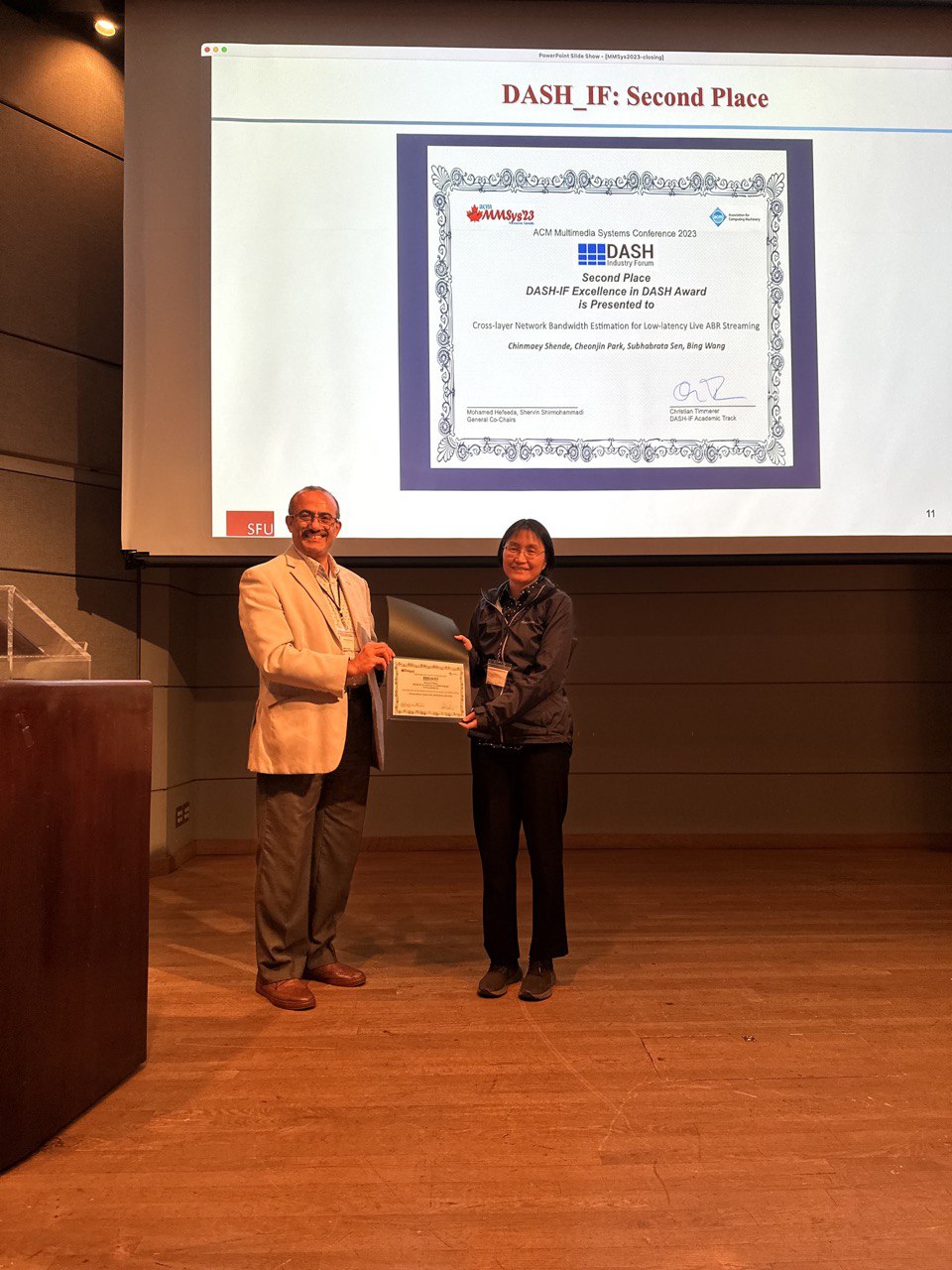
DASH-IF awarded Excellence in DASH award at ACM MMSys 2023

Vancouver, June 9, 2023


The DASH Industry Forum Excellence in DASH Award at ACM MMSys 2023 acknowledges papers substantially addressing MPEG-DASH as the presentation format and are selected for presentation at ACM MMSys 2023. Preference is given to practical enhancements and developments which can sustain future commercial usefulness of DASH. The DASH format used should conform to the DASH-IF Interoperability Points as defined by http://dashif.org/guidelines/. It is a financial prize as follows: first place – €750; second place – €500; and third place – €250. The winners are chosen by a DASH Industry Forum-appointed committee, and the results are final.

This year's award goes to the following papers:

First Place

Latency Target based Analysis of the DASH.js Player
by
Piers O’Hanlon and Adil Aslam

Abstract: We analyse the low latency performance of the three Adaptive Bitrate (ABR) algorithms in the dash.js Dynamic Adaptive Streaming over HTTP (DASH) player with respect to a range of latency targets and configuration options. We perform experiments on our DASH Testbed which allows for testing with a range of real world derived network profiles. Our experiments enable a better understanding of how latency targets affect quality of experience (QoE), and how well the different algorithms adhere to their targets. We find that with dash.js v4.5.0 the default Dynamic algorithm achieves the best overall QoE. We show that whilst the other algorithms can achieve higher video quality at lower latencies, they do so only at the expense of increased stalling. We analyse the poor performance of L2A-LL in our tests and develop modifications which demonstrate significant improvements. We also highlight how some low latency configuration settings can be detrimental to performance.

Second Place

Cross-layer Network Bandwidth Estimation for Low-latency Live ABR Streaming
by
Chinmaey Shende, Cheonjin Park, Subhabrata Sen, Bing Wang

Abstract: Low-latency live (LLL) adaptive bitrate (ABR) streaming relies critically on accurate bandwidth estimation to react to dynamic network conditions. While existing studies have proposed bandwidth estimation techniques for LLL streaming, these approaches are at the application level, and their accuracy is limited by the distorted timing information observed at the application level. In this paper, we propose a novel cross-layer approach that uses coarse-grained application-level semantics and fine-grained kernel-level packet capture to obtain accurate bandwidth estimation. We incorporate this technique in three popular open-source ABR players and show that it provides significantly more accurate bandwidth estimation than the state-of-the-art application-level approaches. In addition, the more accurate bandwidth estimation leads to better bandwidth prediction, which we show can lead to significantly better quality of experience (QoE) for end users.


Third Place

TASQ: Temporal Adaptive Streaming over QUIC
by
Akram Ansari, Yang Liu, Mea Wang, Emir Halepovic

Abstract: Traditional Adaptive BitRate (ABR) streaming faces a challenge of providing smooth experience under highly variable network conditions, especially when low latency is required. Effective adaptation techniques exist for deep-buffer scenarios, such as streaming long-form Video-on-Demand content, but remain elusive for short-form or low-latency cases, when even a short segment may be delivered too late and cause a stall. Recently proposed temporal adaptation aims to mitigate this problem by being robust to losing a part of the video segment, essentially dropping the tail of the segment intentionally to avoid the stall. In this paper, we analyze this approach in the context of a recently adopted codec AV1 and find that it does not always provide the promised benefits. We investigate the root causes and find that a combination of codec efficiency and TCP behavior can defeat the benefits of temporal adaptation. We develop a solution based on QUIC, and present the results showing that the benefits of temporal adaptation that still apply to AV1, including reduced stall time up to 65% compared to the original TCP-based approach. In addition, we present a novel way to use the stream management features of QUIC to benefit Quality-of-Experience (QoE) and reduce wasted data in video streaming.


The DASH-IF congratulates all winners and hopes to see you next year at ACM MMSys 2024.

Monday, June 12, 2023

DASH-IF awarded Best PhD Dissertation on Algorithms and Protocols for Adaptive Content Delivery over the Internet

Vancouver, June 9, 2023


The DASH Industry Forum (DASH-IF) is set to honor the most outstanding PhD dissertation on Algorithms and Protocols for Adaptive Content Delivery over the Internet during the ACM Multimedia Systems 2023. The winner of the award will be selected by a committee composed of DASH-IF members. All dissertations that fall within the scope and have been successfully defended in 2021, 2022 or 2023 (before the May 1, 2023 submission deadline) are qualified for nomination. The recipient of the award will receive 750 USD.

And the winner is

Dr. Mehmet N. Akcay
for his dissertation on
Server and Client-side Algorithms for Enhancing Adaptive Streaming


Abstract: HTTP adaptive video streaming is a technique widely used on the internet today to stream live and on-demand content. Server and client-side algorithms play an important role in improving user experience in terms of metrics such as latency, rebufferings, and rendering quality. After explaining the commonly used metrics, the author analyzed four main aspects of video streaming (i) bandwidth prediction accuracy, (ii) utilization of playback speed, (iii) adaptive streaming for content-aware-encoded videos, and (iv) head motion awareness for 360-degree videos. 360-degree video streaming requires much higher bandwidth compared to conventional video streaming. The author demonstrates that most of the algorithmic improvements achieved for video streaming can also be applied to Viewport Dependent Streaming (VDS) for 360-degree videos. It is also important that in 360-degree video streaming, we have a Head Mounted Display (HMD) device that is capable of pointing the viewport orientation of the user. We also investigate and improve the rate-adaptation algorithms for 360-degree videos by developing several new algorithms using the HMD. The new algorithms proposed in this thesis are Low-on-Latency (LoL), Low- on-Latency+ (LoL+), Bang-on-Bandwidth (BoB), Size-aware Rate Adaptation (SARA), Content-aware Playback Speed Control (CAPSC), Head-motion-aware Viewport Margins (HMAVM). We evaluate the proposed new algorithms using the objective metrics discussed in detail and show significant contributions for these new algorithms including up to 91% decrease in rebuffering duration for on-demand streaming, a 61.9% decrease in rebuffering duration, and an 8.1% decrease in latency compared to L2A for low-latency live streaming, 81.3% bandwidth prediction accuracy for interactive streaming, lastly 20% improvement in viewport quality and 50% reduction in motion- to-high-quality delay for 360-degree video streaming.

The DASH-IF congratulates the winner and hopes to see you next year at ACM MMSys 2024.

Thursday, June 11, 2020

DASH-IF awarded Excellence in DASH awards at ACM MMSys 2020

The DASH Industry Forum Excellence in DASH Awards at ACM MMSys 2020 acknowledges papers substantially addressing MPEG-DASH as the presentation format and are selected for presentation at ACM MMSys 2020. Preference is given to practical enhancements and developments which can sustain future commercial usefulness of DASH. The DASH format used should conform to the DASH-IF Interoperability Points as defined by http://dashif.org/guidelines/. It is a financial prize as follows: first place – €1000; second place – €500; and third place – €250. The winners are chosen by a DASH Industry Forum appointed committee and results are final.

This year's award goes to the following papers (Two first places, and one third):

1. Susanna Schwarzmann, Nick Hainke, Thomas Zinner, Christian Sieber, Werner Robitza, Alexander Raake. Comparing Fixed and Variable Segment Durations for Adaptive Video Streaming – A Holistic Analysis

1. Tomasz Lyko, Matthew Broadbent, Nicholas Race, Mike Nilsson, Paul Farrow, Steve Appleby. Evaluation of CMAF in Live Streaming Scenarios

3. Nan Jiang, Yao Liu, Tian Guo, Wenyao Xu, Viswanathan Swaminathan, Lisong Xu, Sheng Wei. 

The DASH-IF would like to congratulate all winners and hope to see you next year at ACM MMSys 2021.

Friday, June 21, 2019

DASH-IF awarded Best PhD Dissertation on Algorithms and Protocols for Adaptive Content Delivery over the Internet

For the first time, the DASH Industry Forum (DASH-IF) awarded the best PhD dissertation on algorithms and protocols for adaptive content delivery over the internet at ACM MMSys 2019. After a public call, the DASH-IF received a good number of nominations from all around the world to pick one winner. Due to the high number and quality of nominations (and since it's the first time), the DASH-IF decided to award also the second and third best dissertation; increasing its financial prize as follows: first place – $750; second place – $500; and third place – $250. The winners are chosen by a DASH Industry Forum appointed committee and results are final.

And the winner is...

First place
Dr. Abdelhak Bentaleb (National University of Singapore)
for the dissertation
Enabling Optimizations of Video Delivery in HTTP Adaptive Streaming
(From left to right): R. Zimmermann (supervisor), A. Bentaleb, A. Giladi (DASH-IF); (c) Ishita Dasgupta

Second place
Dr. Jeroen van der Hooft (Ghent University), Low-Latency Delivery of Adaptive Video Streaming Services
(From left to right): Jeroen van der Hooft, A. Giladi (DASH-IF); (c) Ishita Dasgupt

Third place
Dr. Jonathan Kua (Swinburne University of Technology), Achieving High Performance Content Streaming with Adaptive Chunklets and Active Queue Management

The DASH-IF would like to congratulate all winners and hope seeing you next year at ACM MMSys 2020.

DASH-IF awarded Excellence in DASH award at ACM MMSys 2019

The DASH Industry Forum Excellence in DASH Award at ACM MMSys 2019 acknowledges papers substantially addressing MPEG-DASH as the presentation format and are selected for presentation at ACM MMSys 2019. Preference is given to practical enhancements and developments which can sustain future commercial usefulness of DASH. The DASH format used should conform to the DASH-IF Interoperability Points as defined by http://dashif.org/guidelines/. It is a financial prize as follows: first place – €1000; second place – €500; and third place – €250. The winners are chosen by a DASH Industry Forum appointed committee and results are final.

This year's award goes to the following papers (Two first places, and one third):

1. Stefan Pham, Patrick Heeren, Daniel Silhavy, Stefan Arbanowski, Evaluation of shared resource allocation using SAND for ABR streaming
(From left to right): S. Pham, A. Giladi (DASH-IF); (c) Ishita Dasgupta


1. Abdelhak Bentaleb, Christian Timmerer, Ali C. Begen, Roger Zimmermann, Bandwidth prediction in low-latency chunked streaming
(From left to right): A. Bentaleb, A. Giladi (DASH-IF); (c) Ishita Dasgupta


3. Xing Liu, Bo Han, Feng Qian, Matteo Varvello, LIME: understanding commercial 360° live video streaming services
(From left to right): X. Liu, A. Giladi (DASH-IF); (c) Ishita Dasgupta

The DASH-IF would like to congratulate all winners and hope seeing you next year at ACM MMSys 2020.

Friday, June 15, 2018

DASH-IF awarded Excellence in DASH award at ACM MMSys 2018

The DASH Industry Forum Excellence in DASH Award at ACM MMSys 2018 acknowledges papers substantially addressing MPEG-DASH as the presentation format and are selected for presentation at ACM MMSys 2018. Preference is given to practical enhancements and developments which can sustain future commercial usefulness of DASH. The DASH format used should conform to the DASH-IF Interoperability Points as defined by http://dashif.org/guidelines/. It is a financial prize as follows: First place – €1000; Second place – €500; and Third place – €250. The winners are chosen by a DASH Industry Forum appointed committee and results are final.

Christian Timmerer (left) and Viswanathan (Vishy) Swaminathan (right)

The winners are chosen by a DASH Industry Forum appointed committee and results are final.

This year's award goes to the following papers (Two first places, one second, and one third):

1. Kevin Spiteri, Ramesh Sitaraman, Daniel Sparacio. From Theory to Practice: Improving Bitrate Adaptation in the DASH Reference Player

Christian Timmerer (from left to right), Kevin Spiteri, Ramesh Sitaraman, and Viswanathan (Vishy) Swaminathan
1. Abdelhak Bentaleb, Ali C. Begen, Roger Zimmermann, Saad Harous. Want to Play DASH? GTA: A Game Theoretic Approach for Adaptive Streaming over HTTP

Christian Timmerer (from left to right), Roger Zimmermann, Abdelhak Bentaleb, Ali C. Begen, and Viswanathan (Vishy) Swaminathan
2. Savino Dambra, Giuseppe Samela, Lucile Sassatelli, Romaric Pighetti, Ramon Aparicio Pardo, Anne-Marie Pinna-Déry. Film Editing: New Levers to Improve VR Streaming

Christian Timmerer (from left to right), Lucile Sassatelli, and Viswanathan (Vishy) Swaminathan
3. S. Silva, J. Bruneau-Queyreix, M. Lacaud, D. Négru, L. Réveillère, MUSLIN: Achieving High, Fairly Shared QoE Through Multi-Source Live Streaming

Christian Timmerer (from left to right), Simon Da Silva, and Viswanathan (Vishy) Swaminathan
We would like to congratulate all winners and hope seeing you next year at ACM MMSys 2019.

Sunday, June 25, 2017

DASH-IF awarded Excellence in DASH award at ACM MMSys 2017

Taipei, Taiwan, June 21, 2017.

The DASH Industry Forum Excellence in DASH Award at ACM MMSys 2017 acknowledges papers substantially addressing MPEG-DASH as the presentation format and are selected for presentation at ACM MMSys 2017. Preference is given to practical enhancements and developments which can sustain future commercial usefulness of DASH. The DASH format used should conform to the DASH-IF Interoperability Points as defined by http://dashif.org/guidelines/. It is a financial prize as follows: First place – €1000; Second place – €500; and Third place – €250. The winners are chosen by a DASH Industry Forum appointed committee and results are final.

Viswanathan (Vishy) Swaminathan 

This year's award goes to the following papers
1. Ahmed H. Zahran, Jason J. Quinlan, K. K. Ramakrishnan, and Cormac J. Sreenan. 2017. SAP: Stall-Aware Pacing for Improved DASH Video Experience in Cellular Networks. In Proceedings of the 8th ACM on Multimedia Systems Conference (MMSys'17). Taiwan, Taipei, June 2017.
Vishy (left), Ahmed H. Zahran (right)
2. Jan Willem Kleinrouweler, Britta Meixner, and Pablo Cesar. 2017. Improving Video Quality in Crowded Networks Using a DANE. In Proceedings of the 27th Workshop on Network and Operating Systems Support for Digital Audio and Video (NOSSDAV'17). Taiwan, Taipei, June 2017.
Jan Willem Kleinrouweler (left), Vishy (right)
3. Mario Graf, Christian Timmerer, and Christopher Mueller. 2017. Towards Bandwidth Efficient Adaptive Streaming of Omnidirectional Video over HTTP: Design, Implementation, and Evaluation. In Proceedings of the 8th ACM on Multimedia Systems Conference (MMSys'17). Taiwan, Taipei, June 2017.
Vishy (left), Christian Timmerer (right)

We would like to congratulate all winners and hope seeing you next year at ACM MMSys 2018.