Showing posts with label mpeg-dash. Show all posts

Thursday, December 7, 2023

Hat-Trick Victory: MPEG-DASH Papers Shine in ACM SIGMM Test of Time Awards

The Association for Computing Machinery (ACM) Special Interest Group on Multimedia (SIGMM) provides a Test of Time Award. The details for this award can be found here, and I took the liberty to copy the main aspects as follows.

"This award is presented every year, starting in 2020, to the authors of the paper published either 10, 11 or 12 years previously at an SIGMM sponsored or co-sponsored conference (so the 2020 award would be for papers at a 2008, 2009 or 2010 SIGMM conference). The award recognizes the paper that has had the most impact and influence on the field of Multimedia in terms of research, development, product or ideas, during the intervening years, as selected by a selection committee. The contributions the selection committee will focus on may be theoretical advances, techniques and/or software tools that have been widely used, and/or innovative applications that have had impact on multimedia computing."

Interestingly, in the past three years, papers related to MPEG-DASH were always among the winners or honorable mentions as follows:

2021 Awards

Winner (MM Systems & Networking)

Thomas Stockhammer. 2011. Dynamic adaptive streaming over HTTP --: standards and design principles. In Proceedings of the second annual ACM conference on Multimedia systems (MMSys '11). Association for Computing Machinery, New York, NY, USA, 133–144. https://dl.acm.org/doi/10.1145/1943552.1943572

Abstract: In this paper, we provide some insight and background into the Dynamic Adaptive Streaming over HTTP (DASH) specifications as available from 3GPP and in draft version also from MPEG. Specifically, the 3GPP version provides a normative description of a Media Presentation, the formats of a Segment, and the delivery protocol. In addition, it adds an informative description on how a DASH Client may use the provided information to establish a streaming service for the user. The solution supports different service types (e.g., On-Demand, Live, Time-Shift Viewing), different features (e.g., adaptive bitrate switching, multiple language support, ad insertion, trick modes, DRM) and different deployment options. Design principles and examples are provided.

2022 Awards

Honorable Mention, in the category of “Multimedia Systems- Networks”

Saamer Akhshabi, Ali C. Begen, and Constantine Dovrolis. 2011. An experimental evaluation of rate-adaptation algorithms in adaptive streaming over HTTP. In Proceedings of the second annual ACM conference on Multimedia systems (MMSys '11). Association for Computing Machinery, New York, NY, USA, 157–168. https://dl.acm.org/doi/10.1145/1943552.1943574

Abstract: Adaptive (video) streaming over HTTP is gradually being adopted, as it offers significant advantages in terms of both user-perceived quality and resource utilization for content and network service providers. In this paper, we focus on the rate-adaptation mechanisms of adaptive streaming and experimentally evaluate two major commercial players (Smooth Streaming, Netflix) and one open source player (OSMF). Our experiments cover three important operating conditions. First, how does an adaptive video player react to either persistent or short-term changes in the underlying network available bandwidth. Can the player quickly converge to the maximum sustainable bitrate? Second, what happens when two adaptive video players compete for available bandwidth in the bottleneck link? Can they share the resources in a stable and fair manner? And third, how does adaptive streaming perform with live content? Is the player able to sustain a short playback delay? We identify major differences between the three players, and significant inefficiencies in each of them.

2023 Awards

Honorable Mention, in the category of "MM Systems & Networking"

Stefan Lederer, Christopher Müller, and Christian Timmerer. 2012. Dynamic adaptive streaming over HTTP dataset. In Proceedings of the 3rd Multimedia Systems Conference (MMSys '12). Association for Computing Machinery, New York, NY, USA, 89–94. https://dl.acm.org/doi/10.1145/2155555.2155570

Abstract: The delivery of audio-visual content over the Hypertext Transfer Protocol (HTTP) got lot of attention in recent years and with dynamic adaptive streaming over HTTP (DASH) a standard is now available. Many papers cover this topic and present their research results, but unfortunately all of them use their own private dataset which -- in most cases -- is not publicly available. Hence, it is difficult to compare, e.g., adaptation algorithms in an objective way due to the lack of a common dataset which shall be used as basis for such experiments. In this paper, we present our DASH dataset including our DASHEncoder, an open source DASH content generation tool. We also provide basic evaluations of the different segment lengths, the influence of HTTP server settings, and, in this context, we show some of the advantages as well as problems of shorter segment lengths.

Tuesday, June 13, 2023

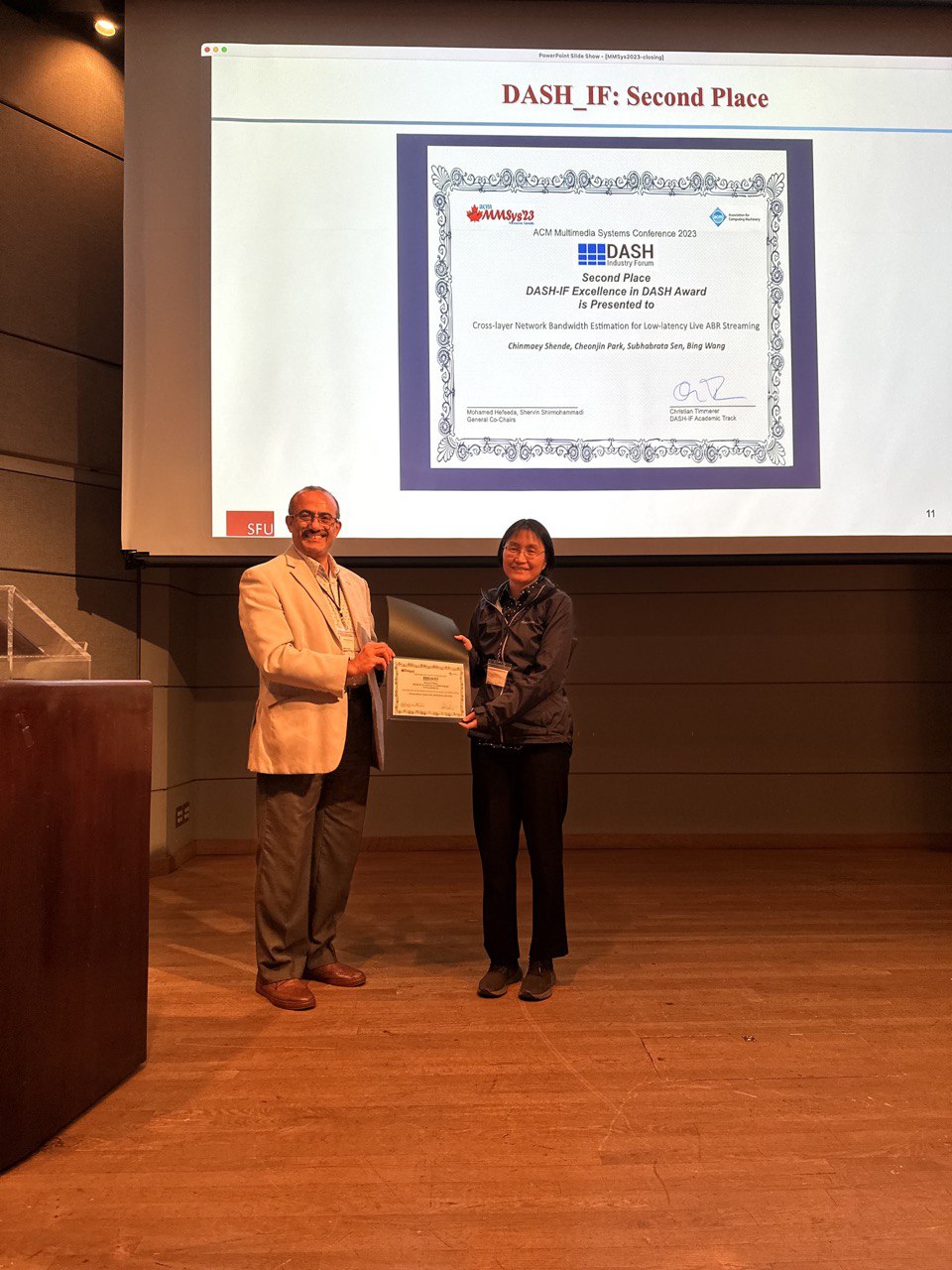
DASH-IF awarded Excellence in DASH award at ACM MMSys 2023

Vancouver, June 9, 2023


The DASH Industry Forum Excellence in DASH Award at ACM MMSys 2023 acknowledges papers substantially addressing MPEG-DASH as the presentation format and are selected for presentation at ACM MMSys 2023. Preference is given to practical enhancements and developments which can sustain future commercial usefulness of DASH. The DASH format used should conform to the DASH-IF Interoperability Points as defined by http://dashif.org/guidelines/. It is a financial prize as follows: first place – €750; second place – €500; and third place – €250. The winners are chosen by a DASH Industry Forum-appointed committee, and the results are final.

This year's award goes to the following papers:

First Place

Latency Target based Analysis of the DASH.js Player
by
Piers O’Hanlon and Adil Aslam

Abstract: We analyse the low latency performance of the three Adaptive Bitrate (ABR) algorithms in the dash.js Dynamic Adaptive Streaming over HTTP (DASH) player with respect to a range of latency targets and configuration options. We perform experiments on our DASH Testbed which allows for testing with a range of real world derived network profiles. Our experiments enable a better understanding of how latency targets affect quality of experience (QoE), and how well the different algorithms adhere to their targets. We find that with dash.js v4.5.0 the default Dynamic algorithm achieves the best overall QoE. We show that whilst the other algorithms can achieve higher video quality at lower latencies, they do so only at the expense of increased stalling. We analyse the poor performance of L2A-LL in our tests and develop modifications which demonstrate significant improvements. We also highlight how some low latency configuration settings can be detrimental to performance.

Second Place

Cross-layer Network Bandwidth Estimation for Low-latency Live ABR Streaming
by
Chinmaey Shende, Cheonjin Park, Subhabrata Sen, Bing Wang

Abstract: Low-latency live (LLL) adaptive bitrate (ABR) streaming relies critically on accurate bandwidth estimation to react to dynamic network conditions. While existing studies have proposed bandwidth estimation techniques for LLL streaming, these approaches are at the application level, and their accuracy is limited by the distorted timing information observed at the application level. In this paper, we propose a novel cross-layer approach that uses coarse-grained application-level semantics and fine-grained kernel-level packet capture to obtain accurate bandwidth estimation. We incorporate this technique in three popular open-source ABR players and show that it provides significantly more accurate bandwidth estimation than the state-of-the-art application-level approaches. In addition, the more accurate bandwidth estimation leads to better bandwidth prediction, which we show can lead to significantly better quality of experience (QoE) for end users.


Third Place

TASQ: Temporal Adaptive Streaming over QUIC
by
Akram Ansari, Yang Liu, Mea Wang, Emir Halepovic

Abstract: Traditional Adaptive BitRate (ABR) streaming faces a challenge of providing smooth experience under highly variable network conditions, especially when low latency is required. Effective adaptation techniques exist for deep-buffer scenarios, such as streaming long-form Video-on-Demand content, but remain elusive for short-form or low-latency cases, when even a short segment may be delivered too late and cause a stall. Recently proposed temporal adaptation aims to mitigate this problem by being robust to losing a part of the video segment, essentially dropping the tail of the segment intentionally to avoid the stall. In this paper, we analyze this approach in the context of a recently adopted codec AV1 and find that it does not always provide the promised benefits. We investigate the root causes and find that a combination of codec efficiency and TCP behavior can defeat the benefits of temporal adaptation. We develop a solution based on QUIC, and present the results showing that the benefits of temporal adaptation that still apply to AV1, including reduced stall time up to 65% compared to the original TCP-based approach. In addition, we present a novel way to use the stream management features of QUIC to benefit Quality-of-Experience (QoE) and reduce wasted data in video streaming.


The DASH-IF congratulates all winners and hopes to see you next year at ACM MMSys 2024.

Monday, June 12, 2023

DASH-IF awarded Best PhD Dissertation on Algorithms and Protocols for Adaptive Content Delivery over the Internet

Vancouver, June 9, 2023


The DASH Industry Forum (DASH-IF) is set to honor the most outstanding PhD dissertation on Algorithms and Protocols for Adaptive Content Delivery over the Internet during the ACM Multimedia Systems 2023. The winner of the award will be selected by a committee composed of DASH-IF members. All dissertations that fall within the scope and have been successfully defended in 2021, 2022 or 2023 (before the May 1, 2023 submission deadline) are qualified for nomination. The recipient of the award will receive 750 USD.

And the winner is

Dr. Mehmet N. Akcay
for his dissertation on
Server and Client-side Algorithms for Enhancing Adaptive Streaming


Abstract: HTTP adaptive video streaming is a technique widely used on the internet today to stream live and on-demand content. Server and client-side algorithms play an important role in improving user experience in terms of metrics such as latency, rebufferings, and rendering quality. After explaining the commonly used metrics, the author analyzed four main aspects of video streaming (i) bandwidth prediction accuracy, (ii) utilization of playback speed, (iii) adaptive streaming for content-aware-encoded videos, and (iv) head motion awareness for 360-degree videos. 360-degree video streaming requires much higher bandwidth compared to conventional video streaming. The author demonstrates that most of the algorithmic improvements achieved for video streaming can also be applied to Viewport Dependent Streaming (VDS) for 360-degree videos. It is also important that in 360-degree video streaming, we have a Head Mounted Display (HMD) device that is capable of pointing the viewport orientation of the user. We also investigate and improve the rate-adaptation algorithms for 360-degree videos by developing several new algorithms using the HMD. The new algorithms proposed in this thesis are Low-on-Latency (LoL), Low- on-Latency+ (LoL+), Bang-on-Bandwidth (BoB), Size-aware Rate Adaptation (SARA), Content-aware Playback Speed Control (CAPSC), Head-motion-aware Viewport Margins (HMAVM). We evaluate the proposed new algorithms using the objective metrics discussed in detail and show significant contributions for these new algorithms including up to 91% decrease in rebuffering duration for on-demand streaming, a 61.9% decrease in rebuffering duration, and an 8.1% decrease in latency compared to L2A for low-latency live streaming, 81.3% bandwidth prediction accuracy for interactive streaming, lastly 20% improvement in viewport quality and 50% reduction in motion- to-high-quality delay for 360-degree video streaming.

The DASH-IF congratulates the winner and hopes to see you next year at ACM MMSys 2024.

Tuesday, August 3, 2021

MPEG news: a report from the 135th meeting (virtual)

The original blog post can be found at the Bitmovin Techblog and has been modified/updated here to focus on and highlight research aspects. Additionally, this version of the blog post will also be posted at ACM SIGMM Records.

MPEG News Archive

The 135th MPEG meeting was once again held as an online meeting, and the official press release can be found here and comprises the following items:

  • MPEG Video Coding promotes MPEG Immersive Video (MIV) to the FDIS stage
  • Verification tests for more application cases of Versatile Video Coding (VVC)
  • MPEG Systems reaches first milestone for Video Decoding Interface for Immersive Media
  • MPEG Systems further enhances the extensibility and flexibility of Network-based Media Processing
  • MPEG Systems completes support of Versatile Video Coding and Essential Video Coding in High Efficiency Image File Format
  • Two MPEG White Papers:
    • Versatile Video Coding (VVC)
    • MPEG-G and its application of regulation and privacy

In this column, I’d like to focus on MIV and VVC including systems-related aspects as well as a brief update about DASH (as usual).

MPEG Immersive Video (MIV)

At the 135th MPEG meeting, MPEG Video Coding has promoted the MPEG Immersive Video (MIV) standard to the Final Draft International Standard (FDIS) stage. MIV was developed to support compression of immersive video content in which multiple real or virtual cameras capture a real or virtual 3D scene. The standard enables storage and distribution of immersive video content over existing and future networks for playback with 6 Degrees of Freedom (6DoF) of view position and orientation.

From a technical point of view, MIV is a flexible standard for multiview video with depth (MVD) that leverages the strong hardware support for commonly used video codecs to code volumetric video. The actual views may choose from three projection formats: (i) equirectangular, (ii) perspective, or (iii) orthographic. By packing and pruning views, MIV can achieve bit rates around 25 Mb/s and a pixel rate equivalent to HEVC Level 5.2.

The MIV standard is designed as a set of extensions and profile restrictions for the Visual Volumetric Video-based Coding (V3C) standard (ISO/IEC 23090-5). The main body of this standard is shared between MIV and the Video-based Point Cloud Coding (V-PCC) standard (ISO/IEC 23090-5 Annex H). It may potentially be used by other MPEG-I volumetric codecs under development. The carriage of MIV is specified through the Carriage of V3C Data standard (ISO/IEC 23090-10).

The test model and objective metrics are publicly available at https://gitlab.com/mpeg-i-visual.

At the same time, MPEG Systems has begun developing the Video Decoding Interface for Immersive Media (VDI) standard (ISO/IEC 23090-13) for a video decoders’ input and output interfaces to provide more flexible use of the video decoder resources for such applications. At the 135th MPEG meeting, MPEG Systems has reached the first formal milestone of developing the ISO/IEC 23090-13 standard by promoting the text to Committee Draft ballot status. The VDI standard allows for dynamic adaptation of video bitstreams to provide the decoded output pictures in such a way so that the number of actual video decoders can be smaller than the number of the elementary video streams to be decoded. In other cases, virtual instances of video decoders can be associated with the portions of elementary streams required to be decoded. With this standard, the resource requirements of a platform running multiple virtual video decoder instances can be further optimized by considering the specific decoded video regions that are to be actually presented to the users rather than considering only the number of video elementary streams in use.

Research aspects: It seems that visual compression and systems standards enabling immersive media applications and services are becoming mature. However, the Quality of Experience (QoE) of such applications and services is still in its infancy. The QUALINET White Paper on Definitions of Immersive Media Experience (IMEx) provides a survey of definitions of immersion and presence which leads to a definition of Immersive Media Experience (IMEx). Consequently, the next step is working towards QoE metrics in this domain that requires subjective quality assessments imposing various challenges during the current COVID-19 pandemic.

Versatile Video Coding (VVC) updates

The third round of verification testing for Versatile Video Coding (VVC) has been completed. This includes the testing of High Dynamic Range (HDR) content of 4K ultra-high-definition (UHD) resolution using the Hybrid Log-Gamma (HLG) and Perceptual Quantization (PQ) video formats. The test was conducted using state-of-the-art high-quality consumer displays, emulating an internet streaming-type scenario.

On average, VVC showed on average approximately 50% bit rate reduction compared to High Efficiency Video Coding (HEVC).

Additionally, the ISO/IEC 23008-12 Image File Format has been amended to support images coded using Versatile Video Coding (VVC) and Essential Video Coding (EVC).

Research aspects: The results of the verification tests are usually publicly available and can be used as a baseline for future improvements of the respective standards including the evaluation thereof. For example, the tradeoff compression efficiency vs. encoding runtime (time complexity) for live and video on-demand scenarios is always an interesting research aspect.

The latest MPEG-DASH Update

Finally, I’d like to provide a brief update on MPEG-DASH! At the 135th MPEG meeting, MPEG Systems issued a draft amendment to the core MPEG-DASH specification (i.e., ISO/IEC 23009-1) that provides further improvements of Preroll which is renamed to Preperiod and it will be further discussed during the Ad-hoc Group (AhG) period (please join the dash email list for further details/announcements). Additionally, this amendment includes some minor improvements for nonlinear playback. The so-called Technologies under Consideration (TuC) document comprises new proposals that did not yet reach consensus for promotion to any official standards documents (e.g., amendments to existing DASH standards or new parts). Currently, proposals for minimizing initial delay are discussed among others. Finally, libdash has been updated to support the MPEG-DASH schema according to the 5th edition.

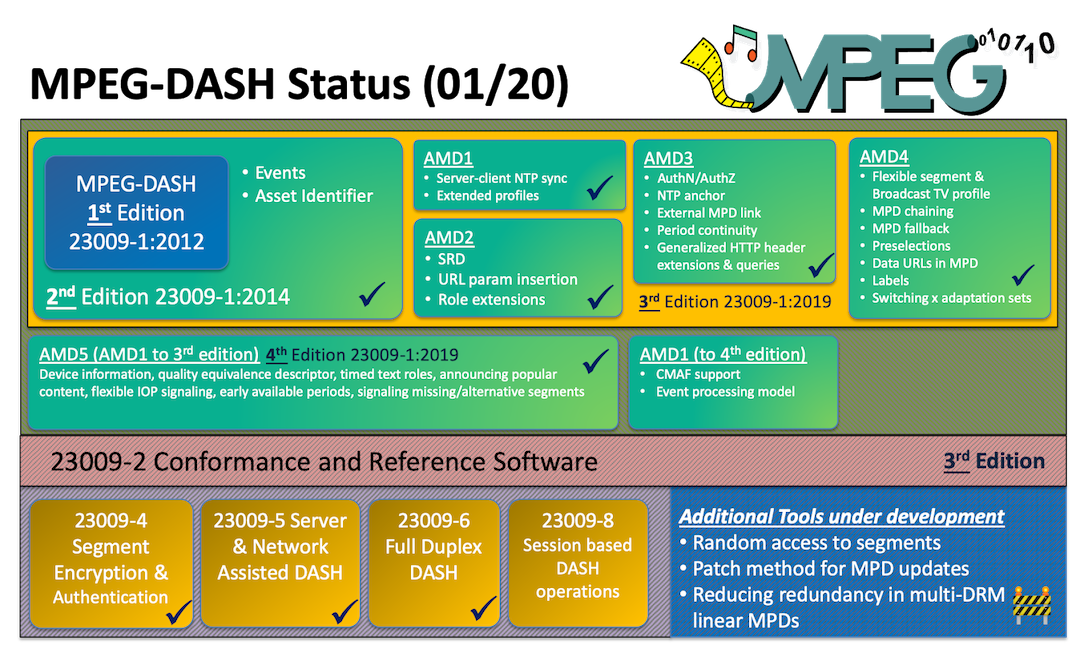
An updated overview of DASH standards/features can be found in the Figure below.

MPEG-DASH status of July 2021.

Research aspects: The informative aspects of MPEG-DASH such as the adaptive bitrate (ABR) algorithms have been subject to research for many years. New editions of the standard mostly introduced incremental improvements but disruptive ideas rarely reached the surface. Perhaps it's time to take a step back and re-think how streaming should work for todays and future media applications and services.

The 136th MPEG meeting will be again an online meeting in October 2021 but MPEG is aiming to meet in-person again in January 2021 (if possible). Click here for more information about MPEG meetings and their developments.

Sunday, November 22, 2020

MPEG news: a report from the 132nd meeting (virtual)

The original blog post can be found at the Bitmovin Techblog and has been modified/updated here to focus on and highlight research aspects. Additionally, this version of the blog post will be also posted at ACM SIGMM Records.

The 132nd MPEG meeting was the first meeting with the new structure. That is, ISO/IEC JTC 1/SC 29/WG 11 -- the official name of MPEG under the ISO structure -- was disbanded after the 131st MPEG meeting and some of the subgroups of WG 11 (MPEG) have been elevated to independent MPEG Working Groups (WGs) and Advisory Groups (AGs) of SC 29 rather than subgroups of the former WG 11. Thus, the MPEG community is now an affiliated group of WGs and AGs that will continue meeting together according to previous MPEG meeting practices and will further advance the standardization activities of the MPEG work program.

The 132nd MPEG meeting was the first meeting with the new structure as follows (incl. Convenors and position within WG 11 structure):

  • AG 2 MPEG Technical Coordination (Convenor: Prof. Jörn Ostermann; for overall MPEG work coordination and prev. known as the MPEG chairs meeting; it’s expected that one can also provide inputs to this AG without being a member of this AG)
  • WG 2 MPEG Technical Requirements (Convenor Dr. Igor Curcio; former Requirements subgroup)
  • WG 3 MPEG Systems (Convenor: Dr. Youngkwon Lim; former Systems subgroup)
  • WG 4 MPEG Video Coding (Convenor: Prof. Lu Yu; former Video subgroup)
  • WG 5 MPEG Joint Video Coding Team(s) with ITU-T SG 16 (Convenor: Prof. Jens-Rainer Ohm; former JVET)
  • WG 6 MPEG Audio Coding (Convenor: Dr. Schuyler Quackenbush; former Audio subgroup)
  • WG 7 MPEG Coding of 3D Graphics (Convenor: Prof. Marius Preda, former 3DG subgroup)
  • WG 8 MPEG Genome Coding (Convenor: Prof. Marco Mattaveli; newly established WG)
  • AG 3 MPEG Liaison and Communication (Convenor: Prof. Kyuheon Kim; (former Communications subgroup)
  • AG 5 MPEG Visual Quality Assessment (Convenor: Prof. Mathias Wien; former Test subgroup).

The 132nd MPEG meeting was held as an online meeting and more than 300 participants continued to work efficiently on standards for the future needs of the industry. As a group, MPEG started to explore new application areas that will benefit from standardized compression technology in the future. A new web site has been created and can be found at http://mpeg.org/.

The official press release can be found here and comprises the following items:

  • Versatile Video Coding (VVC) Ultra-HD Verification Test Completed and Conformance and Reference Software Standards Reach their First Milestone
  • MPEG Completes Geometry-based Point Cloud Compression (G-PCC) Standard
  • MPEG Evaluates Extensions and Improvements to MPEG-G and Announces a Call for Evidence on New Advanced Genomics Features and Technologies
  • MPEG Issues Draft Call for Proposals on the Coded Representation of Haptics
  • MPEG Evaluates Responses to MPEG IPR Smart Contracts CfP
  • MPEG Completes Standard on Harmonization of DASH and CMAF
  • MPEG Completes 2nd Edition of the Omnidirectional Media Format (OMAF)
  • MPEG Completes the Low Complexity Enhancement Video Coding (LCEVC) Standard

In this report, I’d like to focus on VVC, G-PCC, DASH/CMAF, OMAF, and LCEVC.

Versatile Video Coding (VVC) Ultra-HD Verification Test Completed and Conformance & Reference Software Standards Reach their First Milestone

MPEG completed a verification testing assessment of the recently ratified Versatile Video Coding (VVC) standard for ultra-high definition (UHD) content with standard dynamic range, as may be used in newer streaming and broadcast television applications. The verification test was performed using rigorous subjective quality assessment methods and showed that VVC provides a compelling gain over its predecessor -- the High Efficiency Video Coding (HEVC) standard produced in 2013. In particular, the verification test was performed using the VVC reference software implementation (VTM) and the recently released open-source encoder implementation of VVC (VVenC):
  • Using its reference software implementation (VTM), VVC showed bit rate savings of roughly 45% over HEVC for comparable subjective video quality.
  • Using VVenC, additional bit rate savings of more than 10% relative to VTM were observed, which at the same time runs significantly faster than the reference software implementation.
Additionally, the standardization work for both conformance testing and reference software for the VVC standard reached its first major milestone, i.e., progressing to the Committee Draft ballot in the ISO/IEC approval process. The conformance testing standard (ISO/IEC 23090-15) will ensure interoperability among the diverse applications that use the VVC standard, and the reference software standard (ISO/IEC 23090-16) will provide an illustration of the capabilities of VVC and a valuable example showing how the standard can be implemented. The reference software will further facilitate the adoption of the standard by being available for use as the basis of product implementations.
Research aspects: as for every new video codec, its compression efficiency and computational complexity are important performance metrics. While the reference software (VTM) provides a valid reference in terms of compression efficiency it is not optimized for runtime. VVenC seems to provide already a significant improvement and with x266 another open source implementation will be available soon. Together with AOMedia's AV1 (including its possible successor AV2) we are looking forward to a lively future in the area of video codecs.

MPEG Completes Geometry-based Point Cloud Compression Standard

MPEG promoted its ISO/IEC 23090-9 Geometry-based Point Cloud Compression (G-PCC) standard to the Final Draft International Standard (FDIS) stage. G-PCC addresses lossless and lossy coding of time-varying 3D point clouds with associated attributes such as color and material properties. This technology is particularly suitable for sparse point clouds. ISO/IEC 23090-5 Video-based Point Cloud Compression (V-PCC), which reached the FDIS stage in July 2020, addresses the same problem but for dense point clouds, by projecting the (typically dense) 3D point clouds onto planes, and then processing the resulting sequences of 2D images using video compression techniques. The generalized approach of G-PCC, where the 3D geometry is directly coded to exploit any redundancy in the point cloud itself, is complementary to V-PCC and particularly useful for sparse point clouds representing large environments.

Point clouds are typically represented by extremely large amounts of data, which is a significant barrier to mass-market applications. However, the relative ease of capturing and rendering spatial information compared to other volumetric video representations makes point clouds increasingly popular for displaying immersive volumetric data. The current draft reference software implementation of a lossless, intra-frame G‐PCC encoder provides a compression ratio of up to 10:1 and lossy coding of acceptable quality for a variety of applications with a ratio of up to 35:1.

By providing high immersion at currently available bit rates, the G‐PCC standard will enable various applications such as 3D mapping, indoor navigation, autonomous driving, advanced augmented reality (AR) with environmental mapping, and cultural heritage.
Research aspects: the main research focus related to G-PCC and V-PCC is currently on compression efficiency but one should not dismiss its delivery aspects including its dynamic, adaptive streaming. A recent paper on this topic has been published in the IEEE Communications Magazine and is entitled "From Capturing to Rendering: Volumetric Media Delivery With Six Degrees of Freedom".

MPEG Finalizes the Harmonization of DASH and CMAF

MPEG successfully completed the harmonization of Dynamic Adaptive Streaming over HTTP (DASH) with Common Media Application Format (CMAF) featuring a DASH profile for the use with CMAF (as part of the 1st Amendment of ISO/IEC 23009-1:2019 4th edition).

CMAF and DASH segments are both based on the ISO Base Media File Format (ISOBMFF), which per se enables smooth integration of both technologies. Most importantly, this DASH profile defines (a) a normative mapping of CMAF structures to DASH structures and (b) how to use Media Presentation Description (MPD) as a manifest format.

Additional tools added to this amendment include
  • DASH events and timed metadata track timing and processing models with in-band event streams,
  • a method for specifying the resynchronization points of segments when the segments have internal structures that allow container-level resynchronization,
  • an MPD patch framework that allows the transmission of partial MPD information as opposed to the complete MPD using the XML patch framework as defined in IETF RFC 5261, and
  • content protection enhancements for efficient signaling.
It is expected that the 5th edition of the MPEG DASH standard (ISO/IEC 23009-1) containing this change will be issued at the 133rd MPEG meeting in January 2021. An overview of DASH standards/features can be found in the Figure below.
Research aspects: one of the features enabled by CMAF is low latency streaming that is actively researched within the multimedia systems community (e.g., here). The main research focus has been related to the ABR logic while its impact on the network is not yet fully understood and requires strong collaboration among stakeholders along the delivery path including ingest, encoding, packaging, (encryption), content delivery network (CDN), and consumption. A holistic view on ABR is needed to enable innovation and the next step towards the future generation of streaming technologies (https://athena.itec.aau.at/). 

MPEG Completes 2nd Edition of the Omnidirectional Media Format

MPEG completed the standardization of the 2nd edition of the Omnidirectional MediA Format (OMAF) by promoting ISO/IEC 23009-2 to Final Draft International Standard (FDIS) status including the following features:
  • “Late binding” technologies to deliver and present only that part of the content that adapts to the dynamically changing users' viewpoint. To enable an efficient implementation of such a feature, this edition of the specification introduces the concept of bitstream rewriting, in which a compliant bitstream is dynamically generated that, by combining the received portions of the bitstream, covers only the users' viewport on the client.
  • Extension of OMAF beyond 360-degree video. This edition introduces the concept of viewpoints, which can be considered as user-switchable camera positions for viewing content or as temporally contiguous parts of a storyline to provide multiple choices for the storyline a user can follow.
  • Enhances the use of video, image, or timed text overlays on top of omnidirectional visual background video or images related to a sphere or a viewport.
Research aspects: standards usually define formats to enable interoperability but various informative aspects are left open for industry competition and subject to research and development. The same holds for OMAF and its 2nd edition enables researchers and developers to work towards efficient viewport-adaptive implementations focusing on the users' viewport.

MPEG Completes the Low Complexity Enhancement Video Coding Standard

MPEG is pleased to announce the completion of the new ISO/IEC 23094-2 standard, i.e., Low Complexity Enhancement Video Coding (MPEG-5 Part 2 LCEVC), which has been promoted to Final Draft International Standard (FDIS) at the 132nd MPEG meeting.
  • LCEVC adds an enhancement data stream that can appreciably improve the resolution and visual quality of reconstructed video with an effective compression efficiency of limited complexity by building on top of existing and future video codecs.
  • LCEVC can be used to complement devices originally designed only for decoding the base layer bitstream, by using firmware, operating system, or browser support. It is designed to be compatible with existing video workflows (e.g., CDNs, metadata management, DRM/CA) and network protocols (e.g., HLS, DASH, CMAF) to facilitate the rapid deployment of enhanced video services.
  • LCEVC can be used to deliver higher video quality in limited bandwidth scenarios, especially when the available bit rate is low for high-resolution video delivery and decoding complexity is a challenge. Typical use cases include mobile streaming and social media, and services that benefit from high-density/low-power transcoding.
Research aspects: LCEVC provides a kind of scalable video coding by combining hardware- and software-based decoders that allows for a certain flexibility as part of regular software life cycle updates. However, LCEVC has been never compared to Scalable Video Coding (SVC) and Scalable High Efficiency Video Coding (SHVC) which could be an interesting aspect for future work.

The 133rd MPEG meeting will be again an online meeting in January 2021.

Click here for more information about MPEG meetings and their developments.

Wednesday, May 27, 2020

MPEG news: a report from the 130th meeting, Alpbach, Austria (virtual)

The original blog post can be found at the Bitmovin Techblog and has been modified/updated here to focus on and highlight research aspects. Additionally, this version of the blog post will be also posted at ACM SIGMM Records.

The 130th MPEG meeting concluded on April 24, 2020, in Alpbach, Austria ... well, not exactly, unfortunately. The 130th MPEG meeting concluded on April 24, 2020, but not in Alpbach, Austria.

I attended the 130th MPEG meeting remotely.
Because of the Covid-19 pandemic, the 130th MPEG meeting has been converted from a physical meeting to a fully online meeting, the first in MPEG’s 30+ years of history. Approximately 600 experts attending from 19 time zones worked in tens of Zoom meeting sessions supported by an online calendar and by collaborative tools that involved MPEG experts in both online and offline sessions. For example, input contributions had to be registered and uploaded ahead of the meeting to allow for efficient scheduling of two-hour meeting slots, which have been distributed from early morning to late night in order to accommodate experts working in different time zones as mentioned earlier. These input contributions have been then mapped to GitLab issues for offline discussions and the actual meeting slots have been primarily used for organizing the meeting, resolving conflicts, and making decisions including approving output documents. Although the productivity of the online meeting could not reach the level of regular face-to-face meetings, the results posted in the press release show that MPEG experts managed the challenge quite well, specifically
  • MPEG ratifies MPEG-5 Essential Video Coding (EVC) standard;
  • MPEG issues the Final Draft International Standards for parts 1, 2, 4, and 5 of MPEG-G 2nd edition;
  • MPEG expands the coverage of ISO Base Media File Format (ISOBMFF) family of standards;
  • A new standard for large scale client-specific streaming with MPEG-DASH;
Other Important Activities at the 130th MPEG meeting: (i) the carriage of visual volumetric video-based coding data, (ii) Network-Based Media Processing (NBMP) function templates, (iii) the conversion from MPEG-21 contracts to smart contracts, (iv) deep neural network based video coding, (v) Low Complexity Enhancement Video Coding (LCEVC) reaching DIS stage, and (vi) a new level of the MPEG-4 Audio ALS Simple Profile for high-resolution audio among others

The corresponding press release of the 130th MPEG meeting can be found here: https://mpeg.chiariglione.org/meetings/130. This report focused on video coding (EVC) and systems aspects (file format, DASH).

MPEG ratifies MPEG-5 Essential Video Coding Standard

At its 130th meeting, MPEG announced the completion of the new ISO/IEC 23094-1 standard which is referred to as MPEG-5 Essential Video Coding (EVC) and has been promoted to Final Draft International Standard (FDIS) status. There is a constant demand for more efficient video coding technologies (e.g., due to the increased usage of video on the internet), but coding efficiency is not the only factor determining the industry's choice of video coding technology for products and services. The EVC standard offers improved compression efficiency compared to existing video coding standards and is based on the statements of all contributors to the standard who have committed announcing their license terms for the MPEG-5 EVC standard no later than two years after the FDIS publication date.

The MPEG-5 EVC defines two important profiles, including "Baseline profile" and "Main profile". The "Baseline profile" contains only technologies that are older than 20 years or otherwise freely available for use in the standard. In addition, the "Main profile" adds a small number of additional tools, each of which can be either cleanly disabled or switched to the corresponding baseline tool on an individual basis.

It will be interesting to see how EVC profiles (baseline and main) will find its path into products and services given the existing number of codecs already in use (e.g., AVC, HEVC, VP9, AV1) and those still under development but being close to ratification (e.g., VVC, LCEVC). That is, in total we, may end up with about seven video coding formats that probably need to be considered for future video products and services. In other words, the multi-codec scenario I have envisioned some time ago is becoming reality raising some interesting challenges to be addressed in the future.

Research aspects: as for all video coding standards, the most important research aspect is certainly coding efficiency. For EVC it might be also interesting to research its usability of the built-in tool switching mechanism within a practical setup. Furthermore, the multi-codec issue, the ratification of EVC adds another facet to the already existing video coding standards in use or/and under development.

MPEG expands the Coverage of ISO Base Media File Format (ISOBMFF) Family of Standards

At the 130th WG11 (MPEG) meeting, the ISOBMFF family of standards has been significantly amended with new tools and functionalities. The standards in question are as follows:
  • ISO/IEC 14496-12: ISO Base Media File Format;
  • ISO/IEC 14496-15: Carriage of network abstraction layer (NAL) unit structured video in the ISO base media file format;
  • ISO/IEC 23008-12: Image File Format; and
  • ISO /IEC 23001-16: Derived visual tracks in the ISO base media file format.
In particular, three new amendments to the ISOBMFF family have reached their final milestone, i.e., Final Draft Amendment (FDAM):
  1. Amendment 4 to ISO/IEC 14496-12 (ISO Base Media File Format) allows the use of a more compact version of metadata for movie fragments;
  2. Amendment 1 to ISO/IEC 14496-15 (Carriage of network abstraction layer (NAL) unit structured video in the ISO base media file format) adds support of HEVC slice segment data track and additional extractor types for HEVC such as track reference and track groups; and
  3. Amendment 2 to ISO/IEC 23008-12 (Image File Format) adds support for more advanced features related to the storage of short image sequences such as burst and bracketing shots.
At the same time, new amendments have reached their first milestone, i.e., Committee Draft Amendment (CDAM):
  1. Amendment 2 to ISO/IEC 14496-15 (Carriage of network abstraction layer (NAL) unit structured video in the ISO base media file format) extends its scope to newly developed video coding standards such as Essential Video Coding (EVC) and Versatile Video Coding (VVC); and
  2. the first edition of ISO/IEC 23001-16 (Derived visual tracks in the ISO base media file format) allows a new type of visual track whose content can be dynamically generated at the time of presentation by applying some operations to the content in other tracks, such as crossfading over two tracks.
Both are expected to reach their final milestone in mid-2021.

Finally, the final text for the ISO/IEC 14496-12 6th edition Final Draft International Standard (FDIS) is now ready for the ballot after converting MP4RA to the Maintenance Agency. WG11 (MPEG) notes that Apple Inc. has been appointed as the Maintenance Agency and MPEG appreciates its valuable efforts for the many years while already acting as the official registration authority for the ISOBMFF family of standards, i.e., MP4RA (https://mp4ra.org/). The 6th edition of ISO/IEC 14496-12 is expected to be published by ISO by the end of this year.

Research aspects: the ISOBMFF family of standards basically offers certain tools and functionalities to satisfy the given use case requirements. The task of the multimedia systems research community could be to scientifically validate these tools and functionalities with respect to the use cases and maybe even beyond, e.g., try to adopt these tools and functionalities for novel applications and services.

A New Standard for Large Scale Client-specific Streaming with DASH

Historically, in ISO/IEC 23009 (Dynamic Adaptive Streaming over HTTP; DASH), every client has used the same Media Presentation Description (MPD) as it best serves the scalability of the service (e.g., for efficient cache efficiency in content delivery networks). However, there have been increasing requests from the industry to enable customized manifests for more personalized services. Consequently, MPEG has studied a solution to this problem without sacrificing scalability, and it has reached the first milestone of its standardization at the 130th MPEG meeting.

ISO/IEC 23009-8 adds a mechanism to the Media Presentation Description (MPD) to refer to another document, called Session-based Description (SBD), which allows per-session information. The DASH client can use this information (i.e., variables and their values) provided in the SBD to derive the URLs for HTTP GET requests. This standard is expected to reach its final milestone in mid-2021.

Research aspects: SBD's goal is to enable personalization while maintaining scalability which calls for a tradeoff, i.e., which kind of information to put into the MPD and what should be conveyed within the SBD. This tradeoff per se could be considered already a research question that will be hopefully addressed in the near future.

An overview of the current status of MPEG-DASH can be found in the figure below.
The next MPEG meeting will be from June 29th to July 3rd and will be again an online meeting. I am looking forward to a productive AhG period and an online meeting later this year. I am sure that MPEG will further improve its online meeting capabilities and can certainly become a role model for other groups within ISO/IEC and probably also beyond.

Thursday, March 26, 2020

DVB World Online: Joint DVB/DASH-IF Webinar

March 31, 2020

DASH-IF is proud and delighted to be part of a series of public and free webinars organized by Digital Video Broadcasting (DVB) project. The webinars replace DVB's annual flagship conference DVB World in March 2020 that was cancelled due to the COVID-19 situation.
On March 31, 2020 at 4pm cest, the webinar DASH: from on-demand to large scale live for premium services will take place. DASH-IF has organized a 90min session on the latest technology and deployment advances of Dynamic Adaptive Streaming over HTTP (DASH).
Registration for the webinar is public and free of charge. Please register here.
The following program is planned:
  • 16:00-16:10 (10 mins) The DASH Industry Forum, who we are and what we do – Thomas Stockhammer (DASH-IF Interop WG Chair, Qualcomm)
  • 16:10-16:25 (15 mins) Meeting live broadcast requirements – the latest on DASH low latency! – Will Law (DASH-IF Leadership Award Winner, Akamai)
  • 16:25-16:40 (15 mins) Ad insertion in live content – pre, mid and post rolling – Zachary Cava (Hulu)
  • 16:40-16:50 (10 mins) Bandwidth prediction for multi-bitrate streaming at low latency – Ali Begen (Comcast)
  • 16:50-17:05 (15 mins) Implementing DASH low latency in FFmpeg – Jean-Baptiste Kempf (VideoLAN)
  • 17:05-17:15 (10 mins) Managing multi-DRM with DASH – Laurent Piron (DASH-IF Content Protection and Security TF Chair, NAGRA)
  • 17:15-17:30 (15 mins) Q&A panel – Per Fröjdh (DASH-IF Promotion WG Chair, Ericsson) moderator

Saturday, February 22, 2020

MPEG news: a report from the 129th meeting, Brussels, Belgium

The original blog post can be found at the Bitmovin Techblog and has been modified/updated here to focus on and highlight research aspects. Additionally, this version of the blog post will be also posted at ACM SIGMM Records.

The 129th MPEG meeting concluded on January 17, 2020 in Brussels, Belgium with the following topics:
  • Coded representation of immersive media – WG11 promotes Network-Based Media Processing (NBMP) to the final stage
  • Coded representation of immersive media – Publication of the Technical Report on Architectures for Immersive Media
  • Genomic information representation – WG11 receives answers to the joint call for proposals on genomic annotations in conjunction with ISO TC 276/WG 5
  • Open font format – WG11 promotes Amendment of Open Font Format to the final stage
  • High efficiency coding and media delivery in heterogeneous environments – WG11 progresses Baseline Profile for MPEG-H 3D Audio
  • Multimedia content description interface – Conformance and Reference Software for Compact Descriptors for Video Analysis promoted to the final stage
Additional Important Activities at the 129th WG 11 (MPEG) meeting
The 129th WG 11 (MPEG) meeting was attended by more than 500 experts from 25 countries working on important activities including (i) a scene description for MPEG media, (ii) the integration of Video-based Point Cloud Compression (V-PCC) and Immersive Video (MIV), (iii) Video Coding for Machines (VCM), and (iv) a draft call for proposals for MPEG-I Audio among others.

The corresponding press release of the 129th MPEG meeting can be found here: https://mpeg.chiariglione.org/meetings/129. This report focused on network-based media processing (NBMP), architectures of immersive media, compact descriptors for video analysis (CDVA), and an update about adaptive streaming formats (i.e., DASH and CMAF).

MPEG picture at friday plenary; © Rob Koenen (Tiledmedia).


Coded representation of immersive media – WG11 promotes Network-Based Media Processing (NBMP) to the final stage

At its 129th meeting, MPEG promoted ISO/IEC 23090-8, Network-Based Media Processing (NBMP), to Final Draft International Standard (FDIS). The FDIS stage is the final vote before a document is officially adopted as an International Standard (IS). During the FDIS vote, publications and national bodies are only allowed to place a Yes/No vote and are no longer able to make any technical changes. However, project editors are able to fix typos and make other necessary editorial improvements.

What is NBMP? The NBMP standard defines a framework that allows content and service providers to describe, deploy, and control media processing for their content in the cloud by using libraries of pre-built 3rd party functions. The framework includes an abstraction layer to be deployed on top of existing commercial cloud platforms and is designed to be able to be integrated with 5G core and edge computing. The NBMP workflow manager is another essential part of the framework enabling the composition of multiple media processing tasks to process incoming media and metadata from a media source and to produce processed media streams and metadata that are ready for distribution to media sinks.

Why NBMP? With the increasing complexity and sophistication of media services and the incurred media processing, offloading complex media processing operations to the cloud/network is becoming critically important in order to keep receiver hardware simple and power consumption low.

Research aspects: NBMP reminds me a bit about what has been done in the past in MPEG-21, specifically Digital Item Adaptation (DIA) and Digital Item Processing (DIP). The main difference is that MPEG now targets APIs rather than pure metadata formats, which is a step forward in the right direction as APIs can be implemented and used right away. NBMP will be particularly interesting in the context of new networking approaches including, but not limited to, software-defined networking (SDN), information-centric networking (ICN), mobile edge computing (MEC), fog computing, and related aspects in the context of 5G.

Coded representation of immersive media – Publication of the Technical Report on Architectures for Immersive Media

At its 129th meeting, WG11 (MPEG) published an updated version of its technical report on architectures for immersive media. This technical report, which is the first part of the ISO/IEC 23090 (MPEG-I) suite of standards, introduces the different phases of MPEG-I standardization and gives an overview of the parts of the MPEG-I suite. It also documents use cases and defines architectural views on the compression and coded representation of elements of immersive experiences. Furthermore, it describes the coded representation of immersive media and the delivery of a full, individualized immersive media experience. MPEG-I enables scalable and efficient individual delivery as well as mass distribution while adjusting to the rendering capabilities of consumption devices. Finally, this technical report breaks down the elements that contribute to a fully immersive media experience and assigns quality requirements as well as quality and design objectives for those elements.

Research aspects: This technical report provides a kind of reference architecture for immersive media, which may help identify research areas and research questions to be addressed in this context.

Multimedia content description interface – Conformance and Reference Software for Compact Descriptors for Video Analysis promoted to the final stage

Managing and organizing the quickly increasing volume of video content is a challenge for many industry sectors, such as media and entertainment or surveillance. One example task is scalable instance search, i.e., finding content containing a specific object instance or location in a very large video database. This requires video descriptors that can be efficiently extracted, stored, and matched. Standardization enables extracting interoperable descriptors on different devices and using software from different providers so that only the compact descriptors instead of the much larger source videos can be exchanged for matching or querying. ISO/IEC 15938-15:2019 – the MPEG Compact Descriptors for Video Analysis (CDVA) standard – defines such descriptors. CDVA includes highly efficient descriptor components using features resulting from a Deep Neural Network (DNN) and uses predictive coding over video segments. The standard is being adopted by the industry. At its 129th meeting, WG11 (MPEG) has finalized the conformance guidelines and reference software. The software provides the functionality to extract, match, and index CDVA descriptors. For easy deployment, the reference software is also provided as Docker containers.

Research aspects: The availability of reference software helps to conduct reproducible research (i.e., reference software is typically publicly available for free) and the Docker container even further contributes to this aspect.

DASH and CMAF

The 4th edition of DASH has already been published and is available as ISO/IEC 23009-1:2019. Similar to previous iterations, MPEG’s goal was to make the newest edition of DASH publicly available for free, with the goal of industry-wide adoption and adaptation. During the most recent MPEG meeting, we worked towards implementing the first amendment which will include additional (i) CMAF support and (ii) event processing models with minor updates; these amendments are currently in draft and will be finalized at the 130th MPEG meeting in Alpbach, Austria. An overview of all DASH standards and updates are depicted in the figure below:

ISO/IEC 23009-8 or “session-based DASH operations” is the newest variation of MPEG-DASH. The goal of this part of DASH is to allow customization during certain times of a DASH session while maintaining the underlying media presentation description (MPD) for all other sessions. Thus, MPDs should be cacheable within content distribution networks (CDNs) while additional information should be customizable on a per session basis within a newly added session-based description (SBD). It is understood that the SBD should have an efficient representation to avoid file size issues and it should not duplicate information typically found in the MPD.

The 2nd edition of the CMAF standard (ISO/IEC 23000-19) will be available soon (currently under FDIS ballot) and MPEG is currently reviewing additional tools in the so-called ‘technologies under considerations’ document. Therefore, amendments were drafted for additional HEVC media profiles and exploration activities on the storage and archiving of CMAF contents.

The next meeting will bring MPEG back to Austria (for the 4th time) and will be hosted in Alpbach, Tyrol. For more information about the upcoming 130th MPEG meeting click here.

Click here for more information about MPEG meetings and their developments

Monday, September 9, 2019

Video Developer Report 2019

... and Bitmovin did it again; published the 2019 Video Developer Report last week. I've briefly reported about it last year here. Interestingly, this year 542 people from 108 countries participated (vs. 456 from over 67 countries last year).

The biggest challenges seem to be latency (54%) and playback on all devices (41%). Other challenges (>20%) are related to DRM, CDN, user engagement with video, and ads in general.

Last year I've also shared the codec usage and it's probably interesting to compare these numbers with this year's results as shown below. Interestingly, the numbers (for 'planning to implement') are a bit lower compared to last year which could be explained by a more conservative approach from developers or simply by the fact that more people responded to the survey with a greater diversity in terms of different countries.

Current Video Codec Usage and Plans to Implement in next 12 Months.
The actual video codec usage compares to last year's report as follows: AVC (-1), HEVC (+1), VP9 (+/- 0), AV1 (+1).

Another interesting aspect is the usage of streaming formats and plans to implement them within the next 12 months as shown below. Comparing with last year's report (available here), we can observe the following major changes: HLS (-3), MPEG-DASH (-3), RTMP (-2), Smooth Streaming (+2), Progressive Streaming (-1), MPEG-CMAF (+2), HDS (-4).

Current Streaming Formats and Plans to Implement in next 12 Months.

In general, one can observe that the adoption of new formats are happening at a slower pace than expected and I am wondering what this means for the new video coding formats coming up like VVC et al. (note: these are results from a public survey with different participants compared to last years which need to be taken into account when comparing results over years).

For more details, the full report can be downloaded for free from here.

Wednesday, August 21, 2019

MPEG news: a report from the 127th meeting, Gothenburg, Sweden

The original blog post can be found at the Bitmovin Techblog and has been modified/updated here to focus on and highlight research aspects. Additionally, this version of the blog post will be also posted at ACM SIGMM Records.

MPEG News Archive

Plenary of the 127th MPEG Meeting in Gothenburg, Sweden.
The 126th MPEG meeting concluded on March 29, 2019 in Geneva, Switzerland with the following topics:
  • Versatile Video Coding (VVC) enters formal approval stage, experts predict 35-60% improvement over HEVC
  • Essential Video Coding (EVC) promoted to Committee Draft
  • Common Media Application Format (CMAF) 2nd edition promoted to Final Draft International Standard
  • Dynamic Adaptive Streaming over HTTP (DASH) 4th edition promoted to Final Draft International Standard
  • Carriage of Point Cloud Data Progresses to Committee Draft
  • JPEG XS carriage in MPEG-2 TS promoted to Final Draft Amendment of ISO/IEC 13818-1 7th edition
  • Genomic information representation – WG11 issues a joint call for proposals on genomic annotations in conjunction with ISO TC 276/WG 5
  • ISO/IEC 23005 (MPEG-V) 4th Edition – WG11 promotes the Fourth edition of two parts of “Media Context and Control” to the Final Draft International Standard (FDIS) stage

The corresponding press release of the 127th MPEG meeting can be found here: https://mpeg.chiariglione.org/meetings/127

Versatile Video Coding (VVC)

The Moving Picture Experts Group (MPEG) is pleased to announce that Versatile Video Coding (VVC) progresses to Committee Draft, experts predict 35-60% improvement over HEVC.

The development of the next major generation of video coding standard has achieved excellent progress, such that MPEG has approved the Committee Draft (CD, i.e., the text for formal balloting in the ISO/IEC approval process).

The new VVC standard will be applicable to a very broad range of applications and it will also provide additional functionalities. VVC will provide a substantial improvement in coding efficiency relative to existing standards. The improvement in coding efficiency is expected to be quite substantial – e.g., in the range of 35–60% bit rate reduction relative to HEVC although it has not yet been formally measured. Relative to HEVC means for equivalent subjective video quality at picture resolutions such as 1080p HD or 4K or 8K UHD, either for standard dynamic range video or high dynamic range and wide color gamut content for levels of quality appropriate for use in consumer distribution services. The focus during the development of the standard has primarily been on 10-bit 4:2:0 content, and 4:4:4 chroma format will also be supported.

The VVC standard is being developed in the Joint Video Experts Team (JVET), a group established jointly by MPEG and the Video Coding Experts Group (VCEG) of ITU-T Study Group 16. In addition to a text specification, the project also includes the development of reference software, a conformance testing suite, and a new standard ISO/IEC 23002-7 specifying supplemental enhancement information messages for coded video bitstreams. The approval process for ISO/IEC 23002-7 has also begun, with the issuance of a CD consideration ballot.

Research aspects: VVC represents the next generation video codec to be deployed in 2020+ and basically the same research aspects apply as for previous generations, i.e., coding efficiency, performance/complexity, and objective/subjective evaluation. Luckily, JVET documents are freely available including the actual standard (committee draft), software (and its description), and common test conditions. Thus, researcher utilizing these resources are able to conduct reproducible research when contributing their findings and code improvements back to the community at large. 

Essential Video Coding (EVC)

MPEG-5 Essential Video Coding (EVC) promoted to Committee Draft

Interestingly, at the same meeting as VVC, MPEG promoted MPEG-5 Essential Video Coding (EVC) to Committee Draft (CD). The goal of MPEG-5 EVC is to provide a standardized video coding solution to address business needs in some use cases, such as video streaming, where existing ISO video coding standards have not been as widely adopted as might be expected from their purely technical characteristics.

The MPEG-5 EVC standards includes a baseline profile that contains only technologies that are over 20 years old or are otherwise expected to be royalty-free. Additionally, a main profile adds a small number of additional tools, each providing significant performance gain. All main profile tools are capable of being individually switched off or individually switched over to a corresponding baseline tool. Organizations making proposals for the main profile have agreed to publish applicable licensing terms within two years of FDIS stage, either individually or as part of a patent pool.

Research aspects: Similar research aspects can be described for EVC and from a software engineering perspective it could be also interesting to further investigate this switching mechanism of individual tools or/and fall back option to baseline tools. Naturally, a comparison with next generation codecs such as VVC is interesting per se. The licensing aspects itself are probably interesting for other disciplines but that is another story...

Common Media Application Format (CMAF)

MPEG ratified the 2nd edition of the Common Media Application Format (CMAF)

The Common Media Application Format (CMAF) enables efficient encoding, storage, and delivery of digital media content (incl. audio, video, subtitles among others), which is key to scaling operations to support the rapid growth of video streaming over the internet. The CMAF standard is the result of widespread industry adoption of an application of MPEG technologies for adaptive video streaming over the Internet, and widespread industry participation in the MPEG process to standardize best practices within CMAF.

The 2nd edition of CMAF adds support for a number of specifications that were a result of significant industry interest. Those include
  • Advanced Audio Coding (AAC) multi-channel;
  • MPEG-H 3D Audio;
  • MPEG-D Unified Speech and Audio Coding (USAC);
  • Scalable High Efficiency Video Coding (SHVC);
  • IMSC 1.1 (Timed Text Markup Language Profiles for Internet Media Subtitles and Captions); and
  • additional HEVC video CMAF profiles and brands.
This edition also introduces CMAF supplemental data handling as well as new structural brands for CMAF that reflects the common practice of the significant deployment of CMAF in industry. Companies adopting CMAF technology will find the specifications introduced in the 2nd Edition particularly useful for further adoption and proliferation of CMAF in the market.

Research aspects: see below (DASH).

Dynamic Adaptive Streaming over HTTP (DASH)

MPEG approves the 4th edition of Dynamic Adaptive Streaming over HTTP (DASH)

The 4th edition of MPEG-DASH comprises the following features:
service description that is intended by the service provider on how the service is expected to be consumed;
  • a method to indicate the times corresponding to the production of associated media;
  • a mechanism to signal DASH profiles and features, employed codec and format profiles; and
  • supported protection schemes present in the Media Presentation Description (MPD).
It is expected that this edition will be published later this year. 

Research aspects: CMAF 2nd and DASH 4th edition come along with a rich feature set enabling a plethora of use cases. The underlying principles are still the same and research issues arise from updated application and service requirements with respect to content complexity, time aspects (mainly delay/latency), and quality of experience (QoE). The DASH-IF awards the excellence in DASH award at the ACM Multimedia Systems conference and an overview about its academic efforts can be found here. For example, see here our recent research on bandwidth prediction in low-latency chunked streaming. Additionally, our tutorial at ACM Multimedia 2019 about a journey towards fully immersive media access reviews state of the art in this area and how it could be extended enabling 6DoF HAS services through point cloud compression.

Carriage of Point Cloud Data

MPEG progresses the Carriage of Point Cloud Data to Committee Draft

At its 127th meeting, MPEG has promoted the carriage of point cloud data to the Committee Draft stage, the first milestone of ISO standard development process. This standard is the first one introducing the support of volumetric media in the industry-famous ISO base media file format family of standards.

This standard supports the carriage of point cloud data comprising individually encoded video bitstreams within multiple file format tracks in order to support the intrinsic nature of the video-based point cloud compression (V-PCC). Additionally, it also allows the carriage of point cloud data in one file format track for applications requiring multiplexed content (i.e., the video bitstream of multiple components is interleaved into one bitstream).

This standard is expected to support efficient access and delivery of some portions of a point cloud object considering that in many cases that entire point cloud object may not be visible by the user depending on the viewing direction or location of the point cloud object relative to other objects. It is currently expected that the standard will reach its final milestone by the end of 2020.

Research aspects: MPEG's Point Cloud Compression (PCC) comes in two flavors, video- and geometric-based but still requires to be packaged into file and delivery formats. MPEG's choice here is the ISO base media file format and the efficient carriage of point cloud data is characterized by both functionality (i.e., enabling the required used cases) and performance (such as low overhead).

MPEG 2 Systems/Transport Stream

JPEG XS carriage in MPEG-2 TS promoted to Final Draft Amendment of ISO/IEC 13818-1 7th edition

At its 127th meeting, WG11 (MPEG) has extended ISO/IEC 13818-1 (MPEG-2 Systems) – in collaboration with WG1 (JPEG) – to support ISO/IEC 21122 (JPEG XS) in order to support industries using still image compression technologies for broadcasting infrastructures. The specification defines a JPEG XS elementary stream header and specifies how the JPEG XS video access unit (specified in ISO/IEC 21122-1) is put into a Packetized Elementary Stream (PES). Additionally, the specification also defines how the System Target Decoder (STD) model can be extended to support JPEG XS video elementary streams.

Genomic information representation

WG11 issues a joint call for proposals on genomic annotations in conjunction with ISO TC 276/WG 5

The introduction of high-throughput DNA sequencing has led to the generation of large quantities of genomic sequencing data that have to be stored, transferred and analyzed. So far WG 11 (MPEG) and ISO TC 276/WG 5 have addressed the representation, compression and transport of genome sequencing data by developing the ISO/IEC 23092 standard series also known as MPEG-G. They provide a file and transport format, compression technology, metadata specifications, protection support, and standard APIs for the access of sequencing data in the native compressed format.

An important element in the effective usage of sequencing data is the association of the data with the results of the analysis and annotations that are generated by processing pipelines and analysts. At the moment such association happens as a separate step, standard and effective ways of linking data and meta information derived from sequencing data are not available.

At its 127th meeting, MPEG and ISO TC 276/WG 5 issued a joint Call for Proposals (CfP) addressing the solution of such problem. The call seeks submissions of technologies that can provide efficient representation and compression solutions for the processing of genomic annotation data.

Companies and organizations are invited to submit proposals in response to this call. Responses are expected to be submitted by the 8th January 2020 and will be evaluated during the 129th WG 11 (MPEG) meeting. Detailed information, including how to respond to the call for proposals, the requirements that have to be considered, and the test data to be used, is reported in the documents N18648, N18647, and N18649 available at the 127th meeting website (http://mpeg.chiariglione.org/meetings/127). For any further question about the call, test conditions, required software or test sequences please contact: Joern Ostermann, MPEG Requirements Group Chair (ostermann@tnt.uni-hannover.de) or Martin Golebiewski, Convenor ISO TC 276/WG 5 (martin.golebiewski@h-its.org).

ISO/IEC 23005 (MPEG-V) 4th Edition

WG11 promotes the Fourth edition of two parts of “Media Context and Control” to the Final Draft International Standard (FDIS) stage

At its 127th meeting, WG11 (MPEG) promoted the 4th edition of two parts of ISO/IEC 23005 (MPEG-V; Media Context and Control) standards to the Final Draft International Standard (FDIS). The new edition of ISO/IEC 23005-1 (architecture) enables ten new use cases, which can be grouped into four categories: 3D printing, olfactory information in virtual worlds, virtual panoramic vision in car, and adaptive sound handling. The new edition of ISO/IEC 23005-7 (conformance and reference software) is updated to reflect the changes made by the introduction of new tools defined in other parts of ISO/IEC 23005. More information on MPEG-V and its parts 1-7 can be found at https://mpeg.chiariglione.org/standards/mpeg-v.

Finally, the unofficial highlight of the 127th MPEG meeting we certainly found while scanning the scene in Gothenburg on Tuesday night...