Showing posts with label qoe. Show all posts

Wednesday, July 15, 2020

QUALINET White Paper on Definitions of Immersive Media Experience (IMEx)

QUALINET announces its recent White Paper on Definitions of Immersive Media Experience (IMEx).

It is online available here https://arxiv.org/abs/2007.07032 for free.

With the coming of age of virtual/augmented reality and interactive media, numerous definitions, frameworks, and models of immersion have emerged across different fields ranging from computer graphics to literary works. Immersion is oftentimes used interchangeably with presence as both concepts are closely related. However, there are noticeable interdisciplinary differences regarding definitions, scope, and constituents that are required to be addressed so that a coherent understanding of the concepts can be achieved. Such consensus is vital for paving the directionality of the future of immersive media experiences (IMEx) and all related matters.

The aim of this white paper is to provide a survey of definitions of immersion and presence which leads to a definition of immersive media experience (IMEx). The Quality of Experience (QoE) for immersive media is described by establishing a relationship between the concepts of QoE and IMEx followed by application areas of immersive media experience. Influencing factors on immersive media experience are elaborated as well as the assessment of immersive media experience. Finally, standardization activities related to IMEx are highlighted and the white paper is concluded with an outlook related to future developments. 

This White Paper is a contribution by QUALINET, the European Network on Quality of Experience in Multimedia Systems and Services (http://www.qualinet.eu/) to the discussions related to Immersive Media Experience (IMEx). It is motivated by the need for definitions around this term to foster a deeper understanding of ideas and concepts originating from multidisciplinary groups but with a joint interest in multimedia experiences. Thus, this white paper has been created mainly with such multimedia experiences in mind but may be also used beyond.

The QUALINET community aims at extending the notion of network-centric Quality of Service (QoS) in multimedia systems, by relying on the concept of Quality of Experience (QoE). The main scientific objective is the development of methodologies for subjective and objective quality metrics taking into account current and new trends in multimedia communication systems as witnessed by the appearance of new types of content and interactions. QUALINET (2010-2014 as COST Action IC1003) meets once a year collocated with QoMEX (http://qomex.org/) to coordinate its activities around 4 Working Groups (WGs): (i) research, (ii) standardization, (iii) training, and (iv) innovation.

List of Authors and Contributors
Andrew Perkis (andrew.perkis@ntnu.no, editor), Christian Timmerer (christian.timmerer@itec.uni-klu.ac.at, editor), Sabina Baraković, Jasmina Baraković Husić, Søren Bech, Sebastian Bosse, Jean Botev, Kjell Brunnström, Luis Cruz, Katrien De Moor, Andrea de Polo Saibanti, Wouter Durnez, Sebastian Egger-Lampl, Ulrich Engelke, Tiago H. Falk, Jesús Gutiérrez, Asim Hameed, Andrew Hines, Tanja Kojic, Dragan Kukolj, Eirini Liotou, Dragorad Milovanovic, Sebastian Möller, Niall Murray, Babak Naderi, Manuela Pereira, Stuart Perry, Antonio Pinheiro, Andres Pinilla, Alexander Raake, Sarvesh Rajesh Agrawal, Ulrich Reiter, Rafael Rodrigues, Raimund Schatz, Peter Schelkens, Steven Schmidt, Saeed Shafiee Sabet, Ashutosh Singla, Lea Skorin-Kapov, Mirko Suznjevic, Stefan Uhrig, Sara Vlahović, Jan-Niklas Voigt- Antons, Saman Zadtootaghaj.

How to reference this white paper
Perkis, A., Timmerer, C., et al., “QUALINET White Paper
on Definitions of Immersive Media Experience (IMEx)”, European Network on Quality of Experience in Multimedia Systems and Services, 14th QUALINET meeting (online), May 25, 2020.

Alternatively, you may export the citation from arXiv: https://arxiv.org/abs/2007.07032.

Wednesday, January 8, 2020

Fourth International Workshop on Quality of Experience Management (QoE- Management 2020) collocated with NetSoft 2020 in Ghent, Belgium

Fourth International Workshop on Quality of Experience Management (QoE-Management)

28th and 29th of June 2020
conjunction with the IEEE Conference on Network Softwarization 2020 (NetSoft 2020)
Gent, Belgium

Recent technological advances have enabled a constant proliferation of novel immersive and interactive services that pose ever-increasing demands to our communication ecosystem. While service and application management has typically been centered around a set of Quality of Service parameters (e.g., packet loss, delay, jitter), there is a clear need to understand and model the impact of management decisions on Quality of Experience (QoE) metrics as perceived by the end-user. To date, a significant amount of research has been devoted to understanding, measuring, and modeling QoE for a variety of media services. The next step is to explore methods that actively exploit such knowledge to improve and manage the quality of multimedia services, while at the same time ensuring efficient and cost-effective network operations. Moreover, with many different players involved in the end-to-end service delivery chain, identifying the root causes of QoE impairments and finding effective solutions for meeting the end-users' requirements and expectations in terms of service quality is a challenging and complex problem.

QoE-Management 2020 aims at providing an international forum for researchers addressing emerging concepts and challenges related to managing QoE for networked services. The workshop addresses QoE management in the context of ongoing developments, such as the move to 5G and virtualized networks; the exploitation of big data analytics and machine learning in the domains of QoE modeling and monitoring; and solutions targeting emerging complex, interactive, and immersive service scenarios. In order to encourage collaboration, the workshop is distributed in two days: seminar and workshop paper presentations.

  • 28/06/2020: Seminar. Researchers with expertise in different areas of QoE research will sit together to brainstorm on different topics.
  • 29/06/2020: Workshop papers presentation. Original full and short paper presentations and a motivating keynote will thoroughly explore this challenging topic.

Topics of interest: SDN, NFV, and QoE; QoE-aware network and application management; Characterization and modeling of QoE; QoE monitoring and measurement, QoE oriented coding; Quality management applied to different business sectors and use cases; Experimental approaches for QoE management. In addition, we encourage the submission of novel, provocative ideas or late-breaking results that have the potential to generate lively debate and new perspectives as short papers or Seminar topics.

Important dates:
  • Paper submission deadline: February 15, 2020; March 2nd (extension)
  • Acceptance notification: March 23, 2020
  • Camera-ready papers: April 6, 2020
For the Seminar topics:

  • Topic submission deadline: May 15, 2020
  • Acceptance notification: June 1, 2020

Authors should submit their papers and seminar topics electronically via the EDAS online submission system.

For more information, you can visit the QoE-Management workshop website and the NetSoft conference website.

Thursday, September 5, 2019

ACMMM'19: Docker-Based Evaluation Framework for Video Streaming QoE in Broadband Networks

Docker-Based Evaluation Framework for Video Streaming QoE in Broadband Networks
(Demo Paper)


[PDF]

Cise Midoglu (Simula), Anatoliy Zabrovskiy (AAU), Özgü Alay (Simula), Daniel Hölbling-Inzko (Bitmovin), Carsten Griwodz (Univ. of Oslo), Christian Timmerer (AAU/Bitmovin)

Abstract: Video streaming is one of the top traffic contributors in the Internet and a frequent research subject. It is expected that streaming traffic will grow 4-fold for video globally and 9-fold for mobile video between 2017 and 2022. In this paper, we present an automatized measurement framework for evaluating video streaming QoE in operational broadband networks, using headless streaming with a Docker-based client, and a server-side implementation allowing for the use of multiple video players and adaptation algorithms. Our framework allows for integration with the MONROE testbed and Bitmovin Analytics, which bring on the possibility to conduct large-scale measurements in different networks, including mobility scenarios, and monitor different parameters in the application, transport, network, and physical layers in real-time.

Keywords: adaptive streaming, network measurements, OTT video analytics, QoE


Tuesday, March 12, 2019

QoMEX'19: Tile-based Streaming of 8K Omnidirectional Video: Subjective and Objective QoE Evaluation

Tile-based Streaming of 8K Omnidirectional Video: Subjective and Objective QoE Evaluation


[PDF]

Raimund Schatz (AIT Austrian Institute of Technology), Anatoliy Zabrovskiy (Alpen-Adria Universität Klagenfurt), Christian Timmerer (Alpen-Adria Universität Klagenfurt, Bitmovin Inc.)


Abstract: Omnidirectional video (ODV) streaming applications are becoming increasingly popular. They enable a highly immersive experience as the user can freely choose her/his field of view within the 360-degree environment. Current deployments are fairly simple but viewport-agnostic which inevitably results in high storage/bandwidth requirements and low Quality of Experience (QoE). A promising solution is referred to as tile- based streaming which allows to have higher quality within the user’s viewport while quality outside the user’s viewport could be lower. However, empirical QoE assessment studies in this domain are still rare. Thus, this paper investigates the impact of different tile-based streaming approaches and configurations on the QoE of ODV. We present the results of a lab-based subjective evaluation in which participants evaluated 8K omnidirectional video QoE as influenced by different (i) tile-based streaming approaches (full vs. partial delivery), (ii) content types (static vs. moving camera), and (iii) tile encoding quality levels determined by different quantization parameters. Our experimental setup is characterized by high reproducibility since relevant media delivery aspects (including the user’s head movements and dynamic tile quality adaptation) are already rendered into the respective processed video sequences. Additionally, we performed a complementary objective evaluation of the different test sequences focusing on bandwidth efficiency and objective quality metrics. The results are presented in this paper and discussed in detail which confirm that tile-based streaming of ODV improves visual quality while reducing bandwidth requirements.

Index Terms: Omnidirectional Video, Tile-based Streaming, Subjective Testing, Objective Metrics, Quality of Experience

Acknowledgment: This work was supported in part by the Austrian Research Promotion Agency (FFG) under the Next Generation Video Streaming project "PROMETHEUS".

Monday, July 2, 2018

Internet-QoE'18 Keynote: HTTP Adaptive Streaming - State of the Art and Challenges Ahead


Internet-QoE

Vienna, Austria, July 2, 2018
co-located with IEEE ICDCS 2018


Abstract: Real-time entertainment services deployed over the open, unmanaged Internet – streaming audio and video – account now for more than 70% of the Internet traffic and it is assumed that this number will reach 80% by 2021. The technology used for such services is commonly referred to as HTTP Adaptive Streaming (HAS) and is widely adopted by various platforms such as YouTube, Netflix, Flimmit, etc. thanks to the standardization of MPEG-DASH and HLS. This talk will provide an overview of HAS, the state of the art of selected deployment options, and reviews work-in-progress as well challenges ahead. The main challenge can be characterized by the fact that (i) content complexity increases, (ii) delay or latency are vital application requirements, and (iii) Quality of Experience cannot be neglected anymore.


Sunday, March 25, 2018

IEEE MIPR'18: Automated Objective and Subjective Evaluation of HTTP Adaptive Streaming Systems

Automated Objective and Subjective Evaluation of HTTP Adaptive Streaming Systems

Christian Timmerer (Alpen-Adria-Universität Klagenfurt / Bitmovin), Anatoliy Zabrovskiy (Petrozavodsk State University / Alpen-Adria-Universität Klagenfurt), and Ali C. Begen (Ozyegin University / Networked Media)

Invited paper at IEEE MIPR 2018

PDF available here (coming soon)

Abstract: Streaming audio and video content currently accounts for the majority of the internet traffic and is typically deployed over the top of the existing infrastructure. We are facing the challenge of a plethora of media players and adaptation algorithms showing different behavior but lack a common framework for both objective and subjective evaluation of such systems. This paper aims to close this gap by (i) proposing such a framework, (ii) describing its architecture, (iii) providing an example evaluation, (iv) and discussing open issues.

Slides:

Tuesday, June 6, 2017

QoMEX'17 Review: Down the Rabbit Hole - Immersive Experience

During QoMEX 2017 in Erfurt, Germany we had a special session entitled "Down the Rabbit Hole" which I have introduced here already. The papers of the special session will appear soon in IEEEXplore but together with my co-organizers of this special session -- Raimund Schatz and Judith Redi -- we also wanted to run the special session in a special way. Therefore, we asked authors to prepare concise and thought-provoking paper presentations (~15min incl. Q&A -- paper title, presenter, picture, key words below) to save some time for a panel discussion. Surprisingly, it worked very well and the special session turned out to be worthwhile and informative. In order to keep the audience connected and involved we posted a single slide of all panelists (i.e., paper presenters) which was shown all the time (see below).


The discussion was centered around the question "what is your understanding of a fully immersive experience" which revealed interesting aspects and finally resulted in the main challenge how to quantify immersive experience. In this context, Mr. T. (only those who've been at QoMEX and in this session know why he is called Mr. T. -- join us next time and we will explain you what's behind) raised an interesting idea to interpret the Turing test for immersive experience. That is, fully or truly immersive experience is achieved if a human is no longer aware that she/he actually interacts with cyber-physical systems. I think this statement sets the bar (high) but definitely worth to consider.

Finally, I'd like to thank all presenters/panelists for an amazing special session at QoMEX'17 but the journey is not yet over. I'll be attending ACM MMSys and IEEE ICME presenting/discussing various aspects of immersive experiences; also at the MPEG meeting in Torino which will be dedicated to standardization aspects of immersive experiences.

Also big big thanks to the conference organizers, the team around the general chair Alexander Raake
(TU Ilmenau, Germany), for hosting such a wonderful event! Hope seeing you all next year for QoMEX 2018.

Feel free to test/play around with Bitmovin solutions for VR/360-degree streaming and if you have a RICOH THETA S check out my blog post how to setup a live streaming session.

Come and join us on the journey down the rabbit hole which eventually will lead to wonderland.


Friday, May 19, 2017

QoMEX'17 Special Session 2: Down the Rabbit Hole – General Aspects of VR and the Immersion Experience


QoMEX 2017
May 31 – June 2, 2017 in Erfurt, Germany


Picture from http://www.chalquist.com/fantastophobia.html

Chairs

  • Raimund Schatz, Austrian Institute of Technology (AIT), Austria
  • Christian Timmerer, Alpen-Adria-Universität (AAU) Klagenfurt, Austria
  • Judith Redi, Delft University of Technology, The Netherlands

Motivation

Currently, we witness a proliferation of new products and applications based on immersive media technologies – exemplified best by the current “VR hype” causing a flurry of new devices and applications to hit the market place. The potential of immersive media is large, however, investigation and application of QoE in this context is still in its infancy as many issues are not yet understood. Consequently, the multimedia-quality community faces new, rapidly moving research targets, resulting in the following overarching questions:
  • What is the interplay between concepts like Immersion, Presence, Interactivity, Multimedia Quality and User Experience in the context of emerging immersive applications and technologies?
  • What should be the role of QoE in this domain?
  • How to characterize, assess, model and manage QoE for immersive media-rich applications?
This special session aims to bring together researchers and practitioners to present and discuss quality-related issues and topics in the field of immersive media. The goal is to highlight the major challenges the multimedia quality community should target in this dynamically evolving domain and identify ways forward to addressing them effectively.

All QoMEX'17 special sessions can be found here.

Schedule & Format

Thursday, June 1, 2017, 13:00 -- 15:00
  1. Chenyan Zhang, Andrew Perkis and Sebastian Arndt, Spatial Immersion versus Emotional Immersion, Which is More Immersive?
  2. Conor Keighrey, Ronan Flynn, Siobhan Murray and Niall Murray, A QoE Evaluation of Augmented and Immersive Virtual Reality Speech & Language Assessment Applications 
  3. Raimund Schatz, Andreas Sackl, Christian Timmerer and Bruno Gardlo, Towards Subjective Quality of Experience Assessment for Omnidirectional Video Streaming
  4. Ashutosh Singla, Stephan Fremerey, Werner Robitza and Alexander Raake, Measuring and Comparing QoE and Simulator Sickness of Omnidirectional Videos in Different Head Mounted Displays
  5. Yashas Rai, Patrick Le Callet and Philippe Guillotel, Which saliency weighting for omni directional image quality assessment?
  6. Evgeniy Upenik, Martin Rerabek and Touradj Ebrahimi, On the Performance of Objective Metrics for Omnidirectional Visual Content
The special session format will be as follows:
  • 15min slots per presentation (12-13min talk, 1min for 1 question, 1-2 min time for speaker change)
  • 30min for panel discussion

Panel Discussion

For the panel discussion, our aim is to address the following questions:
  1. What is your understanding of a fully immersive experience (provide a definition or propose keywords to characterize immersive experiences)?
  2. Which aspects should the QoMEX community focus on?
  3. What can we learn and which knowledge can we re-use from the 3D and HDR research experiences?
... and we'd like to solicit also input from the community at large. Therefore, we setup a shared Google doc which is available here, asking for YOUR input: http://bit.ly/QoMEXSpS2.

Come and join us on the journey down the rabbit hole which eventually will lead to wonderland.

Thursday, April 27, 2017

QoMEX'17 paper accepted: "Towards Subjective Quality of Experience Assessment for Omnidirectional Video Streaming"

Towards Subjective Quality of Experience Assessment for Omnidirectional Video Streaming 

Raimund Schatz (AIT), Andreas Sackl (AIT), Christian Timmerer (AAU/Bitmovin) and Bruno Gardlo (AIT)

Abstract: Currently, we witness dramatically increasing interest in immersive media technologies like Virtual Reality (VR), particularly in omnidirectional video (OV) streaming. Omnidirectional (also called 360-degree) videos are panoramic spherical videos in which the user can look around during playback and which therefore can be understood as hybrids between traditional movie streaming and interactive VR worlds. Unfortunately, streaming this kind of content is extremely bandwidth intensive (compared to traditional 2D video) and therefore, Quality of Experience (QoE) tends to deteriorate significantly in absence of continuous optimal bandwidth conditions.

In this paper, we present a first approach towards subjective QoE assessment for omnidirectional video (OV) streaming. We present the results of a lab study on the QoE impact of stalling in the context of OV streaming using head-mounted displays (HMDs). Our findings show that subjective testing for immersive media like OV is not trivial, with even simple cases like stalling leading to unexpected results. After a discussion of characteristic pitfalls and lessons learned, we provide a a set of recommendations for upcoming OV assessment studies.


Please feel free to contact me for details and/or I'd be happy to meet you at QoMEX'17.

Wednesday, October 5, 2016

New Springer Journal “Quality and User Experience”

In 2016, the Springer journal “Quality and User Experience” was launched (Editors-in-Chief: S. Möller; M. Tscheligi). It presents research on the human experience and quality perception of digital media, telecommunication and Information Communications Technology (ICT) products and interactive services. It explores human-centered and technology-centered approaches and examines a range of perspectives on quality of experience. Coverage includes mobile and pervasive applications, augmented and virtual reality, gaming, video conferencing, telepresence, and video-on-demand. Tactics can be human centered (e.g., to characterize user perceptions) or technology centered (to guide product development). As a result of this research, technologies, products and systems can be evaluated and optimized to provide optimum experience; this optimization process is also targeted by the journal.

The journal promotes integration of knowledge by assembling a range of disciplinary perspectives on experience quality: quality of experience (QoE), user experience (UX), quality management, usability engineering, human-centered design, cognitive processes, subjective audio & video quality assessment, and human-computer interaction.


The journal will encourage and enable first class research from any scientific discipline that contributes to and shows relevance to quality of experience and user experience. Examples include: development of a new metric based on subjective or objective analysis; taxonomies and models to define and explain quality of experience and user experience; relationship to other concepts such as user acceptance or value systems; lab or situated studies delivering insights to specific experience aspects, discussion of influence factors on UX and QoE and their relationships; the significance of time for the dynamics of user experience and quality of experience, relevant insights from different disciplines such as design, psychology, social sciences or material science; research in contextual experiences to capture specific situations including specific domain aspects; tools and frameworks towards the development of next generation experiences; methods to capture, analyze, design and evaluate user experience and quality of experience; user experience research related to special user groups, special needs as well personal differences; insights on the design of experiences from the constructive as well as from the process perspective; experience design approaches and methods; viewpoints on the meaning of experience design; and experience design for specific application domains.  

Please note that QUEX offers permanent free access to all articles published in 2016 and 2017.

More information: http://link.springer.com/journal/41233

Tuesday, November 18, 2014

ACM International Conference on Interactive Experiences for Television & Online Video


*** TVX 2015 ***
ACM International Conference on Interactive Experiences for Television & Online Video
3rd – 5th June 2015

Hosted by iMinds Digital Society Department at the Crowne Plaza Hotel, Brussels, Belgium

Jointly organised with the International Symposium on Media Innovations (ISMI) and the Private Television Conference

IMPORTANT DATES:
  •  November 15, 2014: Course and Workshop proposals
  • January 12, 2015: Full and Short Paper submissions
  • March 2, 2015: WiP, TVX in Industry, Demo, Doctoral Consortium
TVX is the ACM International Conference on Interactive Experiences for Television and Online Video. TVX is the leading international conference for presentation and discussion of research into online video and TV interaction and user experience. The conference brings together international researchers and practitioners from a wide range of disciplines, ranging from human-computer interaction, multimedia engineering and design to media studies, media psychology and sociology. In addition to standard research paper presentations the conference includes a wide range of formats for presentation and discussion of research, including Industry Papers, Demos, Works-in-Progress, and also provides the opportunity to participate in the Doctoral Consortium and to run and attend courses and workshops on specialist topics in TV and online video interaction and user experience.

Topics of interest include (but are not limited to):
  • Content Production: traditional & novel content production for the new media landscape, including cross-platform services and interactive storytelling, and personalisation.
  • Systems & Infrastructures: system designs and architectures and their evaluation, including delivery, transmission, and synchronization of media.
  • Interaction Technologies & techniques: including gestural and multi-sensory, multi-display systems, and interaction for device ecosystems.
  • Experience Design & Evaluation: TV and online video design and evaluation research, including social and shared experiences.
  • Media Studies: including consumption practices and theoretical and practical ethical, regulatory, and policy issues.
  • Empirical Methods: novel methods for evaluating TV and online video experience, and audience measurement.
  • Data Science for TV & Online Video: advances in techniques for collaborative filtering, interactive/synchronous environments, collective intelligence and crowd-sourcing, and location-based and context-aware applications and services.
  • Business Models & Marketing: research and practice around novel business models and marketing strategies for the new media landscape of television and online video. Studies around novel ways of advertisement models and strategies.
  • Innovation & Visions of Future TV & Online Video: research on innovative design strategies, new concepts, and prototype experiences for television and online video, including case studies and media artworks and performances.
SUBMISSION GUIDELINES

Contributions must describe unpublished original work, emphasizing completed or advanced research, and a parallel submission to other venues should be clearly indicated to the program committee. Research paper submissions are double-blind and will be reviewed by at least three program committee members.

For detailed submission guidelines, including the use of the ACM SIGCHI PCS submission system see: http://tvx2015.com/participation

MENTORING PROGRAM

Along the inclusion and accessibility strategy at TVX2015, we also provide a mentoring opportunity. During the TVX submission process, we can provide the opportunity to bring the experience of established researchers to new researchers. In the mentorship program we get you in contact with a specific member of the community who will provide feedback and support for your submission.

Please find more information on how to ask for mentoring, becoming a mentor, and our existing mentors: http://tvx2015.com/inclusion-accessibility/mentoring-program/

CONTACT

For up-to-date information and further details visit: http://tvx2015.com/

For questions, please contact us on: info@tvx2015.com

ORGANISATION COMMITTEE

GENERAL CHAIRS

David Geerts, iMinds / KU Leuven, Belgium

Lieven De Marez, iMinds / UGent, Belgium

Caroline Pauwels, iMinds / VUB, Belgium

PROGRAM CHAIRS

Frank Bentley, Yahoo Labs, USA

Christian Timmerer, Alpen-Adria-Universität Klagenfurt, Austria

WORK IN PROGRESS CHAIRS

Hokyoung Blake Ryu, Hanyang University, South Korea

Jeroen Vanattenhoven, iMinds / KU Leuven, Belgium

WORKSHOP CHAIRS

Rene Kaiser, Joanneum Research, Austria

Noor Ali-Hasan, Google, USA

COURSE CHAIRS

Pedro Almeida, University of Aveiro, Portugal

Santosh Basapur, Illinois Institute of Technology, USA

DOCTORAL CONSORTIUM CHAIRS

Marian Ursu, University of York, UK

Teresa Chambel, University of Lisbon, Portugal

TVX IN INDUSTRY CHAIRS

Katia Aerts, Mike Matton, VRT, Belgium

DEMO CHAIRS

Tom Bartindale, Culture Lab, Newcastle University, UK

Rinze Leenheer, iMinds / KU Leuven, Belgium

INCLUSION AND ACCESSIBILITY CHAIR

Reuben Kirkham, Culture Lab, Newcastle University, UK

Tom Evens, iMinds / UGent, Belgium

LOCAL PRODUCTION CHAIR

Jonathan Huyghe, iMinds / KU Leuven, Belgium

Thursday, June 26, 2014

VideoNext: Design, Quality and Deployment of Adaptive Video Streaming


The workshop co-located with CoNEXT 2014
December 2, 2014
Sydney, Australia

Submission deadline changed: August 29, 2014 (no further extensions)

Call for Papers

As we continue to develop our ability to generate, process, and display video at increasingly higher quality, we confront the challenge of streaming the same video to the end user. Device heterogeneity in terms of size and processing capabilities combined with the lack of timing guarantees of packet switching networks is forcing the industry to adopt streaming solutions capable of dynamically adapting the video quality in response to resource variability in the end-to-end transport chain. For example, many vendors and providers are already trialing their own proprietary adaptive video streaming platforms while MPEG has recently ratified a standard, called Dynamic Adaptive Streaming over HTTP (DASH), to facilitate widespread deployment of such technology. However, how to best adapt the video to ensure highest user quality of experience while consuming the minimum network resources poses many fundamental challenges, which is attracting the attention of researchers from both academia and industry. The goal of this workshop is to bring together researchers and developers working on all aspects of adaptive video streaming with special emphasis on innovative concepts backed up by experimental evidence.

Specific areas of interest include, but are not limited to:
  • New metrics for measuring user quality of experience (QoE) for adaptive video streaming
  • Solutions for improving streaming QoE for high-speed user mobility
  • Analysis, modelling, and experimentation of DASH
  • Exploitation of user contexts for improving efficiency of adaptive streaming
  • Big data analytics to assess viewer experience of adaptive video
  • Efficient and fair bandwidth sharing techniques for bottleneck links supporting multiple adaptive video streams
  • Network functions to assist and improve adaptive video streaming
  • Synchronization issues in adaptive video streaming (inter-media, inter-device/destination)
  • Methods for effective simulation or emulation of large scale adaptive video streaming platforms
  • Cloud-assisted adaptive video streaming including encoding, transcoding, and adaptation in general
  • Attack scenarios and solutions for adaptive video streaming
  • Energy-efficient adaptive streaming for resource-constraint mobile devices
  • Reproducible research in adaptive video streaming: datasets, evaluation methods, benchmarking, standardization efforts, open source tools
  • Novel use cases and applications in the area of adaptive video streaming

The workshop is considered an integral part of the CoNEXT 2014 conference. All workshop papers will be published in the same set of proceedings as the main conference, and available on the ACM Digital Library. Publication at this workshop is not intended to preclude later publication of an extended version of the paper. At least one author of each accepted papers is expected to present his/her paper at the workshop.

Instructions for Authors

A submission must be no greater than 6 pages in length including all figures, tables, references, appendices, etc., and must be a PDF file of less than 10MB. The review process is single-blind.

Follow the same formatting guidelines as the CoNEXT conference, except VideoNext has a 6 page limit and a 10MB file size limit. See the “Formatting Guidelines” section. Submissions that deviate from these guidelines will be rejected without consideration.

Then use the paper submission site to submit your paper by 8:59 pm Pacific Standard Time (PDT), August 29, 2014.
Important dates
  • Paper Submission: August 2229, 2014 20:59 PDT
  • Notification of Acceptance: September 30, 2014
  • Camera-ready Papers Due: October 24, 2014
  • Workshop: December 2, 2014

TPC co-chairs
  • Mahbub Hassan, University of New South Wales, Australia
  • Ali C. Begen, Cisco Canada
  • Christian Timmerer, Alpen-Adria-Universität Klagenfurt, Austria

Technical Program Committee
  • Alexander Raake, Deutsche Telecom Labs, Germany
  • Carsten Griwodz, University of Oslo/Simula, Sweden
  • Chao Chen, Qualcom, USA
  • Colin Perkins, University of Glasgow, Scotland
  • Constantine Dovrolis, Georgia Tech, USA
  • Grenville Armitage, Swinburne University of Technology, Australia
  • Imed Bouazizi, Samsung
  • Kuan-Ta Chen, Academia Sinica
  • Magda El Zarki, University of California Irvine, USA
  • Manzur Murshed, Federation University Australia, Australia
  • Pal Halvorsen, University of Oslo/Simula
  • Polychronis Koutsakis, Technical University of Crete, Greece
  • Roger Zimmerman, National University of Singapore, Singapore
  • Saverio Mascolo, University of Bari, Italy
  • Shervin Shirmohammadi ,University of Ottawa, Canada
  • Victor Leung, University of British Columbia, Canada

Thursday, April 24, 2014

Quality of Experience: Advanced Concepts, Applications, and Methods

Quality of Experience
Advanced Concepts, Applications, and Methods

Sebastian Möller and Alexander Raake (Eds.)

  • Develops and applies the definition of Quality of Experience in telecommunication services
  • Includes examples and guidelines for many fields of applications
  • Written and Edited by known experts in the field
This pioneering book develops definitions and concepts related to Quality of Experience in the context of multimedia- and telecommunications-related applications, systems and services, and applies these to various fields of communication and media technologies. The editors bring together numerous key-protagonists of the new discipline “Quality of Experience” and combine the state-of-the-art knowledge in one single volume.

The Sensory Experience Lab (SELab) is also having its chapter within this book entitled Sensory Experience: Quality of Experience Beyond Audio-Visual with the abstract as follows:

Abstract: This chapter introduces the concept of Sensory Experience which aims to define the Quality of Experience (QoE) going beyond audio-visual content. In particular, we show how to utilize sensory effects such as ambient light, scent, wind, or vibration as additional dimensions contributing to the quality of the user experience. Therefore, we utilize a standardized representation format for sensory effects that are attached to traditional multimedia resources such as audio, video, and image contents. Sensory effects are rendered on special devices (e.g., fans, lights, motion chair, scent emitter) in synchronization with the traditional multimedia resources and shall stimulate also other senses than hearing and seeing with the intention to increase the Quality of Experience (QoE), in this context referred to as Sensory Experience.

Tuesday, March 18, 2014

The Social Multimedia Experience

As of 2014, I'm taking over the IEEE Computer Social Computing column from John Riedl, who, sadly, passed away last year. The Social Computing column aims to explore the latest developments within the field from the point of view of both researchers and practitioners.

Topics of interest include, but are not limited to:
  • social networking services, applications, and tools;
  • social search;
  • social multimedia and social communications;
  • mobile social networks;
  • social network analysis and visualization;
  • standardization trends and federated social Web initiatives;
  • social computing business models; and
  • societal aspects such as privacy and data protection.
This column is part of the IEEE Computer Society’s Special Technical Community on Social Networking (STCSN) which aims to be the online portal for researchers and practitioners in social computing, social networking, and related fields, fostering communication and interaction among members of this rapidly growing global community. Further information about the STCSN and its goals and members are available at www.computer.org/stcsn. Come and join now!

The March 2014 issue is about

The Social Multimedia Experience

Monday, October 28, 2013

2nd IEEE/IFIP Workshop on QoE Centric Management - QCMAN 2014

CALL FOR PAPERS : QCMAN 2014
2nd IEEE/IFIP Workshop on QoE Centric Management - Part of  IEEE/IFIP NOMS 2014

Krakow, Poland,  9 May 2014

ABSTRACT REGISTRATION DEADLINE: 7 December 2013
PAPER SUBMISSIONS DUE: 15 December 2013

The Second IEEE/IFIP International Workshop on Quality of Experience Centric Management (QCMan)  will be held in conjunction with IEEE/IFIP NOMS 2014 in Krakow, Poland, from May 5-9, 2014. The workshop is sponsored by the IEEE Communications Society (ComSoc) and supported by the Klagenfurt University and iMinds. The workshop is endorsed by the Technical Committee on Network Operations and Management (CNOM).

In recent years, the Internet has evolved from a pure packet forwarder to a provider of complex and high demanding services and applications (e.g., video, voice, on-line gaming, cloud applications). These services and applications are typically managed through a set of Quality of Services parameters (e.g. packet loss, delay, jitter).  However, it is widely agreed that the management of these services and applications should be centered on their quality as perceived by the end user: the Quality of Experience (QoE). However, this QoE centric management is greatly challenged in today’s Internet by (i) the stringent QoE requirements of the supported services and applications (e.g., timing constraints, loss intolerance) and users (e.g., unpredictability of user behavior, request for high quality services), (ii) the plethora of service consumption possibilities (e.g. for video: live vs on-demand, managed vs over-the-top), (iii)  the inherent complexity of services and applications which can be offered to users in several ways to reach the same QoE level and (iv) the difficulty in assessing the quality as perceived by the end user also due to insufficient insight in the psychological and sociological factors of the service and application consumption.

QCMan 2014 aims at providing an international forum for researchers addressing these challenges. QCMan 2014 will combine original full paper presentations with a motivating keynote to thoroughly explore this challenging topic.

TOPICS OF INTEREST

Authors are invited to submit papers that fall into or are related to the topic areas listed below:

Characterization of QoE
  • Definition of QoE: methods and tools
  • Relationship between QoE and QoS in multimedia networking
  • Objective & subjective QoE assessment of multimedia delivery systems
  • New objective & subjective methods and algorithms
  • QoE-aware management systems
QoE management in heterogeneous networks
  • QoE optimized multimedia network management
  • Adaptive video streaming in Over-The-Top and IPTV networks
  • QoE issues of multimedia services and applications
  • QoE management of multimedia services over wireless networks
  • Energy efficient QoE management
  • QoE driven network diagnostics, tracing, troubleshooting 
Nature-like techniques for QoE management
  • Adaptive QoE management
  • Self-organization techniques for the management of multimedia services
  • Cognitive approaches, self-learning and Computational Intelligence-based algorithms for QoE management
  • Autonomic techniques for QoE management
  • Policy-based QoE management
QoE oriented coding
  • Streaming aware video encoding
  • QoE oriented coding for multimedia streaming
  • Energy aware video coding and decoding
Experimental approaches
  • Subjective studies in commercial settings
  • Subjective studies in a controlled lab environments
  • QoE of mobile services
  • Experimental facilities for QoE evaluation of algorithms and services
  • Subjective QoE evaluation pilots
SUBMISSION INSTRUCTIONS

Paper submissions must present original, research or experiences. Late-breaking advances and work-in-progress reports from ongoing research are also encouraged. Only original papers that have not been published or submitted for publication elsewhere can be submitted. Each submission must be written in English, accompanied by a 75 to 200 word abstract and a list of up to 5 key words. There is a length limitation of 6 pages (including title, abstract, figures, tables, and references) for workshop papers. Submissions must be in IEEE 2-column style. Papers exceeding these limits, multiple submissions, and self-plagiarized papers will be rejected without further review.

Authors should submit their papers in PDF, postscript, or Word formats via JEMS: (https://submissoes.sbc.org.br/home.cgi?c=1969).

IMPORTANT DATES
  • Abstract registration deadline: December 7, 2013
  • Paper submission: December 15, 2013
  • Notification of acceptance: January 31, 2014
  • Final version of papers due: February 15, 2014
WORKSHOP CO-CHAIRS
  • Prof. Christian Timmerer, Klagenfurt University, Austria
  • Prof. Filip De Turck, Ghent University – iMinds, Belgium
  • Prof. Steven Latré, University of Antwerp – iMinds, Belgium

For more information, please contact one of the Co-Chairs at info@qcman.org

Monday, March 25, 2013

QUALINET Multimedia Databases

A key for current and future developments in Quality of Experience resides in a rich and internationally recognized database of content of different sorts, and to share such a database with the scientific community at large. The QUALINET Database platform takes the necessary steps to make them accessible to all researchers:

(registration is free of charge)

Currently, the QUALINET database comprises > 170 multimedia databases, based on literature/Internet search and input from QUALINET partner laboratories. They're mostly image (~52) or video datasets (~68), with (~57) or w/o subjective quality rating, special content, e.g. 3D (~23), FV, eyetracking (~21), audio, audiovisual (~8), HDR (~14), and other modalities.

The documentation of the QUALINET databases can be found on the corresponding Wiki page. For an overview, please consult the white paper on QUALINET databases (PDF) and please reference it as follows:
Karel Fliegel, Christian Timmerer, (eds.), “WG4 Databases White Paper v1.5: QUALINET Multimedia Database enabling QoE Evaluations and Benchmarking”, Prague/Klagenfurt, Czech Republic/Austria, Version 1.5, March 2013.

Finally, you're welcome to contribute to this effort, simply send an email to wg4.qualinet@listes.epfl.ch and briefly describe your dataset [to subscribe, send an e-mail (its content is unimportant) to wg4.qualinet-subscribe@listes.epfl.ch, you will receive information to confirm your subscription, and upon the acceptance of the moderator will be included in the mailing-list].

Additionally, you may consider submitting a dataset paper to QoMEX or MMSys which hosts dataset tracks and accepted dataset paper will be automatically included within the QUALINET database.

Friday, October 12, 2012

Qualinet White Paper on Definitions of Quality of Experience

Preface [PDF]:

This White Paper is a contribution of the European Network on Quality of Experience in Multimedia Systems and Services, Qualinet (COST Action IC 1003, see www.qualinet.eu), to the scientific discussion about the term “Quality of Experience” (QoE) and its underlying concepts. It resulted from the need to agree on a working definition  for this term  which facilitates the communication of ideas within a multidisciplinary group, where a joint interest around multimedia communication systems exists, however approached from different perspectives. Thus, the concepts and ideas cited in this paper mainly refer to the Quality of Experience of multimedia communication systems, but may be helpful also for other areas where QoE is an issue.

The Network of Excellence (NoE) Qualinet aims at extending the notion of network-centric Quality of Service (QoS) in multimedia systems, by relying on the concept of Quality of Experience (QoE). The main scientific objective is the development of methodologies for subjective and objective quality metrics taking into account current and new trends in multimedia communication systems as witnessed by the appearance of new types of content and interactions. A substantial scientific impact on fragmented efforts carried out in this field will be achieved by coordinating the research of European experts under the catalytic COST umbrella.

The White Paper has been compiled on the basis of a first open call for ideas which was launched for the February 2012 Qualinet Meeting held in Prague, Czech Republic. The ideas were presented as short statements during  that meeting, reflecting the ideas of the persons listed under the headline “Contributors” in the previous section. During the Prague meeting, the ideas have been further discussed and consolidated in the form of a general structure of the present document. An open call for authors was issued at that meeting, to which the persons listed as “Authors” in the previous section have announced their willingness to contribute in the preparation of individual sections. For each section, a coordinating author has been assigned which coordinated the writing of that section, and which is underlined in the author list preceding each section. The individual sections were then integrated and aligned by an editing group (listed as “Editors” in the previous section), and the entire document was iterated with the entire group of authors. Furthermore, the draft text was discussed with the participants of the Dagstuhl Seminar 12181 “Quality of Experience: From User Perception to Instrumental Metrics” which was held in Schloß Dagstuhl, Germany, May 1-4 2012, and a number of changes were proposed, resulting in the present document.

As a result of the writing process and the large number of contributors, authors and editors, the document will not reflect the opinion of each individual person at all points. Still, we hope that it is found to be useful for everybody working in the field of Quality of Experience of multimedia communication systems, and most probably also beyond that field.

Any comments or suggestions should be sent to the editors:

Sebastian.Moeller@telekom.de
Patrick.Le-Callet@univ-nantes.fr
andrew@iet.ntnu.no

Please, refer to the paper as follows:
"Qualinet White Paper on Definitions of Quality of Experience (2012). European Network on Quality of Experience in Multimedia Systems and Services (COST Action IC 1003), Patrick Le Callet, Sebastian Möller and Andrew Perkis, eds., Lausanne, Switzerland, Version 1.1, June 3, 2012."
Find the .pdf here

Friday, April 22, 2011

QoX: What is it really?

ETSI TC on Human Factors
This article provides a very good article around QoX where X stands for anything, specifically it encompasses Quality of Service (QoS), Class of Service (CoS), Grade of Service (GoS), Quality of Resilience (QoR), and - last but not least - Quality of Experience (QoE).

At the beginning the article provides an overview about different QoS definitions and application/traffic/service classes as defined by various standard-developing organizations (SDOs) such as ITU-T, IETF, 3GPP, and IEEE. Also an attempt to perform the mapping between service classes defined within various approaches is given. Additionally, no so well-known terms such as Grade of Service (GoS) and Quality of Resilience are described.

The article provides a good definition of Quality of Experience (QoE), its various dimensions, and how it relates to the other QoX terms and to a general model which defines three levels of QoS: intrinsic (network performance; ITU-T E.800), perceived (QoS; ITU-T G.1000), and assessed (QoE; ITU-T P.10). It is concluded that QoE is somewhere on the border between perceived and assessed which I tend to agree. Interestingly, the article points out the various dimensions of QoE including environmental, psychological, and sociological factors such as user expectation, experience with similar services, opinions of others (i.e., social networks), pricing policies, location-based factors, etc. Also, QoE measures and metrics, classification of QoE evaluation methods, and the relationship between QoE and intrinsic quality parameters are highlighted.

Finally, the article is concluded with open issues clusters into scientific, technical, economical, and legal challenges.

In particular, I like:
  • the introduction into the terminology and how QoX is realized in various SDOs (ITU-T, IETF, 3GPP, IEEE);
  • the definition of QoE and its variants; and
  • the challenges at the end.
However, I'm missing vital, novel, future applications in/around QoX, otherwise one might think that the aim of this research is providing a solution/fix to current issues only (btw. that's fine, don't get me wrong ;-)

Citation:
Stankiewicz, R.; Cholda, P.; Jajszczyk, A.; , "QoX: What is it really?," Communications Magazine, IEEE , vol.49, no.4, pp.148-158, April 2011
doi: 10.1109/MCOM.2011.5741159

Monday, June 21, 2010

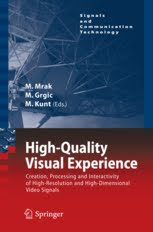
Book announcement - "High-Quality Visual Experience"

Mrak, Marta; Grgic, Mislav; Kunt, Murat (Eds.)

1st Edition., 2010, X, 550 p. 164 illus. in color., Hardcover
ISBN: 978-3-642-12801-1

Abstract: Last few years have seen rapid acceptance of high-definition television (HDTV) technology around the world. This technology has been hugely successful in delivering more realistic television experience at home and accurate imaging for professional applications. Adoption of high definition continues to grow as consumers demand enhanced features and greater quality of content. Following this trend, natural evolution of visualisation technologies will be in the direction of fully realistic visual experience and highly precise imaging. However, using the content of even higher resolution and quality is not straightforward as such videos require significantly higher access bandwidth and more processing power. Therefore, methods for radical reduction of video bandwidth are crucial for realisation of high visual quality. Moreover, it is desirable to look into other ways of accessing visual content, solution to which lies in innovative schemes for content delivery and consumption. This book presents selected chapters covering technologies that will enable greater flexibility in video content representation and allow users to access content from any device and to interact with it.

Keywords » 3D Visual Experience - High Dynamic Range Video - High-Dimensional Video Signals - Super Resolution - Ultra High Definition Content Generation - Visual Experience

Table of Contents:

Part I: Quality of Visual Information
  • Automatic Prediction of Perceptual Video Quality: Recent Trends and Research Directions by Anush K. Moorthy, Alan C. Bovik
  • Quality of Experience for High Definition Presentations – Case: Digital Cinema by Andrew Perkis, Fitri N. Rahayu, Ulrich Reiter, Junyong You, Touradj Ebrahimi
  • Quality of Visual Experience for 3D Presentation – Stereoscopic Image by Junyong You, Gangyi Jiang, Liyuan Xing, Andrew Perkis
Part II: Video Coding for High Resolutions
  • The Development and Standardization of Ultra High Definition Video Technology by Tokumichi Murakami
  • Compression Formats for HD Recording and Production by Joeri Barbarien, Marc Jacobs, Adrian Munteanu
  • Super Hi-Vision and Its Encoding System by Shinichi Sakaida
  • A Flexible Super High Resolution Video CODEC and Its Trial Experiments by Takeshi Yoshitome, Ken Nakamura, Kazuto Kamikura
  • Mathematical Modeling for High Frame-Rate Video Signal by Yukihiro Bandoh, Seishi Takamura, Hirohisa Jozawa, Yoshiyuki Yashima
Part III: Visual Content Upscaling
  • Next Generation Frame Rate Conversion Algorithms by Osman Serdar Gedik, Engin Turetken, Abdullah Aydın Alatan
  • Spatiotemporal Video Upscaling Using Motion- Assisted Steering Kernel (MASK) Regression by Hiroyuki Takeda, Peter van Beek, Peyman Milanfar
  • Temporal Super Resolution Using Variational Methods by Sune Høgild Keller, Fran ̧cois Lauze, Mads Nielsen
  • Synthesizing Natural Images Using Spatial Layout Information by Ling Shao, Ruoyun Gao
Part IV: 3D Visual Content Processing and Displaying
  • The Use of Color Information in Stereo Vision Processing by Wided Miled, Beatrice Pesquet-Popescu
  • 3D Object Classification and Segmentation Methods by Martin Zagar, Mario Kovac, Josip Knezovic, Hrvoje Mlinaric, Daniel Hofman
  • Three-Dimensional Video Contents Exploitation in Depth Camera-Based Hybrid Camera System by Sung-Yeol Kim, Andreas Koschan, Mongi A. Abidi, Yo-Sung Ho
  • Improving 3D Visual Experience by Controlling the Perceived Depth Distortion by Jessica Prevoteau, Sylvia Chalencon-Piotin, Didier Debons, Laurent Lucas, Yannick Remion
  • 3D Visual Experience by Peter Tamas Kovacs, Tibor Balogh
  • 3D Holoscopic Imaging Technology for Real- Time Volume Processing and Display by Amar Aggoun
Part V: Accessing Technologies for Visual Content
  • Video Streaming with Interactive Pan/Tilt/Zoom by Aditya Mavlankar, Bernd Girod
  • End-to-End Management of Heterogeneous Environments Enabling Quality of Experience by Christian Timmerer, Maria Teresa Andrade, Alberto Leon Martin
  • Quality-Driven Coding and Prioritization of 3D Video over Wireless Networks by Sabih Nasir, Chaminda T.E.R. Hewage, Zaheer Ahmad, Marta Mrak, Stewart Worrall, Ahmet Kondoz
  • Scalable Indexing of HD Video by Jenny Benois-Pineau, Sandrine Anthoine, Claire Morand, Jean- Philippe Domenger, Eric Debreuve, Wafa Bel Haj Ali, Paulo Piro
  • Stereo Correspondence in Information Retrieval by Huiyu Zhou, Abdul H. Sadka
Further information can be found here.

Thursday, June 17, 2010

Multimedia conferences this week

I just saw on my calendar that this week there are a couple of multimedia-related events worth to report here:
  • MMedia2010 (June 13-19, 2010 - Athens/Glyfada, Greece), 2nd International Conference on Advances in Multimedia, where our department had a couple of papers in the program ranging from self-organizing multimedia systems and transcoding to peer-to-peer architectures.
  • WoWMoM2010 (June 14-17, 2010 - Montreal, Canada), International Symposium on a World of Wireless, Mobile and Multimedia Networks, where the program covers all layers in the network related to wireless and multimedia. Interestingly, the program includes a PhD forum and industry track.
  • IWQoS2010 (June 16-19, 2010 - Beijing, China), International Workshop on Quality of Service, where Henning Schulzrinne is giving a keynote entitled "25 years of quality of service research - where next?". In general, this workshop is the QoS workshop in the world and the program is available here (there's a session about overlays and peer-to-peer networks).
  • FMN2010 (June 17-18, 2010 - Krakow, Poland), 3rd International Workshop on Future Multimedia Networking, where the program is only available as PDF and there's also a session on QoS and Quality of Experience (QoE).