Showing posts with label svc. Show all posts

Thursday, August 2, 2012

MPEG news: a report from the 101st meeting, Stockholm, Sweden

The 101st MPEG meeting was held in Stockholm, Sweden, July 16-20, 2012. The official press release can be found here and I would like to highlight the following topics:
  • MPEG Media Transport (MMT) reaches Committee Draft (CD)
  • High-Efficiency Video Coding (HEVC) reaches Draft International Standard (DIS)
  • MPEG and ITU-T establish JCT-3V
  • Call for Proposals: HEVC scalability extensions
  • 3D audio workshop
  • Green MPEG
MMT goes CD

The Committee Draft (CD) of MPEG-H part 1 referred to as MPEG Media Transport (MMT) has been approved and will be publicly available after an editing period which will end Sep 17th. MMT comprises the following features:
  • Delivery of coded media by concurrently using more than one delivery medium (e.g., as it is the case of heterogeneous networks).
  • Logical packaging structure and composition information to support multimedia mash-ups (e.g., multiscreen presentation).
  • Seamless and easy conversion between storage and delivery formats.
  • Cross layer interface to facilitate communication between the application layers and underlying delivery layers.
  • Signaling of messages to manage the presentation and optimized delivery of media.
This list of 'features' may sound very high-level but as the CD usually comprises stable technology and is publicly available, the research community is more than welcome to evaluate MPEG's new way of media transport. Having said this, I would like to refer to the Call for Papers of  JSAC's special issue on adaptive media streaming which is mainly focusing on DASH but investigating its relationship to MMT is definitely within the scope.

HEVCs' next step towards completion: DIS

The approval of the Draft International Standard (DIS) brought the HEVC standard one step closer to completion. As reported previously, HEVC shows inferior performance gains compared to its predecessor and real-time software decoding on the iPad 3 (720p, 30Hz, 1.5 Mbps) has been demonstrated during the Friday plenary [1, 2]. It is expected that the Final Draft International Standard (FDIS) is going to be approved at the 103rd MPEG meeting in January 21-25, 2013. If the market need for HEVC is only similar as it was when AVC was finally approved, I am wondering if one can expect first products by mid/end 2013. From a research point of view we know - and history is our witness - that improvements are still possible even if the standard has been approved some time ago. For example, the AVC standard is now available in its 7th edition as a consolidation of various amendments and corrigenda.

JCT-3V

After the Joint Video Team (JVT) which successfully developed standards such as AVC, SVC, MVC and the Joint Collaborative Team on Video Coding (JCT-VC), MPEG and ITU-T establish the Joint Collaborative Team on 3D Video coding extension development (JCT-3V). That is, from now on MPEG and ITU-T also joins forces in developing 3D video coding extensions for existing codecs as well as the ones under development (i.e., AVC, HEVC). The current standardization plan includes the development of AVC multi-view extensions with depth to be completed this year and I assume HEVC will be extended with 3D capabilities once the 2D version is available.

In this context it is interesting that a call for proposals for MPEG Frame Compatible (MFC) has been issued to address current deployment issues of stereoscopic videos. The requirements are available here.

Call for Proposals: SVC for HEVC

In order to address the need for higher resolutions - Ultra HDTV - and subsets thereof, JCT-VC issued a call for proposals for HEVC scalability extensions. Similar to AVC/SVC, the requirements include that the base layer should be compatible with HEVC and enhancement layers may include temporal, spatial, and fidelity scalability. The actual call, the use cases, and the requirements shall become available on the MPEG Web site.

MPEG hosts 3D Audio Workshop

Part 3 of MPEG-H will be dedicated to audio, specifically 3D audio. The call for proposals will be issues at the 102nd MPEG meeting in October 2012 and submissions will be due at the 104th meeting in April 2013. At this meeting, MPEG has hosted a 2nd workshop on 3D audio with the following speakers.
  • Frank Melchior, BBC R&D: “3D Audio? - Be inspired by the Audience!”
  • Kaoru Watanabe, NHK and ITU: “Advanced multichannel audio activity and requirements”
  • Bert Van Daele, Auro Technologies: “3D audio content production, post production and distribution and release”
  • Michael Kelly, DTS: “3D audio, objects and interactivity in games”
The report of this workshop including the presentations will be publicly available by end of August at the MPEG Web site.

What's new: Green MPEG

Finally, MPEG is starting to explore a new area which is currently referred to as Green MPEG addressing technologies to enable energy-efficient use of MPEG standards. Therefore, an Ad-hoc Group (AhG) was established with the following mandates:

  1. Study the requirements and use-cases for energy efficient use of MPEG technology.
  2. Solicit further evidence for the energy savings.
  3. Develop reference software for Green MPEG experimentation and upload any such software to the SVN.
  4. Survey possible solutions for energy-efficient video processing and presentation.
  5. Explore the relationship between metadata types and coding technologies.
  6. Identify new metadata that will enable additional power savings.
  7. Study system-wide interactions and implications of energy-efficient processing on mobile devices.
AhGs are usually open to the public and all discussions take place via email. To subscribe please feel free to join the email reflector.

Monday, January 16, 2012

Top 10 Blog Posts


  1. HTTP Streaming of MPEG Media: My first article in this series which I've started after the MPEG CfP has been issued that lead to the standardization of DASH.
  2. MMSys'11 Special Session on MMT/DASH: the CfP for a special session I've organized.
  3. MPEG news: a report from the 93rd meeting in Geneva, right after the responses to the HTTP streaming CfP has been evaluated.
  4. MPEG advances DASH towards completion which is the MPEG press release after the 94th meeting in Guangzhou.
  5. Open Source Scalable Video Coding (SVC) Software where I have received quite a few comments ;-)
  6. MPEG Media Transport: Basically the same as #1 but a different scope. However, it seems the readers are more interested in HTTP streaming than media transport in general.
  7. Vision and Requirements for High-Performance Video Coding which has been renamed now to High-Efficiency Video Coding.
  8. DASH provides an overview about the Draft International Standard which is publicly available.
  9. MPEG DASH vs. W3C WebTV which is still a hop topic and worth following on both sides...
  10. Immersive Future Media Technologies: From 3D Video to Sensory Experience: I'm happy having this one in my top ten. It's the summary of a tutorial I had at ACM Multimedia 2010 together with Karsten Müller.
In general, most of the readers are very much interested in HTTP streaming / DASH / MMT followed by video coding (SVC/HEVC/3DVC) and the Sensory Experience stuff I've started some time ago.

Thanks again for visiting my blog and don't hesitate to leave a comment here and there. I'd love to read your thoughts and feedback.

Monday, March 22, 2010

CfP: Workshop on Impact of Scalable Video Coding on Multimedia Provisioning (SVCVision)

Collocated with MobiMedia - 6th International Mobile Multimedia Communications Conference
6th-8th September 2010 - Lisbon, Portugal

http://www.mobimedia.org/ws_SVCVision.html


Aims and Scope
===============
Scalable Video Coding (SVC) refers to the possibility of removing certain parts of a video bit stream in order to adapt it to a changing usage environment, e.g., end device capabilities, network condition or user preferences. SVC has been an active standardization and research area for at least 20 years, reaching back to H.262/MPEG-2, which offered scalable profiles. However, these previous attempts suffered from a significant loss in coding efficiency as well as a large increase in decoder complexity (and thus energy consumption), which hindered market adoption. Only the most recent attempt, i.e., the SVC extension of H.264/AVC, focuses on avoiding these disadvantages. Since H.264/SVC standardization started in 2003, it has been at the focus of many multimedia research groups.

Today's increasing variety of end devices (smart phones, tablet PCs, Netbooks, Laptops, PCs, networked HDTVs, …) and the associated multitude of Internet connectivity options (GPRS/EDGE, UMTS, ADSL, PLC, WiMAX, …) provide particular momentum for SVC, which can be easily and pervasively adapted to these various usage environments. SVC also allows end devices to only decode a sub-set of the SVC bit stream, thus enabling in particular mobile end devices to minimize the necessary (processing) power requirements.

This workshop aims to provide a forum for both academic and industrial participants to exchange and discuss recent advancements and future perspectives of SVC.


SVC topics of interest include, but are not limited to:
==========================================
- Robust streaming, error resilience and error concealment
- Streaming in heterogeneous environments
- Peer-to-Peer (P2P) video distribution
- Internet Protocol television (IPTV)
- Energy-efficient video distribution
- Content adaptation (e.g., scaling, rewriting, transcoding) and summarization
- Complexity optimization and new tools for achieving scalability
- Adaptation decision taking & context information
- Storage & file format
- Conditional access & protection
- Novel applications & implementation experiences


Important Dates
==============
Paper Submission:  23. April 2010
Notification:          28. May 2010
Camera Ready:  25. June 2010


All accepted papers will be published in Springer Lecture Notes of ICST (LNICST) series and included in major article indexing services.

Tuesday, December 22, 2009

O Universal Multimedia Access, Where Art Thou? (Part II)

-by Christian Timmerer, Klagenfurt University, Austria

Preface: First I thought about writing this article for a journal or something equivalent but then I concluded to make this article available through my blog. The aim is to perform an experiment in order to determine whether it is possible (a) to get direct feedback through comments and (b) to be referenced from elsewhere. As it is a quite comprehensive article, it’s split up in separate parts. If someone (i.e., a journal editor) is interested in publishing this article, yes, I can still do that! :-)

Part I was about giving an introduction to the topic and an overview on multimedia content adaptation techniques. This part focuses on the adaptation by transformation approach that utilizes scalable coding formats such as JPEG2000, MPEG-4 BSAC, and MPEG-4 SVC and is mainly based on [1].

Part II – Adaptation by Transformation


Scalable coding techniques have been recognized as an appropriate tool for realizing the concepts of UMA. Furthermore, if widely adopted across industries, scalable coding would provide a generalized solution to the interoperability problem.

In [2], a scalable bitstream is defined as a coded multimedia resource (i.e., audio-visual multimedia resources) consisting of a structured sequence of binary symbols which is organized in such a way that, by retrieving the bitstream, it is possible to first render a degraded version of the bitstream, and then progressively improve it by loading additional data. This definition implicates a bitstream structure where the bitstream can be logically divided into several layers, i.e., a base layer and one or more enhancement layers. The base layer offers a minimal quality of the bitstream whereas each of the enhancement layers successively provides improvements with respect to the quality in various dimensions. These dimensions include improvements in the temporal, spatial, signal-to-noise ratio (SNR), color, region-of-interest (ROI), and complexity domain, among others. Recently, abstract models describing scalable bitstreams have been proposed [3][4] which are briefly reviewed in the following.

In general, a scalable bitstream can be organized in a logical hypercube model where each axis represents a scalability dimension (e.g., temporal, spatial, quality) and every data block within this model corresponds to a certain bitstream segment (cf. Figure 1). The adaptation of a bitstream corresponding to such a model comprises the removal of one or more data blocks sometimes followed by minor updates of the remaining data blocks. Please go to [4] for a more detailed overview on adaptation possibilities.

Figure 1. Scalability Model using the Hypecube Model according to [3][4].


In the following I'd like to introduce some coding formats and their scalability features featuring the hypercube model as introduced above, namely:

  • JPEG2000 which introduces spatial, color, SNR, and ROI scalability for still images; 
  • MPEG-4 Visual Elementary Stream (VES) with temporal and semantic scalability;
  • MPEG-4 BSAC with fine-grained SNR scalability;
  • MPEG-4 SVC with native support for temporal, spatial, and SNR scalability.
Please note each scalable coding format is introduced with a special focus on its scalability aspects. For details regarding basic coding techniques the reader is referred to appropriate literature, e.g., [5] or [6].


JPEG2000


The JPEG2000 standard [7][8][9] is known as the successor of the world-famous and widely adopted JPEG standard [10]. The JPEG2000 standard has been developed in order to accommodate the increasing demands and additional requirements for multimedia and Internet applications. In particular, some of the most important features (with respect to scalability) the JPEG200 standard should offer are progressive transmission by pixel accuracy and resolution as well as Region of Interest (ROI) coding and random code-stream access and processing. Progressive transmission enables the rendering of images with different resolution and pixel accuracy starting from a base version up to a high-resolution/quality version in an incremental manner, i.e. more and more data is added to the base layer by only transmitting the additional data which is required for increasing quality and/or resolution.

The hypercube model for JPEG2000 with the dimensions represent color, spatial, and SNR scalability respectively is depicted in Figure 2.

Figure 2. Hypercube for JPEG2000 scalability and a possible bitstream layout.

In particular, the figure shows the hypercube for JPEG2000 with its scalability dimensions and a possible bitstream layout with quality-spatial-color progression order. The gray cube represents the base layer with QCIF dimension, Y color component only, any a quality of 29 dB PSNR. In contrast, the blue cubes represent another version of the tile including more quality layers, i.e., a PSNR of 31 dB, with a CIF resolution but still only one color component, i.e., the resulting image is still a grayscale version of the original image.

MPEG-4 Visual Elementary Streams


MPEG-4 [11][12][13] also provides support for scalability in the spatial, temporal, and SNR dimensions but only a small amount of the scalability features has been adopted by industry, i.e., the temporal scalability. The spatial and SNR scalability features introduced too much coding overhead which was the main reason for not adopting these features at this time.

Temporal scalability is often also referred to as frame dropping where frames or visual object planes (VOPs) are removed which are not used as a reference frame for other frames. Bi-directional coded VOPs (B-VOPs) are not used as a reference for other frames, i.e., B-VOPs can be dropped arbitrarily. In case a predictive coded VOP (P-VOP) needs to be dropped all corresponding B-VOPs which use this P-VOP as reference frame need to be dropped as well. Similar behavior holds for intra coded VOPs (I-VOPs) although usually not dropped in traditional temporal scalability scenarios.

Another dimension of scalability is introduced here known as semantic scalability. This additional dimension associates properties to a group of VOPs (GoVs) providing means for summarization or personalization of MPEG-4 visual resources. With respect to the scalability model, GoVs can be compared with parcels and VOPs can be seen as the data blocks. The semantic scalability is, of course, also applicable for other audio/visual coding formats including those introduced in this article.

Figure 3. Hypercube for MPEG-4 VES scalability and a possible bitstream layout.

A possible configuration for an MPEG-4 Visual Elementary Stream hypercube model is depicted in Figure 3 with two levels of scalability, namely temporal and semantic. The former is characterized by different frame rates and the latter uses terms from the Internet Content Rating Association (ICRA) for rating the violence level of the actual content. For example, level 0 indicates no violence or sports-related content, respectively. The gray block represents a base layer (e.g., a scene or even only one I-VOP) with a frame rate of 15 Hz and a violence level 0 whereas the blue block indicate a scene with violence level 2 and 20 frames per second (fps).

MPEG-4 Bit-Sliced Arithmetic Coding


The concept of bit-sliced arithmetic coding for audio coding was introduced in [14] but is also excerpted in [11][15]. It is very similar to the well-known Advanced Audio Coding (AAC) [16] scheme except that the quantized values are not Huffman coded but arithmetically coded in bit-slices. Thus, MPEG-4 Bit-Sliced Arithmetic Coding (BSAC) provides fine-grain scalability of approximately 1 kbit/s per audio channel per enhancement layer. The base layer comprises side information, scaling factors and the actual audio data according to the bit rate of the base layer. Each enhancement layer incrementally adds more and more information with respect to the bit rate and a maximum of 48 enhancement layers are allowed. Due to the small size of the enhancement layers, i.e., 20 to 60 bits per AAC frame typically representing 20 to 30 ms, which may result in undesired packetization overhead, data packets of consecutive frames can be grouped together.

Figure 4. Hypercube for MPEG-4 BSAC scalability and a possible bitstream layout.

A hypercube model for a stereo MPEG-4 BSAC bitstream including a possible bitstream layout is illustrated in Figure 4. The base layer is encoded at 48 kbit/s/channel and a possible adapted stereo version of the bitstream with 50 kbit/s is indicated as well.

MPEG-4 Scalable Video Coding


MPEG-4 Scalable Video Coding (SVC) [17] is being introduced as an extension of MPEG-4 Advanced Video Coding (AVC) [18] which is part 10 of the MPEG-4 family of audio/visual coding standards. MPEG-4 SVC natively supports three scalability dimensions, namely temporal, spatial, and quality (SNR).

Figure 5.  Hypercube for MPEG-4 SVC scalability and a possible bitstream layout.

In Figure 5 a hypercube model with the three scalability dimensions of MPEG-4 SVC including a possible bitstream layout is shown. In this example, the base layer provides a QCIF version at 20Hz with a PSNR of 28dB. Additionally, an improved version with higher temporal, spatial, and SNR resolution is indicated.

Adaptation of Scalable Bitstreams


The adaptation of scalable bitstreams can be basically organized into two category:
  • The first category is a coding-format specific approach which, in general, is applicable to one coding format only such as the Bitstream Extractor that is part of the Joint Scalable Video Model (JSVM). The disadvantage here is that for each coding format a separate "bitstream extraxtor" is needed which become an issue for a growing number of instances.
  • The second category is referred to as coding-format independent or generic approach that is applicable to all scalable coding format but requires additional metadata [19]. As this approach is rather new and not commonly known, I will give an brief overview in the following.
Please note that a comparison between the generic and specific approach in the context of SVC is reported in [20].

Generic Multimedia Content Adaptation


This section discusses means to process (i.e., adapt, customize, manipulate, etc.) multimedia content independently of the actual coding format by utilizing XML-based metadata describing the high-level structure (i.e., syntax) of a bitstream. That is, the resulting XML document describes the bitstream how it is organized at different syntactical and even semantic levels, e.g., in terms of packets, headers, layers, units, segments, shots, scenes, etc., depending on the actual application requirements. It is important to note that the XML description does not describe the bitstream on a bit-by-bit basis, i.e., it does not replace the actual bitstream but provides metadata regarding bit/byte positions of meaningful segments for the given application. Therefore, the XML description does not necessarily provide any information of the actual coding format used as only the positions and – in some cases – meanings are required for processing.

High-level Architecture of Generic Content Adaptation

Figure 6 depicts the high-level architecture of generic multimedia content adaptation which can be logically divided into two processes, namely the Description Transformation and the Bitstream Generation.

Figure 6. High-level architecture of Generic Multimedia Content Adaptation (adopted from [21]).

The description transformation process receives as an input the XML description of the source bitstream and a so-called style sheet that transforms the XML document according to the context information, e.g., the device capabilities. The output of this process is a transformed description which already reflects the bitstream segments of the target (i.e., adapted) bitstream. However, the transformed description still refers to the bit/byte positions of the source bitstream which needs to be parsed in order to generate the target bitstream within the second step of the adaptation process, i.e., the bitstream generation.

Please note that the description transformation and bitstream generation processes should be combined by applying appropriate implementation techniques in order to achieve the required performance. However, implementation and optimization techniques for this kind of approach are out of scope of this article and the interested reader is referred to [22-25].

Technical Solution Approaches

The literature offers several technical solution approaches for generic multimedia content adaptation which are briefly highlighted in the following:
  • (X)Flavor [26]: A Formal Language for Audio-Visual Object Representation which has been extended with XML features.
  • Bitstream Syntax Description Language (BSDL) [27]: An XML Schema-based language for constructing a Bitstream Syntax Schema (BS Schema) for a given coding format [28]. It enables the generation of a Bitstream Syntax Description (BSD) based on a given bitstream and vice versa. The generic counterpart of the coding format-specific BS Schema is referred to as gBS Schema which is fully coding format-agnostic. An XML document conforming to the gBS Schema is referred to as a generic Bitstream Syntax Description (gBSD) [29].
  • BFlavor [30]: A method that combines BSDL and XFlavor and basically uses XFlavor techniques – enhanced with BSDL concepts – to generate Java code which is used for automatic generation of BSDs.

Summary


Figure 7 gives a summary of the various multimedia content adaptation techniques presented in Part I and Part II. The summary has been adopted and extended from [31].

Figure 7. Summary of Multimedia Content Adaptation (adopted from [31]).

This is the end of Part II and I will continue in Part III with the adaptation decision-taking also known as the brain of multimedia content adaptation. Thus, stay tuned!

References:
[1] C. Timmerer, Generic Adaptation of Scalable Multimedia Resources, VDM Verlag Dr. Müller, 2008.
[2] ISO/IEC 21000-7, Information technology — Multimedia framework (MPEG-21) — Part 7: Digital Item Adaptation, October 2004.
[3] S. Lerouge, R. De Sutter, P. Lambert, and R. Van de Walle, "Fully Scalable Video Coding in Multicast Applications", Proceedings of SPIE/Electronic Imaging 2004, vol. 5308, San Jose, CA, US, 2004, pp. 555-564.
[4] D. Mukherjee, A. Said, and S. Liu, "A framework for fully format-independent adaptation of scalable bit-streams," IEEE Transactions on Circuits and Systems for Video Technology, Special Issue on Video Adaptation, vol. 15, no. 10, October 2005, pp. 1280-1290.
[5] R. Steinmetz, Multimedia-Technologie. Grundlagen, Komponenten und Systeme, Springer, Berlin, July 2000.
[6] F. Halsall, Multimedia Communications. Applications, Networks, Protocols and Standards, Addison Wesley, November 2000.
[7] ISO/IEC 15444-1:2004, Information technology — JPEG 2000 image coding system: Core coding system, 2nd edition, September 2004.
[8] D. Taubman and M. Marcellin (eds.), JPEG2000: Image Compression Fundamentals, Standards and Practice, Springer, November 2001.
[9] C. Christopoulos, A. Skodras, and T. Ebrahimi, "The JPEG2000 Still Image Coding System: An Overview", IEEE Transactions on Consumer Electronics, vol. 46, no. 4, November 2000, pp. 1103-1127.
[10] G. K. Wallace, "The JPEG still picture compression standard", Communications of the ACM, vol. 34, no. 4, April 1991, pp. 30-44.
[11] F. Pereira and T. Ebrahimi (eds.), The MPEG-4 Book, Prentice Hall PTR, August 2002.
[12] S. Battista, F. Casalino, and C. Lande, "MPEG-4: A Multimedia Standard for the Third Millennium, Part 1", IEEE MultiMedia Magazine, vol. 6, no. 4, October-December 1999, pp. 74-83.
[13] S. Battista, F. Casalino, and C. Lande, "MPEG-4: A Multimedia Standard for the Third Millennium, Part 2", IEEE MultiMedia Magazine, vol. 7, no. 1, January-March 2000, pp. 76-84.
[14] S. Park, Y. Kim, S. Kim, and Y. Seo, "Multi-Layer Bit-Sliced Bit-Rate Scalable Audio Coding", in 103rd AES Convention, preprint 4520, New York, September 1997.
[15] H. Prunhagen, "An Overview of MPEG-4 Audio Version 2", Proceedings of AES 17th International Conference on High-Quality Audio Coding, Florence, Italy, September 1999, pp. 157-168.
[16] ISO/IEC 13818-7:2006, Information technology — Generic coding of moving pictures and associated audio information — Part 7: Advanced Audio Coding (AAC), 4th edition, January 2006.
[17] H. Schwarz, D. Marpe, T. Wiegand, "Overview of the Scalable Video Coding Extensions of the H.264/AVC Standard", IEEE Transactions on Circuits and Systems for Video Technology, vol. 17, no. 9, Sep. 2007, pp. 1103-1120.
[18] T. Wiegand, G. J. Sullivan, G. Bjøntegaard, A. Luthra, "Overview of the H.264/AVC Video Coding Standard", IEEE Transactions on Circuits and Systems for Video Technology, vol. 13, no. 7, July 2003, pp. 560-576.
[19] C. Timmerer, M. Ransburg, and H. Hellwagner, "Generic Multimedia Content Adaptation", in: Borko Furht (ed.), Encyclopedia of Multimedia, 2nd edition, Springer, pp. 263-271, October 2008.
[20] M. Eberhard, L. Celetto, C. Timmerer, E. Quacchio and H. Hellwagner, "Performance Analysis of Scalable Video Adaptation: Generic versus Specific Approach", Proceedings of WIAMIS 2008, Klagenfurt, Austria, May 2008.
[21] C. Timmerer and H. Hellwagner, “Interoperable Adaptive Multimedia Communication”, IEEE Multimedia Magazine, vol. 12, no. 1, pp. 74-79, January-March 2005.
[22] C. Timmerer, G. Panis, and E. Delfosse, “Piece-wise Multimedia Content Adaptation in Streaming and Constrained Environments”, Proceedings of the 6th International Workshop on Image Analysis for Multimedia Interactive Services (WIAMIS 2005), Montreux, Switzerland, April 2005.
[23] C. Timmerer, T. Frank, and H. Hellwagner, “Efficient processing of MPEG-21 metadata in the binary domain”, Proceedings of SPIE International Symposium ITCom 2005 on Multimedia Systems and Applications VIII, Boston, Massachusetts, USA, October 2005.
[24] M. Ransburg, C. Timmerer, H. Hellwagner, and S. Devillers, “Processing and Delivery of Multimedia Metadata for Multimedia Content Streaming”, Proceedings of the Workshop Multimedia Semantics - The Role of Metadata, RWTH Aachen, March 2007.
[25] M. Ransburg, H. Gressl, and H. Hellwagner, “Efficient Transformation of MPEG-21 Metadata for Codec-agnostic Adaptation in Real-time Streaming Scenarios”, Proceedings of the 9th International Workshop on Image Analysis for Multimedia Interactive Services (WIAMIS 2008), Klagenfurt, Austria, May 2008.
[26] D. Hong and A. Eleftheriadis, “XFlavor: Bridging Bits and Objects in Media Representation”, Proceedings IEEE International Conference on Multimedia and Expo (ICME), Lausanne, Switzerland, pp. 773- 776, August 2002.
[27] M. Amielh and S. Devillers, “Bitstream Syntax Description Language: Application of XML-Schema to Multimedia Content”, 11th International World Wide Web Conference (WWW 2002), Honolulu, May, 2002.
[28] G. Panis, A. Hutter, J. Heuer, H. Hellwagner, H. Kosch, C. Timmerer, S. Devillers and M. Amielh, “Bitstream Syntax Description: A Tool for Multimedia Resource Adaptation within MPEG-21”, Signal Processing: Image Communication, vol. 18, no. 8, pp. 721-747, September 2003.
[29] C. Timmerer, G. Panis, H. Kosch, J. Heuer, H. Hellwagner, and A. Hutter, “Coding format independent multimedia content adaptation using XML”, Proceedings of SPIE International Symposium ITCom 2003 on Internet Multimedia Management Systems IV, Orlando, Florida, USA, pp. 92-103, September 2003.
[30] W. De Neve, D. Van Deursen, D. De Schrijver, S. Lerouge, K. De Wolf, and R. Van de Walle, “BFlavor: A harmonized approach to media resource adaptation, inspired by MPEG-21 BSDL and XFlavor”, Signal Processing: Image Communication, vol. 21, no. 10, pp. 862-889, November 2006.
[31] B. Shen, W-T. Tan, F. Huve, “Dynamic Video Transcoding in Mobile Environments“, IEEE Multimedia, vol. 15, no. 1, Jan.-Mar. 2008, pp. 42-51.

Tuesday, June 23, 2009

Open Source Scalable Video Coding (SVC) Software

After DVB and ATSC announced to consider Scalable Video Coding (SVC) within their standards, I thought it would be interesting to blog about SVC software that is publicly available, especially because SVC has found its way already into video conferencing products (e.g., Vidyo, RADVISION, GIPS, SPIRIT DSP). Currently, I'm aware of the following open source SVC software:
  • SVC Reference Software (JSVM software) which focuses on functionality rather than performance. Most of the people use this for research purposes as the reference codec.
  • The P2P-Next consortium provides its SVC software (encoder/decoder) as open source under LGPL which comprises an optimized version of the JSVM for both encoding and decoding.
  • The Open SVC Decoder has been released recently - also under LGPL - and provides an alternative to the above mentioned implementations. Interestingly, it provides an integration for the Core Pocket Media Player (TCPMP) and Mplayer. Further information can be found on their Wiki.
In case you think I missed anything, don't hesitate to comment...

Thursday, April 2, 2009

ATSC is considering Scalable Video Coding (SVC) as part of their Video System Characteristics

The ATSC is currently considering the adoption of Scalable Video Coding (SVC) for the ATSC Mobile DTV Candidate Standard. One can find the exact definition in Part 7 – Video System Characteristics which defines the following:
  • Video processing before AVC compression followed by the source coding specification for AVC
  • Video processing before SVC compression (informative) followed by the source coding specification for SVC
From the specification I'd like to quote something from p. 15:
"The SVC bit stream comprises two layers: the term “SVC base layer” is used to designate the layer that has dependency_id and quality_id values both equal to 0, and the term “SVC enhancement layer” to designate the layer that has dependency_id value higher than 0."
That is, ATSC defines one base layer and one enhancement layer. The base layer is per definition compliant to AVC as defined in AVC part of this candidate specification. The enhancement layer has some constraints defined which can be found in Table 9.3 on p. 17. Finally, it's interesting to see that an RTP packetization is defined for the SVC transport in two RTP sessions and a single RTP session.

Sunday, January 18, 2009

SVC, MANE, and the Future of the Internet

What have Scalable Video Coding (SVC), Media-Aware Network Elements (MANEs) and the Future of the Internet in common? Well, in this article, I'm trying to highlight this...

Scalable Video Coding

Scalability in video coding has a long history which started with MPEG-2 (Wikipedia) introducing temporal, spatial, signal-to-noise ratio (SNR) scalability, and data partitioning. However, as it successor MPEG-4, it lacks of coding efficiency compared to a single layer coded bitstream. With the emergence of the Advanced Video Coding (AVC) standard - a joint development between ISO/MPEG and ITU-T (H.264) referred to as Joint Video Team (JVT) - that gained momentum (i.e., AVC is THE state-of-the-art video coding standard with which one has to compare), the JVT tried it again and started working on Scalable Video Coding with the aim to introduce at most 10% coding overhead ... and this goal has been reached! SVC offers three (main) scalability dimensions:
  • temporal: frames per second, e.g., 30fps -> 15 fps
  • spatial: resolution, e.g., HTDV (1920x1080) -> SDTV (720×576)
  • SNR: quality, e.g., 32dB -> 28 dB
The main advantage of SVC is that it allows for extraction of low-quality (i.e., temporal, spatial, SNR) bitstreams by simply discarding portions of the original bitstream whereby the base layer is always compliant to AVC. In the past, we've done some measurements concerning the adaptation of SVC bitstreams utilizing a generic vs. specific approach.

Media-Aware Network Element

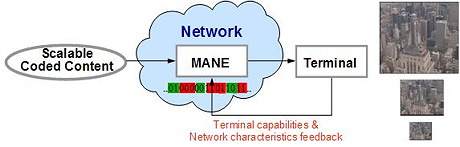
A Media-Aware Network Element (MANE) as defined by the IETF RFC3984 is referred to as a network element, such as a middlebox or application layer gateway that is capable of parsing certain aspects of the RTP payload headers or the RTP payload and reacting to the contents. MANEs - in its current state - are tightly aligned with SVC and, thus, allow the adaptation of SVC bitstreams within the network as shown in the figure below (taken from here).
The current status of the RTP payload format for SVC bitstreams can be found here. With SVC and its RTP payload format, it's very simple to deploy an adaptation engine within the network (i.e., the MANE) that adapts the video content according to different terminal capabilities and network characteristics (e.g., HDTV, SDTV, mobile devices).

The Future Internet

The term "Future Internet" comes from the future Internet conference that was held in spring 2008 in Bled, Slovenia and refers to the European Future Internet Portal which serves as the central forum for European activities and discussions on the future of the Internet. Within the Bled Declaration the main challenges towards the Future Internet have been highlighted, among them capabilities for supporting the creation, sharing, locating and delivery of new-media content which indeed is the result of research and development in the area of SVC and MANE respectively. EC-funded projects that are active supporters of the Bled Declaration and utilize SVC and MANE respectively are, for example, P2P-Next and SEA. However, there's still a long, difficult path ahead with a lot of challenges to be addressed, specifically in the area of Quality of Servce/Experience and, thus, adaptation of multimedia content (but that's another story...).

The next event is the Future of the Internet conference in Prague, in May 2009.

Wednesday, January 14, 2009

Joint Master Thesis Projects between STMicroelectronics and Klagenfurt University

For further information, please contact me!

Visual quality optimization techniques applied to rate-control in SVC
Reference: Tea Anselmo (STM), Daniele Alfonso (STM), Christian Timmerer (UNIKLU), Hermann Hellwagner (UNIKLU)
Description: In digital video coding, the main aim of bit-rate control is to provide a bit-stream with a final data rate as close as possible to a predefined target one, by simply adapting the quantization parameter to the video sequence complexity. However, in case of low bit-rate applications or highly complex sequences, the bit-rate control would impose a too high quantization step thus inevitably compromising the visual quality of coded pictures.
In the depicted case, it is convenient the application of a Frame Skipping strategy. The Frame Skipping technique adaptively skips whole coded pictures, so the encoder could allocate more bits for other frames so as to perform higher image quality and reduce rate criticisms without losing bits. Moreover, the human visual system is particularly sensitive to quantization artefacts and frame rate discontinuity, therefore skipping frame selection must balance quality and rate to avoid visual fluctuation of image quality. This thesis work implies:
  • Study and documentation on frame skipping techniques in literature.
  • Development and integration of the Frame Skipping technique into the STMicroelectronics proprietary Constant Bit-Rate (CBR) control algorithm. The STMicroelectronics encoder is a C++ software model of the new MPEG SVC (Scalable Video Coding) standard. The implementation will be carried out using GNU C/C++ program languages and will be executed in a general purpose computational platform (PC).
  • Finally, extensive objective and subjective evaluations must be done to test the algorithm performance.
Streaming of scalable video bitstreams on variable bandwidth channels
Reference: Daniele Alfonso (STM), Christian Timmerer (UNIKLU), Hermann Hellwagner (UNIKLU)
Description: The new video coding standard ITU-T/MPEG Scalable Video Coding (SVC) extends the H.264/AVC functionalities with new effective improvements particularly devoted to layered coding in terms of temporal, spatial and quality scalability. A scalable bitstream can contain different representations of the same video sequence, with different temporal or spatial resolutions and quality granularity, all encapsulated according to the standard coding hierarchy. In particular, with the MGS (Medium Grain Scalability) each picture can have multiple quality representations, each one with an increasing associated bit-rate, thus providing the possibility to select different compromises between quality and rate. In this way, SVC enables the transmission and decoding of partial bit-streams to adapt instantaneously to channel conditions, for example in case of video streaming applications as video conferencing services.
The final aim of this thesis work is the study, development and performance evaluation of a transmission system based on the SVC standard and devoted to video streaming applications on variable bandwidth channels. The activity implies:
  • outline a set of significant encoding scenarios to be tested;
  • channel modelling and simulation;
  • extensive objective and subjective evaluations on decoder side of algorithm performance.
Development of motion compensated filtering techniques for noise reduction in digital video sequences generated by CMOS sensors
Reference: Daniele Alfonso (STM), Christian Timmerer (UNIKLU), Hermann Hellwagner (UNIKLU)
Description: Noise reduction is a fundamental aspect for every digital video process since it produces two main benefits: it improves human visual perception and increases compression efficiency of digital video coding systems. Today the most diffused video standard is the H.264/AVC (Advanced Video Coding), which implements a hybrid coding approach by exploiting both temporal and spatial redundancies to achieve efficient compression ratios. The noise, actually, causes high frequency spectral contributions in both spatial and temporal domains, thus preventing the coding process from fully exploitation of temporal and spatial samples correlation. The main targets of this thesis work are:
  • noise model shaping of most diffused CMOS sensors for digital cameras and camcorders;
  • development of a noise reduction method combining spatial and temporal filtering, also known as MCTF (Motion Compensated Temporal Filtering), employing STMicroelectronics proprietary algorithm implementation;
  • integration of the de-noising model as spatio-temporal prefiltering stage of HDTV resolution sequences, according to the H.264/AVC coding standard;
  • extensive objective and subjective evaluation of algorithm performance.

Monday, December 1, 2008

Scalable Video Coding within DVB

Daniele Alfonso came up with this breaking news. I think/hope this will boost SVC's industry adoption.

The last issue of DVB-SCENE (the quarterly magazine of the DVB Project) includes an article by Ken McCann (Zetacast and Chairman of TM Ad Hoc Group on Audio-Visual Content, TM-AVC) entitled "Scalable Video Coding within DVB".

Here is the abstract:
The two main DVB Audio-Visual Coding specifications, for broadcast applications based on the MPEG-2 Transport Stream and for DVB applications delivered directly over IP protocols, are currently being revised to add new options to the toolboxes. Probably the most significant of these new options is Scalable Video Coding, defined by an amendment to the H.264/AVC specification. The objective is to produce an encoded signal that has the capability of being decoded to give video, albeit at reduced quality, from only part of the bit-stream.

Scalable Video Coding is a worthy addition to the DVB toolbox, applicable to a wide range of potential applications. However, as with the other tools, it should be selected for use when appropriate; it is not a 'magic bullet' that gives benefits under all circumstances.

DVB-SCENE #28 is available for download in PDF at this link.

Other articles include:
  • Making the Content and Device Value Chains Work for All Stakeholders
  • Synchronised Interactivity with MHP
  • Mobile Return Channel
  • Market Watch

Wednesday, July 2, 2008

Interoperable SVC Streaming featuring MPEG-21 DIA at ICME'08 Demo Track

Abstract: In this paper we present an interoperable multimedia delivery framework for scalable video coding based on MPEG-21 Digital Item Adaptation (DIA). In can be used to transmit scalable video contents within heterogeneous usage environments where the properties of the usage environment (e.g., terminal/network capabilities) may change dynamically during the streaming session. The usage environment is signaled by interoperable description formats provided by the DIA standard. Additionally, the adaptation itself is done by exploiting the standard's generic adaptation approach, i.e., independent of the actual coding format. Thus, the overall framework is also applicable for other scalable coding formats.
Interestingly, the demo provides thanks to the optimizations of the reference software a superior performance compared to other SVC player implementations. A lot of people were impressed that the sequences were shown smoothly on a "casual" laptop without any delays or faulty pictures.

The 2-pager (demo description) is available here.