Friday, February 26, 2010

WISMA 2010 approaching

CALL for PAPERS
Workshop on Interoperable Social Multimedia Applications (WISMA 2010)
11th International Workshop of the Multimedia Metadata Community

Submission due: 14th March 2010 - Workshop dates: 19th-20th May 2010
Workshop venue: Universitat Politècnica de Catalunya, Barcelona (Spain)

In the Web 2.0, a growing amount of multimedia content is being shared on Social Networks. Due to the dynamic and ubiquitous nature of this content (and associated descriptors), new interesting challenges for  indexing, access, and search and retrieval have arisen. In addition, there is a growing concern on privacy protection, as a lot of personal data is being exchanged. Teenagers (and even younger kids), for example, require special protection applications; while adults are willing to have a higher control over the access to content. Furthermore, the integration of mobile technologies with the Web 2.0 applications is also an interesting area of research that needs to be addressed; not only in terms of content protection, but also considering the implementation of new and enriched context-aware applications. Finally, social multimedia is also expected to improve the performance of traditional multimedia information search and retrieval approaches by contributing to bridge the semantic gap. The integration of these aspects, however, is not trivial and has created a new interdisciplinary area of research.

In any case, there is a common issue that needs to be addressed in all the previously identified social multimedia applications: the interoperability and extensibility of their applications. Thus, the workshop is particularly interested in research contributions based on standards.

Recommended topics include, but are not limited to, the following:
• Privacy in social networks
• Access control in social networks
• Social media analysis
• Social media retrieval
• Context-awareness in social networks
• Mobile applications scenario
• Social networks ontologies and interoperability
• Security and privacy ontologies
• Content distribution over social networks
• Multimedia ontologies and interoperability
• Multimedia search and retrieval
• Semantic metadata management
• Collaborative tagging
• Interaction between access control and privacy policies
• Social networks and policy languages
• Policy management

Research Papers: Papers should describe original and significant work in
the research practice of related topics.
(i) Long papers: up to 8 pages, will normally be focused on research studies, applications and experiments.
(ii) Short papers: up to 4 pages, will be particularly suitable for reporting work-in-progress, interim results, or as a position paper submission.
Applications and Industrial Presentations: Proposals for presentations of applications or tools, including project reports, industrial practices and models, or tools/systems demonstrations. Abstract: 2 pages.

All submissions and proposals are to be in English and submitted in PDF format at the WISMA paper submission web site (http://www.easychair.org/conferences/?conf=wisma2010) on or before 14th
March 2010. Papers should be formatted according to LNCS style (http://www.springer.com/computer/lncs?SGWID=0-164-7-72376-0). The workshop proceedings are to be published as a volume at CEUR Workshop Proceedings (http://ceur-ws.org).

General Chair: Jaime Delgado (UPC, Spain).
International Programme Committee:
Anna Carreras (Universitat Politècnica de Catalunya, Spain),
Ansgar Scherp (University of Koblenz-Landau, Germany),
Bill Grosky (University of Michigan, USA),
Chris Poppe (Ghent University - IBBT, Belgium),
Christian Timmerer (Alpen-Adria-University Klagenfurt, Austria),
Dominik Renzel (RWTH Aachen University, Germany),
Frédéric Dufaux (EPFL, Switzerland),
Harald Kosch (University of Passau, Germany),
Herve Bourlard (Idiap, Switzerland),
Jaime Delgado (Universitat Politècnica de Catalunya, Spain),
Laszlo Böszörmenyi (Klagenfurt University, Austria),
Marc Spaniol (MPI - Saarbrücken, Germany),
Markus Strohmaier (Know Center Graz, Austria),
Mathias Lux (Klagenfurt University, Austria),
Michael Granitzer (Know Center Graz, Austria),
Oge Marques (Florida Atlantic University, USA),
Ralf Klamma (RWTH Aachen University, Germany),
Richard Chbeir (Bourgogne University, France),
Romulus Grigoras (ENSEEIHT, France),
Ruben Tous (Universitat Politècnica de Catalunya, Spain),
Savvas Chatzichristofis (Democritus University of Thrace, Greece),
Vincent Charvillat (ENSEEIHT, France),
Vincent Oria (NJIT, USA),
Werner Bailer (Joanneum Research Graz, Austria),
Yu Cao (California State University, Fresno, USA).

Supported by:
Multimedia Metadata Community
Universitat Politècnica de Catalunya BARCELONATECH
segur@, a project co-funded by the CDTI (Government of Spain)
=====================================================================

Peer-to-Peer Computing 2010

August 25-27, 2010, Delft, Netherlands: http://p2p10.org/

Scope and Topics
The P2P'10 conference solicits papers on all aspects of peer-to-peer computing. Of particular interest is research that furthers the state-of-the-art in the design and analysis of peer-to-peer applications and systems, or that investigates real, deployed, large-scale peer-to-peer applications or systems. The applications can range from the traditional peer-to-peer application of file sharing to more novel applications such as media streaming and intelligence sharing. Topics of interest include but are not limited to the following aspects of P2P computing:
  • Information retrieval and query support
  • Semantic overlay networks and semantic query routing
  • P2P for grids, clouds, and datacenters
  • Deployed (commercial) applications and systems
  • Security, trust, and reputation
  • Cooperation, incentives, and fairness
  • P2P economics
  • Social networks
  • Overlay architectures and topologies
  • Overlay interaction with underlying infrastructure
  • Overlay monitoring and management
  • Self-organization
  • P2P applications and systems over mobile networks
  • Performance, robustness, and scalability 
Paper submission guidelines
Papers can be submitted either as full papers or as short papers in the IEEE single-spaced two-column format using at least 10 point font size. Full papers should not exceed 10 pages and short papers should not exceed 4 pages. Papers must be submitted electronically in PDF format through the paper-submission website linked from the conference website. IEEE templates for LaTeX and Microsoft Word, as well as related information, can be found at the IEEE Digital Toolbox webpage. The conference proceedings will be published by the IEEE Communications Society.

All submissions will be evaluated using a double-blind review process. To ensure blind reviewing, papers should be anonymized by removing author names and affiliations, as well as by masking any information about projects and bibliographic references, etc. that might reveal the authors' identities. Papers that are not properly anonymized will be returned without review. Submitted papers should describe original and previously unpublished research and are not allowed to be simultaneously submitted or under review elsewhere.

All papers must be registered with the submission system by the abstract submission deadline. At least one author of every accepted paper must register to the conference not later than June 10, 2010, 12 PM (EST) and present the paper.

Important Dates

  • Abstracts Due March 29, 2010
  • Full Papers Due April 5, 2010
  • Conference: August 25, 2010

Thursday, February 25, 2010

O Universal Multimedia Access, Where Art Thou? (Part III)

-by Christian Timmerer, Klagenfurt University, Austria

Preface: First I thought about writing this article for a journal or something equivalent but then I concluded to make this article available through my blog. The aim is to perform an experiment in order to determine whether it is possible (a) to get direct feedback through comments and (b) to be referenced from elsewhere. As it is a quite comprehensive article, it’s split up in separate parts. If someone (i.e., a journal editor) is interested in publishing this article, yes, I can still do that! :-)

Part I was about giving an introduction to the topic and an overview on multimedia content adaptation techniques. Part II was about the adaptation by transformation approach that utilizes scalable coding formats such as JPEG2000, MPEG-4 BSAC, and MPEG-4 SVC. This part comprises adaptation decision-taking also known as the brain of multimedia content adaptation.

Part III – Adaptation Decision-Taking

Definition: (Multimedia) adaptation decision-taking is referred to as the process of finding the optimal parameter settings for (multiple, possibly in series connected) multimedia content adaptation engines given the properties, characteristics, and capabilities of the content and the context in which it will be processed.

Problem Description

The information revolution of the last decade has resulted in a phenomenal increase in the quantity of multimedia content available to an increasing number of different users with different preferences who access it through a plethora of devices and over heterogeneous networks. End devices range from mobile phones to high definition TVs, access networks can be as diverse as UMTS (Universal Mobile Telecommunications System) and broadband networks, and the various backbone networks are different in bandwidth and Quality of Service (QoS) support. Additionally, users have different content/presentation preferences and intend to consume the content at different locations, times, and under altering circumstances, i.e., within a variety of different contexts.

In order to cope with situations indicated above, multimedia content adaptation has become a key issue which results in a lot of research and standardization efforts collectively referred to as Universal Multimedia Access (UMA). An important aspect of UMA is adaptation decision-taking (ADT) which aims at finding the optimal parameter settings for the actual multimedia content adaptation engines based on the properties, characteristics, and capabilities of the content and the context in which it will be processed. This article provides an overview of the different metadata required for adaptation decision-taking and points out technical solution approaches for the actual decision-taking.

High-level Architecture and Metadata Assets

Figure 1 depicts a high-level architecture for adaptation decision-taking including the actual content adaptation. The input of the adaptation decision-taking engine (ADTE) can be divided into content- and context-related metadata. The former provides information about the syntactic and semantic aspects (e.g., bitrate, scene description) of the multimedia content that support the decision-taking process. The latter describes the usage environment (e.g., terminal capabilities) in which the multimedia content is consumed or processed. The result of the ADTE is an adaptation decision which steers the multimedia content adaptation engine(s) to produce the adapted multimedia content fulfilling the constraints imposed by the context-related metadata. The input to the actual adaptation engine is the given multimedia content possibly accompanied with additional content-related metadata required for the adaptation itself (e.g., syntax descriptions).
 
Figure 1. High-level Architecture of Adaptation Decision-Taking and Multimedia Content Adaptation.

The focus of this article is on the ADTE. In the following sections the two types of metadata assets required for adaptation decision-taking are reviewed and, finally, technical solution approaches are highlighted.

Content-related Metadata

This type of metadata comprises descriptive information about the characteristics of the content which can be divided into four categories:
  • Semantic metadata provides means for annotating multimedia content with textual information enabling various applications such as search and retrieval. This kind of metadata covers a broad range of annotation possibilities, among them are the name of the content, authors, actors, scene descriptions, etc.
  • Media characteristics describe the syntactical information pertaining to multimedia bitstreams in terms of the physical format and its characteristics. This may include the storage and coding format as well as bit-rate, frame-rate, width, height, and other related parameters.
  • The Digital Rights Management (DRM) information for adaptation decision-taking specify which kind of adaptation operations (e.g., scaling, format conversion, etc.) are allowed and under which constraints (e.g., bit-rate shall be greater than 512kbps).
  • Finally, Adaptation Quality of Service (QoS) describes the relationship between usage environment constraints, feasible adaptation operations satisfying these constraints, and associated utilities (i.e., qualities).

    Context-related Metadata

    Similar to the content-related metadata, the context-related metadata can be also divided into four categories:
    • End user-related metadata: The first category of metadata is pertained to metadata describing the characteristics of end users in terms of preferences, disabilities, and location-based information.
    • Terminal-related metadata: The second category provides context information regarding the capabilities of the terminal which are used by the end users for consuming multimedia content. This information includes – among others – information about the codecs installed, display properties, and audio capabilities.
    • Network-related metadata: The third category of metadata comprises the information concerning the access and core networks in terms of its characteristics and conditions. Such information may include bandwidth, delay, and jitter.
    • Adaptation-related metadata: Finally, the fourth category of metadata describes the actual adaptation engines in terms of adaptation operations they are capable to perform. For example, an adaptation engine may be able to perform temporal scaling whereas another one provides means for spatial scaling or even complex transcoding operations between different coding formats.

      Solution Approaches for Adaptation Decision-Taking

      In the literature the following approaches towards adaptation decision-taking are known:
      • Knowledge-based ADT [1]: adopts an Artificial Intelligence-based planning approach to find an appropriate sequence of adaptation steps from an initial state (i.e., described by content-related metadata) towards a goal state (i.e., described by context-related metadata).
      • Optimization-based ADT [2]: models the problem of finding adaptation decisions as a mathematical optimization problem by describing functional dependencies between content- and context-related metadata. Furthermore, limitation constraints as well as an objective function is specified.
      • Utility-based ADT [3]: can be seen as an extension of the previous two approaches which explicitly takes the users’ specific utility aspects into account.
      This is the end of Part III and I will continue in Part IV with interoperability issues, i.e., standards supporting UMA. Thus, stay tuned!
       

      References

      [1]    D. Jannach, K. Leopold, C. Timmerer, and H. Hellwagner, "A Knowledge-based Framework for Multimedia Adaptation", Applied Intelligence, vol. 24, no. 2, pp. 109-125, April 2006.
      [2]    I. Kofler, C. Timmerer, H. Hellwagner, A. Hutter, and F. Sanahuja, "Efficient MPEG-21-based Adaptation Decision-Taking for Scalable Multimedia Content", Proceedings of the 14th SPIE Annual Electronic Imaging Conference – Multimedia Computing and Networking (MMCN 2007), San Jose, CA, USA, January/February 2007.
      [3]    M. Prangl, T. Szkaliczki, and H. Hellwagner, "A Framework for Utility-based Multimedia Adaptation", IEEE Transactions on Circuits and Systems for Video Technology, vol. 17, no. 6, pp. 719-728, June 2007.

      Wednesday, February 24, 2010

      CFP: Computer Networks Journal Special Issue: Architectures and Protocols for the Future Internet

      The Internet architecture has been remarkably successful in allowing a planet-scale internetwork to form. However, the architecture has been losing its original simplicity and transparency as new classes of applications, business models, security mechanisms, scalability enablers and operational and management requirements have given rise to point solutions that extend the architecture without regard to its original design principles.

      Consequently, the research community has been actively looking for new approaches to evolve or supersede the Internet architecture. Substantial academic efforts in Europe, the Americas and Asia, as well as within the vendor and network operator communities have resulted in promising proposals to address the limitations of the current Internet architecture.

      This special issue of the Computer Networks Journal solicits original, high-quality papers that present, analyze and discuss revolutionary "clean slate" or evolutionary "dirty slate" Internet architectures, "future-proofing" improvements to current Internet protocols, especially at the internetworking, routing, transport and application layers, or new internetworking components that integrate into the existing architecture. Related topics, such as measurement studies or mathematical models that analyze and quantify Internet scalability issues, studies into architectural design principles that enable evolution, interworking technologies with the existing Internet, and others are also within the scope of the special issue.

      About the Computer Networks Journal Computer Networks is a scientific journal of computer and telecommunications networking published by Elsevier. Computer Networks is an international, archival journal providing a publication vehicle for complete coverage of all topics of interest to those involved in the computer communications networking area. The audience includes researchers, managers and operators of networks as well as designers and implementors.

      Submission Format
      Submissions should be clearly organized, written in excellent English and must describe original, complete research not published or currently under review by other journals or conferences. Substantially enhanced and extended versions of quality papers presented at conferences or workshops may be submitted with the differences to the previous version clearly described. All submissions will be peer reviewed. The guest editors reserve the right to reject submissions that are clearly out of scope or well below the expected quality for this special journal issue without further review.

      Submission Guidelines
      Authors must prepare and format their submissions according to the "Guide for Authors" available from http://ees.elsevier.com/comnet/ and submit them online at the same URL, choosing "SI-Future Internet" as the article type. Submissions must be in single-column format, double-spaced, use a font size of at least 11 points, and should not exceed 25 pages including all figures and references.

      Guest Editors
      Lars Eggert, Nokia Research Center & Aalto University, lars.eggert@nokia.com
      Tilman Wolf, University of Massachusetts, wolf@ecs.umass.edu

      Editors in Chief
      Ian F. Akyildiz, ian@ece.gatech.edu
      Harry Rudin, hr@zurich.ibm.com

      Important Dates
      Paper submission: 2010-4-30
      Acceptance notification: 2010-7-16
      Final papers: 2010-8-27
      Publication: early 2011

      Tuesday, February 23, 2010

      ACM Multimedia 2010 - Call for Full Papers, Brave New Ideas, Interactive Art Program and Workshops

      Deadline for abstract registration: March 21st, 2010
      http://www.acmmm10.org/
      October 25-29th 2010 - Firenze, Italy
      The deadline for submissions to ACM Multimedia 2010 Full Papers, Brave New Ideas, Interactive Art Program and Workshops is March 21st, 2010.
      Full Papers describe scientific achievements in the following tracks: Multimedia Content, Multimedia Systems, Human Centered Multimedia and Multimedia Applications.
      Brave New Ideas proposals address long term research challenges, point to new research directions, or provide new insights or brave perspectives that pave the way to innovation.
      Interactive Art Program will consist of an Art Exhibition and a Conference track.
      Workshops will address clearly focused topics, pertinent to the main conference, offering emerging interest to multimedia research community.
      All details for submitting are on the conference web site http://www.acmmm10.org/.
      Important dates:
      • March 21st, 2010 – Abstract or proposal submission deadline
      • March 29th, 2010 – Workshop notification of acceptance
      • April 11th, 2010 – Full Paper and Art Work submission deadline
      • May 7th, 2010 – Brave New Idea and Short Paper submission deadline
      • July 5th, 2010 – Notification of acceptance
      • July 26th, 2010 – Camera-ready submission deadline

      Friday, February 19, 2010

      [ACM MULTIMEDIA 2010] Call for Proposals: Workshops, Panels and Tutorials

      Deadline for proposal submission: March 21st (Workshops), April 11th, 2010 (Panels and Tutorials)
      http://www.acmmm10.org/
      October 25-29th 2010 - Firenze, Italy
      ACM Multimedia 2010 solicites proposals for Workshops, Panels and Tutorials. ACM Multimedia 2010 is the worldwide premier multimedia conference and a key event to display scientific achievements and innovative industrial products.
      Workshops will address clearly focused topics, pertinent to the main conference. They should offer emerging interest to multimedia research community, give the opportunity to better explore some new ideas and bridge the community with other areas. A typical Workshop duration is one day. Workshop day for ACM Multimedia 2010 is Friday, October 29, 2010.
      Panels: Proposals are solicited for panels of 90 minutes duration. Proposers should organize the panel so that the panelists have high interaction with the attendees. To this end, at least 45 minutes should be spent in interaction with the audience.
      Tutorials will address the state-of-the-art developments regarding all aspects of multimedia, and will be of interest to the entire multimedia community, from novices in the world of multimedia to the most seasoned researchers, from people working in academia to industry professionals.
      All submission details are on the conference web site http://www.acmmm10.org/.

      Important dates:
      • March 21st, 2010 – Workshop Proposal submission deadline
      • March 29th, 2010 – Workshop notification of acceptance
      • April 11th, 2010 – Tutorial and Panels Proposal submission deadline
      • June 5th, 2010 – Notification of acceptance
      • July 26th, 2010 – Tutorial outline camera-ready submission deadline

      Monday, February 15, 2010

      Computing Now has its own iPhone App

      Computing Now, IEEE Computer Society's one-stop source for new print and online content from the IEEE Computer Society's 13 peer-reviewed magazines, as well as selections from our journals and conference proceedings, has its own iPhone App.

      The application provides access to most of the Computing Now content on the iPhone and is currently in a kind of beta phase. Currently, it acts as an advanced RSS reader but tailored to the needs of Computing Now, e.g., you may access podcast episodes directly from within this application or get in touch with the CS president through his blog on CN. As usual there's always room for improvement and you're able to provide feedback through a survey. Please find below a couple of screenshots or simple follow the link above to install it on your own iPhone or iPod Touch. Finally, it's free of charge!

      Last Call for Papers: European Signal Processing Conference (EUSIPCO-2010)

      August 23-27 2010, Aalborg, Denmark (http://www.eusipco2010.org)

      The 2010 European Signal Processing Conference (EUSIPCO-2010) is the 18th of its kind organized by the European Association for Signal, Speech, and Image Processing (EURASIP). The conference will be held at Aalborg Congress & Culture Centre in Aalborg, Denmark and is organized by Aalborg University. The focus will be on signal processing theory, algorithms, and applications. Papers will be accepted based on quality, relevance, and novelty and accepted papers will be published in the proceedings of EUSIPCO-2010 as well as presented at the conference.
      Areas of Interest

      Submissions are invited in, but not limited to, the following areas:
      * Audio and electroacoustics
      * Design and implementation of signal processing systems
      * Multimedia signal processing
      * Speech processing
      * Image and video processing
      * Signal estimation and detection
      * Sensor array and multi-channel processing
      * Signal processing for communications
      * Nonlinear signal processing
      * Signal processing applications

      Submission
      Procedures to submit a paper and tutorials are detailed at www.eusipco2010.org. Submitted papers must be camera-ready, no more than five pages long, and conforming to the format specified on the EUSIPCO-2010 website.

      Important Dates
      * Proposals for tutorials February 20, 2010
      * Electronic submission of papers February 22, 2010
      * Notification of acceptance May 17, 2010
      * Submissions of camera-ready papers June 14, 2010
      ----------------------------------------------------------------------------
      You are receiving this call-for-papers from EDAS, based on your user profile. To unsubscribe from call-for-paper messages such as this one, go to "My profile" and update your areas of interest (link at top of page - http://edas.info/editAreaInterest.php ).

      Friday, February 12, 2010

      WIAMIS'10: Increasing the User Experience of Multimedia Presentations with Sensory Effects

      Here comes the abstract of our paper that has been accepted for publication at WIAMIS'10. Please join us there in case you'd like to get in touch we us!

      Markus Waltl, Christian Timmerer, Hermann Hellwagner, Increasing the User Experience of Multimedia Presentations with Sensory Effects, accepted for publication at 11th International Workshop on Image Analysis for Multimedia Interactive Services (WIAMIS’10), Desenzano del Garda, Italy, April 12-14, 2010.

      Abstract:
      The term Universal Multimedia Experience (UME) has gained momentum and is well recognized within the research community. As this approach puts the user into the center stage, additional complexity is added to the overall quality assessment problem which calls for a scientific framework to capture, measure, quantify, judge, and explain the user experience. In previous work we have proposed the annotation of multimedia content with sensory effect metadata that can be used to stimulate also other senses than vision or audition. In this paper we report first results obtained from subjective tests in the area of sensory effects attached to traditional multimedia presentations such as movies that shall lead to an enhanced, unique, and worthwhile user experience.

      See here the list of accepted papers at WIAMIS'10.

      Thursday, February 11, 2010

      Heil The New xVC Heir: HVC

      For the record and also as an update, here is my guest post at RADVISION's Video over Enterprise blog.
      "The HVC efforts have already begun. Based on the current timeline, one can expect the new standard to be available around the end of 2012/beginning of 2013. This may seem far away, but as many video infrastructure products have a 2 year design process, this is very relevant to today’s design efforts.
      And so we are looking forward to a new and very exciting xVC episode, and it will be very interesting to see how the new standard evolves and whether it will fit today’s expectations. Thus, stay tuned!"


      The latest information about High-performance Video Coding (HVC) can be found at the MPEG Web site and here are links to the publicly available documents:
      Most interestingly, the joint CfP on HVC - joint between MPEG and ITU-T - and the vision and requirements documents. If you're interested in the upcoming discussions around HVC you may join the mailing list or even the #HVC Twitter stream (alt) ;-)

      Tuesday, February 9, 2010

      CfP: Special Issue of MTAP on Semantic Multimedia - DEADLINE EXTENSION


      Due to several requests the DEADLINE for the special issue has been EXTENDED to Feb. 28, 2010.


      ===============================================================

      Call for Papers

      Multimedia Tools and Applications, Springer

      *** Special issue on "Semantic Multimedia" ***

      ===============================================================

      Growing amounts of multimedia data of various modalities (video, audio, 3D objects, etc.) make management, distribution of and access to multimedia material ever harder, both for lay and professional users. Novel approaches, bridging the large disparity between descriptors computed automatically from multimedia content and subjectivity and context in user interpretation and interaction, are required. It still needs to be further explored how technologies from different research areas can be used to increase the value of multimedia content, e.g. to assist multimedia representation, analysis and annotation with semantics and knowledge based methods.

      This special issue invites high quality contributions addressing related theoretical and practical aspects of semantic multimedia. We especially invite the submission of extended versions of papers presented at the 4th International Conference on Semantic and Digital Media Technologies (SAMT 2009) and at the attached workshops.

      Topics of interest include, but are not limited to:
      * SEMANTIC ANALYSIS OF MULTIMEDIA
       - Knowledge assisted multimedia analysis
       - Content-based multimedia analysis linked with natural language/speech processing
      * SEMANTIC RETRIEVAL OF MULTIMEDIA
       - Semantic-driven multimedia indexing and retrieval
       - Semantic retrieval of 3D objects
       - Machine Learning and relevance feedback for finding semantics
      * Semantic-driven multimedia content adaptation/summarization
       - SEMANTIC METADATA MANAGEMENT OF MULTIMEDIA
       - Metadata management for multimedia
       - Multimedia ontologies and infrastructures
       - Standards bridging the multimedia and knowledge domains
      * USER INTERFACES FOR SEMANTIC MULTIMEDIA
       - Interfaces and personalization for interaction with large multimedia repositories
       - Semantic media annotation
       - Inference and machine learning for semi-automatic annotation
       - Browsing multimedia archives
       - Device-specific access to and adaptation of multimedia
      * SEMANTICS IN VISUALIZATION AND COMPUTER GRAPHICS
       - illustrative depiction and rendering
       - mapping meaning to presentation content
       - smart virtual environments
       - supporting knowledge discovery
      * APPLICATIONS OF SEMANTIC MULTIMEDIA
       - Social multimedia tagging
       - Context, user, network, semantics-aware media engineering
       - Multimedia mash-ups
       - Case studies with clear, innovative lessons learned


      Important Dates
      --------------------------
      Submission of papers: 15 February 2010
      Submission of final accepted papers: 15 May 2010

      Submissions
      --------------------------
      All the papers should be full journal length versions and follow the guidelines set out by Multimedia Tools and Applications (http://www.springer.com/computer/information+systems/journal/11042).
      Submissions should be uploaded to
      http://mtap.editorialmanager.com choosing "Semantic Multimedia" as article type, no later than February 15, 2010.

      Guest Editors
      --------------------------
      Werner Bailer, JOANNEUM RESEARCH, Austria
      Bernard Mérialdo, Eurecom, France
      Yiannis Kompatsiaris, ITI, Greece
      Tat-Seng Chua, National University of Singapore

      The CfP can be found at http://www.samt2009.org/sites/default/files/mtap_cfp_flyer_v1.pdf

      Final CfP QoMEX


      Final Call for Papers - 5 days left - *firm deadline*!

      The 2nd International Workshop on Quality of Multimedia Experience - QoMEX'10
      June 21-23, 2010  Trondheim / Norway
      http://www.qomex.org/

      Technical Sponsorship by
      - IEEE
      - IEEE Signal Processing Society
      - IEEE Norway Section
      - IEEE Norway Section Joint Chapter on Signal Processing, Information Theory and Communications
      -------------------------------------------------------------------------

      Dear colleagues,
      the International Workshop on Quality of Multimedia Experience (QoMEX) brings together leading professionals and scientists working on methods for evaluating multimedia quality as user experience. It provides an interdisciplinary platform for people from engineering, psychology, sociology, and business. Following the very successful first workshop in San Diego in July 2009, the second will be held in Trondheim, Norway, on June 21-23, 2010.


      Topics include:

      * User Experience Assessment and Enhancement
      * Visual User Experience (Image/Video/Graphics)
      * Auditory User Experience (Speech/Audio)
      * QoE for Virtual, Augmented and Mixed Realities
      * Link between QoS, QoE and Acceptance
      * Psychological and Sociological Dimension of QoE
      * Standardization Activities in Multimedia Quality Evaluation

      Confirmed plenary talks:

      Dr. John G. Beerends, TNO, The Netherlands Dr. Andrew B. Watson, NASA Ames Research Center, USA

      Important dates:

      Submission deadline:          February 14, 2010
      Notification of acceptance:   April 1, 2010
      Camera ready submission:      May 1, 2010
      Workshop:                     June 21-23, 2010

      Further information:

      Download a PDF version of the call for papers at http://www.qomex2010.org/QoMEX2010_CfP.pdf or visit the QoMEX website at http://www.qomex.org

      DMS2010 call for papers


      DMS 2010: Globalization and Personalization
      The Sixteenth International Conference on Distributed Multimedia Systems
      www.ksi.edu/seke/dms10.html
      Hyatt Lodge at McDonald's Campus, Oak Brook, Illinois, USA
      October 14 - October 16, 2010
      Organized by
      Knowledge Systems Institute, USA, University of Florence, Italy, University of Leeds. UK

      Call For Papers

      The DMS conference is an international conference series, which covers a wide spectrum of paper presentations, technical discussions and demonstrations in the fields of distributed multimedia computing. The theme for DMS2010 is Globalization and Personalization. The conference organizers seek contributions of high quality papers, panels or tutorials, addressing various aspects of distributed multimedia systems and applications, for presentation at the conference and publication in the proceedings.  Both research and case study papers or demonstrators describing results in research area as well as industrial development cases and experiences are solicited. Demonstrators prototypes are welcome to support the submission and to be presented at the conference in the discussion sections.

      Special issue of Journals
      The DMS conference is closely coordinated with the International Journal of Software Engineering and Knowledge Engineering, the Journal of Visual Languages and Computing and the International Journal of Distance Education Technologies. Usually the best ranked papers from the conference, after rigorous reviews, extensive revisions and further enhancements, will appear in one or more special issues of the above journals. Papers suggested for the special issue(s) will be reviewed by external reviewers following the standard procedure of review stipulated by the respective journal.

      Information for Authors
      Papers must be written in English. An electronic version (Postscript, PDF, or MS Word format) of the full paper should be submitted using the following URL: http://conf.ksi.edu/dms2010/submit/SubmitPaper.php.
      Manuscript must include a 200-word abstract and no more than 6 pages of IEEE double column text (include figures and references).
      All submissions must not be published or under consideration for publication in a journal or in a conference with proceedings. Papers will be evaluated based on originality, significance, technical soundness and clarify
      of exposition. Depending upon the results of evaluation a paper may be accepted as regular paper (6 pages), short paper (4 pages) or poster (poster presentation only). If you have any questions please send e-mail to:
      dms10@ksi.edu.

      DMS 2010 Conference Secretariat
      Knowledge Systems Institute
      3420 Main Street
      Skokie, IL 60076 USA
      Tel: 847-679-3135
      Fax: 847-679-3166
      E-mail: dms10@ksi.edu

      Important Dates
      Paper submission due:  April 30, 2010
      Notification of acceptance: June 30, 2010
      Camera-ready copy: July 31, 2010
      Early conference registration due: July 31, 2010

      DMS'10 Conference Co-Chairs
      Augusto Celentano, Universita Ca Foscari di Venezia, Italy
      Atsuo Yoshitaka, JAIST, Japan
      DMS'10 Program Co-Chairs
      Paolo Nesi, University of Florence, Italy
      Kia Ng, University of Leeds, UK

      DMS'10 Steering Committee Chair
      Shi-Kuo Chang, University of Pittsburgh, USA
      DMS'10 Publicity Committee
      Kao-Shing Hwang, National Chung Cheng University, Taiwan

      The conference is listed by:
      DBLP
      AllConferences.com, a directory of conferences and conventions.

      The conference is organized by:
      Knowledge Systems Institute, USA
      Univeristy of Florence, Italy
      University of Leeds, UK

      [ACM MULTIMEDIA 2010] Call for Full Papers and Brave New Ideas


      ACM Multimedia 2010 - Call for Full Papers and Brave New Ideas
      Deadline for abstract registration: March 21st, 2010
      http://www.acmmm10.org/
      October 25-29th 2010 - Firenze, Italy

      ACM Multimedia 2010 solicits submissions for Full Papers and Brave New Ideas. Full Papers describe scientific achievements in the following tracks: Multimedia Content, Multimedia Systems, Human Centered Multimedia and Multimedia Applications. Brave New Ideas proposals address long term research challenges, point to new research directions, or provide new insights or brave perspectives that pave the way to innovation.

      All details for the submission are on the conference web site http://www.acmmm10.org/.

      Full papers will be presented in the oral sessions of the ACM Multimedia 2010 technical program. Papers can be of interest of multiple tracks simultaneously: if the case applies, it must be specified upon paper submission. Extended version of the four candidate Best Papers (one from each track) will appear in a special section in the ACM Transactions on Multimedia Computing, Communications and Applications (TOMCCAP 2011). ACM Multimedia review is double-blind. Traditional acceptance rate for Full Papers is about 18%. Contributions submitted to the Full Papers program that will have received good ratings although not accepted, will be suggested for inclusion in the Short Paper program. The maximum length allowed for full papers is 10 pages.

      Brave New Ideas proposals should present exciting new topics that are highly related and relevant to the future of the field and which may not be traditionally presented at ACM Multimedia. Proposals may be for Research Papers and Session Proposals. Brave New Ideas papers will be reviewed in two stages: abstracts (500 words) will be first filtered by the Brave New Ideas Program Chairs, then selected papers (4 to 10 pages) will undergo a full review plus discussion with the Chairs. Session proposals should include title, a one-page abstract describing the scope of the session, names and one-paragraph bios of the organizers, and the expected composition of the session.

      Important dates:

      March 21st, 2010 – Full Paper and Brave New Ideas abstract submission deadline
      April 11th, 2010 – Full Paper submission deadline
      May 7th, 2010 – Brave New Idea Paper submission deadline
      July 5th, 2010 – Notification of acceptance
      July 26th, 2010 – Camera-ready submission deadline

      Monday, February 8, 2010

      Quality of Multimedia Experience (QoMEx)

      What is QoMEx? I think it can be explained as a derivation of Quality of Service (QoS) and Quality of Experience (QoE) whereby the latter is an extension of the former taking a user-centric approach, i.e., it is the user who is ultimately consuming a service and, therefore, shall be the focus of attention (see here or here for more details). An interview with Video Quality Experts can be found here.

      Quality of Multimedia Experience is basically an application of QoE in the field of multimedia (communication), e.g., Video on Demand, streaming, audio/video conferencing, voice applications, etc. etc.

      Recently, quite a few multimedia events (conferences, workshops, symposia) appeared on the horizon and I'd like to name just a few:
      "My own" two workshops related to QoS ;-)
      If you think something is missing here, please drop me a note...

        Call for Technical Demonstration Submissions – VCIP2010

        The 2010 Visual Communications and Image Processing conference (VCIP2010) will be held in Huang Shan, An Hui, China, 11-14 July 2010. Visual communication has become an important engineering area that attracts interdisciplinary research interest and has lead to significant developments in technology and science. This conference is designed as a forum for presenting important research results. We are currently seeking outstanding technical demo submissions.
        Demonstrations will include leading edge work and work in progress in every area of visual communication or image processing technology and its implementation and applications. Submissions are encouraged in areas including image and video coding, visual communication techniques, image and video analysis, image and video synthesis and rendering. In particular, it is encouraged to submit demonstrations on practical systems and research prototypes in these areas.
        Submissions will be peer-reviewed to ensure quality. Submitters are encouraged to provide videos where applicable to show the proposed demonstrations. Demonstrators will be provided with space, poser and networking (with special request). Participants will be required to provide their own computing equipment and any additional network, display, sensor, etc., hardware needed for the demonstration.
        For more information about VCIP2010, please see http://vcip2010.ustc.edu.cn/, or contact: vcip2010@ustc.edu.cn.
        Submission Instructions:
        Those who are interested in submitting technical demos should submit a description of the demo in one page, using the template of VCIP2010 Demo, via the online submission system (https://cmt.research.microsoft.com/VCIP2010/). Descriptions of selected demos will be included in VCIP 2010 webpage and brochure. If you also submit video, please do not send the video file itself but send a link to the video (e.g., a URL to download it).
        Submission Deadline: 10 March 2010
        Authors will be notified of acceptance by 31 March 2010.
        Demo Chairs:
        Shao-Yi Chien (sychien@cc.ee.ntu.edu.tw), National Taiwan University (Taiwan)
        Ye-Kui Wang (yekuiwang@huawei.com), Huawei Technologies, USA

        References about the Multi-view Video Coding (MVC) standard and related technology principles

        G. J. Sullivan, "Standards-based approaches to 3D and multiview video coding", SPIE Applications of Digital Image Processing XXXII, Aug. 2009.

        A. Vetro, S. Yea, M. Zwicker, W. Matusik, H. Pfister, "Overview of multiview video coding and anti-aliasing for 3D displays", IEEE Int'l Conf on Image Proc., Sept. 2007.
        (esp. section 2 - http://www.merl.com/reports/docs/TR2007-027.pdf)

        A. Vetro, S. Yea, and A. Smolic, "Towards a 3D video format for auto-stereoscopic displays", SPIE Conference on Applications of Digital Image Processing XXXI, Aug. 2008.
        (esp. section 2.4 - http://www.merl.com/papers/docs/TR2008-057.pdf)

        Philipp Merkle, Aljoscha Smolic, Karsten Müller, and Thomas Wiegand: Efficient Prediction Structures for Multiview Video Coding, IEEE Transactions on Circuits and Systems for Video Technology, Special Issue on Multi-view Video Coding and 3DTV, vol. 17, no. 11, pp. 1461-1473, November 2007
        (http://ip.hhi.de/imagecom_G1/assets/pdfs/ieee07_Prediction_MVC.pdf)

        Philipp Merkle, Karsten Müller, Aljoscha Smolic, and Thomas Wiegand: Efficient Compression of Multi-View Video Exploiting Inter-View Dependencies Based on H.264/MPEG4-AVC,
        IEEE International Conference on Multimedia and Expo (ICME'06), Toronto, Ontario, Canada, July 2006.
        (http://ip.hhi.de/imagecom_G1/assets/pdfs/h264_multi_view.pdf)

        Aljoscha Smolic, Karsten Müller, Philipp Merkle, Christoph Fehn, Peter Kauff, Peter Eisert, and Thomas Wiegand: 3D Video and Free Viewpoint Video - Technologies, Applications and MPEG Standards, Proceedings of International Conference on Multimedia and Expo (ICME 2006), Toronto, Canada, pp. 2161-2164, July 2006.

        Karsten Müller, Philipp Merkle, Heiko Schwarz, Tobias Hinz, Aljoscha Smolic, and Thomas Wiegand:
        Multi-view Video Coding Based on H.264/AVC Using Hierarchical B-Frames, Picture Coding Symposium (PCS'06), Beijing, China, April 2006.

        Ying Chen, Ye-Kui Wang, Kemal Ugur, Miska M. Hannuksela, Jani Lainema, and Moncef Gabbouj, “3D video services with the emerging MVC standard”, EURASIP Journal on Advances in Signal Processing, Volume 2009 (2009), Article ID 786015, 13 pages, doi:10.1155/2009/786015.

        MPEG targets next generation teleconferencing and personalized audio in its newest technology

        Kyoto, Japan – The 91st MPEG meeting was held in Kyoto, Japan from the 18th to the 22nd of January 2010.

        Highlights of the 91st Meeting
        • Advanced technology enables bitrate-efficient teleconferencing and personalized audio
        • MPEG and ITU-T SG16 form Joint Collaborative Team (JCT) for High Performance Video Coding
        • Creating solutions for Advanced IPTV Terminals
        • MPEG Extensible Middleware (MXM) standard debuts to facilitate easy access to MPEG tools across a global market
        • MPEG creates efficient and flexible standard for 3D graphics compression
        • MPEG Media Transport (MMT) workshop targets requirements and technologies for streaming of MPEG content
        Wanna know more/details? Please check out the official press release!

          Thursday, February 4, 2010

          W3C's "The System Information API"

          W3C has published a first working draft out of their Device APIs and Policy Working Group and it is for sure worth to look into. Let's have a look at the abstract:
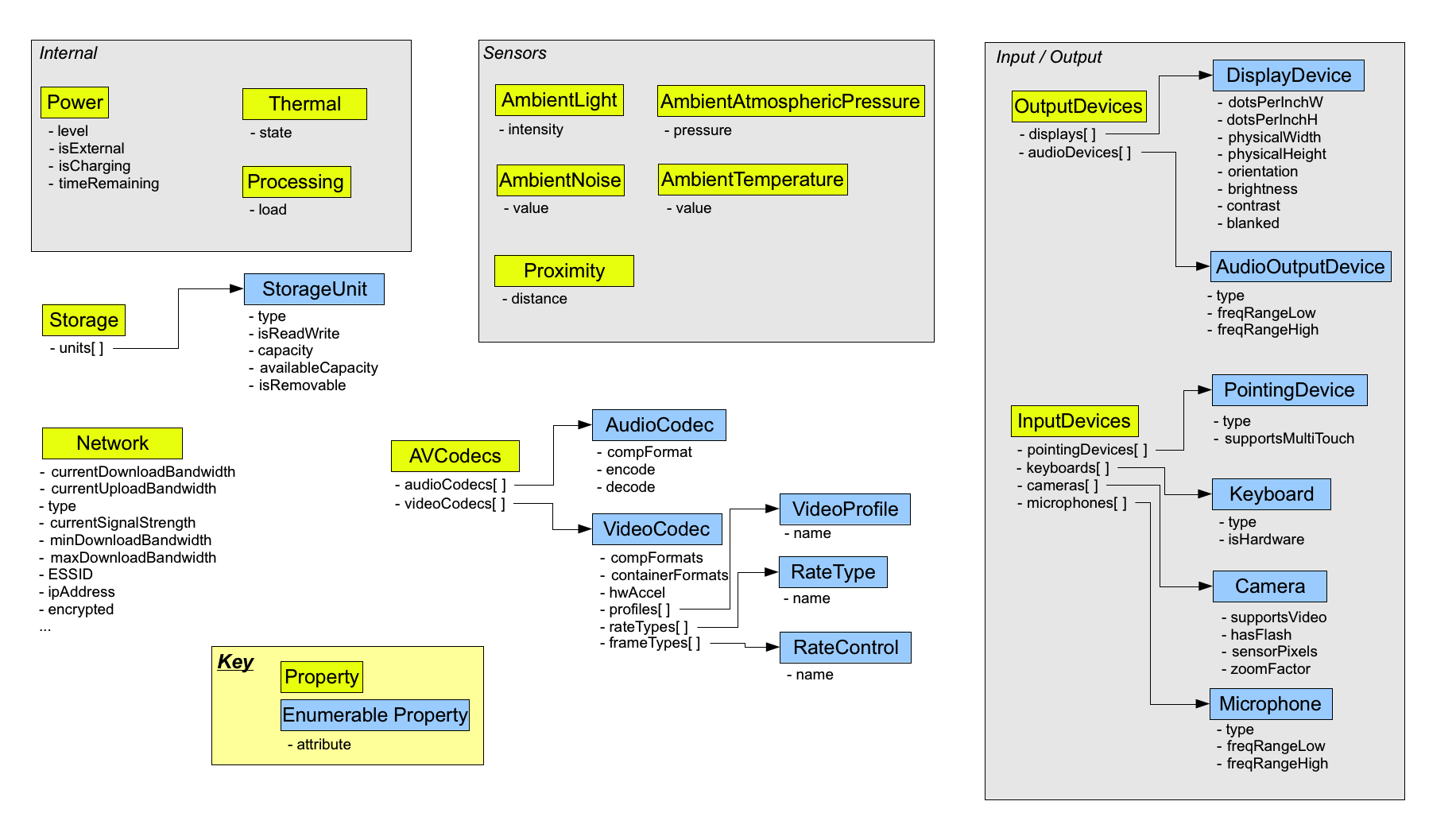
          This specification defines an API to provide Web applications with access to various properties of the system which they are running on. Specifically, properties pertaining to the device hardware are addressed. Examples include battery status, current network bandwidth. Additionally, some of those properties offer access to the environment around the device, such as ambient brightness or atmospheric pressure.
          Remember that's a first working draft which means it's still subject to changes. There's also a nice figure that gives a good overview which APIs one can anticipate in this standard.
          In any case, I would appreciate if W3C could define the scope of this specification and what they actually mean by a "system". A proper definition thereof is somewhat missing at the moment but remember, it's a first working draft only...

          Finally, defining APIs are now in vogue within SDOs as W3C is doing it for a while, MPEG has some APIs defined and will continue this path, and I wonder whether IETF is also about to join the API club.

          Wednesday, February 3, 2010

          Science 2.0

          First of all, I'm not doing research in this area but I'm a user of Web 2.0 services and would like to use it for disseminating my research results, e.g., see one of my previous posts. Furthermore, I'm an associate editor for Computing Now and would like to share some findings I've gathered together with respect to Scientific Publishing + Web 2.0 = Science 2.0. If one does a Google search on this, one might get back quite a few results. However, here's my view on that and maybe you like it - or not - but in any case, your feedback is very much appreciated! First of all, Computing Now is already some kind of Science 2.0 service as it provides a mash-up of articles across all IEEE Computer Society magazines that are related to a certain topic identified by the editorial board. Check out our editorial calender for details and upcoming issues.


          However, traditional scientific publishers like IEEE and ACM/Springer still follow they "good old procedure": (1) Submit a paper, (2) peer review, (3) revision if necessary, (4) submit camera-ready paper, and (5) publishing in a journal which appear on a regular basis, even still in print format, but in any case PDF only! I also have still some subscriptions running but I must admit that I rarely look into it, i.e., the print versions.

          Recently, they've started to provide RSS feeds (e.g., Computing Now Feeds) but still they are updated once a month or so and with each update one receives a punch of new online papers for which its difficult to overview them. Furthermore, there's almost no possibility to share your feedback to a certain article other than posting it on your own blog or get directly in touch with the authors by email. However, if one visits Computing Now Web site right at the moment, one is able to share articles from the "current theme" and "new articles" sections using an AddThis button and there is also a commenting feature BUT one has to login with her/his IEEE account! Anyway, I know that people are working hard in order to improve the current situation ... stay tuned.

          Nevertheless, I'd like to come back to my understanding of Science 2.0 and here's a brief high-level workflow how it should look like. For quality assurance one needs a review process which is okay for me but once it comes to the publishing, people should start thinking about alternatives (see also figure above):
          1. Make the paper available as HTML/XML (e.g., like a blog post) so that people can comment on it and enable efficient sharing possibilities. Once the content (i.e., the paper) is available in a structured format, one can easily repurpose it for whatever other needs (e.g., platforms, devices, etc.). That is, everything needs to be repurposeable!
          2. Ask authors to provide alternative presentation forms like slides (e.g., for Slideshare) or even a video (e.g., for YouTube).
          3. Most authors are asked to provide an abstract so why not asking them to provide a 100 character summary for Twitter or identi.ca. The abstract could be still used for Facebook, LinkedIn, Xing, etc. which allow for more characters/words.
          4. Finally and most importantly, utilize the feedback (see also figure above) from the readers coming through the various social network channels and bring it back to the authors, i.e., by email or any other communication media (e.g., Twitter, Facebook, LinkedIn, RSS, etc.) the authors have provided during the submission of the camera-ready paper. In this way we would create a new Web 2.0-enabled scientific discourse ultimately leading to real Science 2.0.
          For sure the last bullet is the most difficult/complex one but no worries there are already tools out there which at least partially support this kind of functionality and they are generally referred to as commenting systems (e.g., DISQUS, JS-KIT ECHO, IntenseDebate, etc.). Okay, that's it from my side and I hope to receive a lot of comments and feedback ...

          The Fourth International Workshop on Image Media Quality and its Applications (IMQA 2010)


          Fourth International Workshop on Image Media Quality and its Applications (IMQA 2010)
          Important dates:
          Submission deadline:          February 19, 2010 (Extended !!)
          Notification of acceptance:   March 20, 2010
          Camera ready submission:      April 10, 2010
          Workshop:                     May 13-14, 2010
          The Fourth International Workshop on Image Media Quality and its Applications (IMQA 2010) is a forum for leading researchers and developers from industry and academia to discuss state-of-the-art and novel image media quality technologies, theories, methods, and applications of quality metrics in industry.
          Scope
          Topics of interest for submissions should include Image Media Quality, but are not limited to:
          * Image Capture Devices (CCD, CMOS, etc.)
          * Image Capture System (TV Camera, Digital Still Camera, Facsimile, Scanner, 3Dimage Input, etc.)
          * Display (CRT, LCD, PDP, EL, etc.), Display System, 3D-Display, Holograph
          * Hard Copy (Ink Jet Printer, Laser Printer, etc.), Graphic Arts (Halftone Screen, Error Diffusion, etc.)
          * QoS Control and Scheduling, IP Video Conferencing, Video phone, Scalable Coding,
          * Digital Broadcasting System, 3DTV, Super-High-Definition TV
          * Multimedia Database (Content Recognition, Analysis, Representation, Indexing, and Retrieval)
          * Coding (JPEG, JPEG2000, MPEG-2, MPEG-4, H.264, etc)
          * Assessment Test Methodology (DSIS, DSCQS, SSCQE, etc.)
          * Objective Picture Quality Metric (VQEG, etc.)
          * Image Reproduction, Image Restoration, Computer Graphics, Computer VisionAnimation, Virtual Reality
          * Human Perception, Psychophysics, Color Reproduction, Hi-fidelity , Sensibility Information
          * Security (Data hiding, Watermarking, Individual Identification, etc.)
          * Human-Machine Interface, Welfare
          Submission
          Prospective authors are invited to submit an electronic version (using PDF) of a 2-4 page abstract of their paper for review. The authors of accepted papers are requested to submit the final camera-ready manuscript of 4-10 pages that will appear in the workshop proceedings.
          Extended versions of selected contributions will be published in forth coming special issue of Trans. IEICE-EA.

          Tuesday, February 2, 2010

          ACM MULTIMEDIA 2010: General Announcement

          ACM MULTIMEDIA 2010 - General Announcement
          October 25-29th 2010 - Firenze, Italy
          http://www.acmmm10.org/
          Dear Colleague,
          We are now organizing ACM MULTIMEDIA 2010, the premiere science conference in the field, that will be held in Florence, Italy on 25-29 October 2010. ACM Multimedia is a great composite event with different programs:
          • The Main Conference Program includes plenary scientific and technical sessions with keynote speeches, oral, poster and video presentations, brave new ideas sessions and technical demonstrations of scientists and practitioners in Multimedia.
          • Opportunities for Deepenings are organized as discussion rooms and doctoral symposiums for students and junior researchers, plus tutorials and panels with worldwide recognized scientists and opinion leaders.
          • Competitions of Research Teams comprise the Multimedia Grand Challenge competition, on relevant and challenging questions about the industry's two-five years horizon for multimedia, and the Open Source Software competition, to encourage the implementations of open source multimedia software.
          • The Interactive Art program provides the opportunity of interaction between artists and computer scientists and investigation on the application of multimedia technologies to art and cultural heritage.
          • The Industry Exhibit program offers to the industries the opportunity to display their innovative products and advertise their initiatives.
          • Workshops associated to ACM MULTIMEDIA 2010 will provide in-focus forums of discussion on some of the most relevant and timely scientific topics in the field.
          Florence is one of the most beautiful art capitals in the world. In 1982 it was declared a World Heritage Site by UNESCO, thanks to its incredible collection of Renaissance art and architecture. History and culture sit in every corner, and visitors follow the steps of great artists like Botticelli, Michelangelo and Leonardo da Vinci on the sides of the famous Duomo, the Uffizi Gallery and the unique Palazzo Vecchio and Ponte Vecchio.
          Please visit ACM MULTIMEDIA 2010 website at http://www.acmmm10.org/ , take note of the program deadlines and plan to participate to the program of ACM MULTIMEDIA 2010 that best suits your activity and results.
          We thank you for your attention and hope that you will contribute to this fantastic event.
          Winston Hsu, Bernard Merialdo, Yong Rui
          ACM MULTIMEDIA 2010 Publicity Chairs
          on behalf of the General Chairs
          Alberto del Bimbo and Shih-Fu Chang
          ACM MULTIMEDIA 2010 - General Announcement

          October 25-29th 2010 - Firenze, Italy
          http://www.acmmm10.org/

          Dear Colleague,

          We are now organizing ACM MULTIMEDIA 2010, the premiere science conference in the field, that will be held in Florence, Italy on 25-29 October 2010. ACM Multimedia is a great composite event with different programs:

          The Main Conference Program includes plenary scientific and technical sessions with keynote speeches, oral, poster and video presentations, brave new ideas sessions and technical demonstrations of scientists and practitioners in Multimedia.
          Opportunities for Deepenings are organized as discussion rooms and doctoral symposiums for students and junior researchers, plus tutorials and panels with worldwide recognized scientists and opinion leaders.
          Competitions of Research Teams comprise the Multimedia Grand Challenge competition, on relevant and challenging questions about the industry‚s two-five years horizon for multimedia, and the Open Source Software competition, to encourage the implementations of open source multimedia software.
          The Interactive Art program provides the opportunity of interaction between artists and computer scientists and investigation on the application of multimedia technologies to art and cultural heritage.
          The Industry Exhibit program offers to the industries the opportunity to display their innovative products and advertise their initiatives.
          Workshops associated to ACM MULTIMEDIA 2010 will provide in-focus forums of discussion on some of the most relevant and timely scientific topics in the field.
          Florence is one of the most beautiful art capitals in the world. In 1982 it was declared a World Heritage Site by UNESCO, thanks to its incredible collection of Renaissance art and architecture. History and culture sit in every corner, and visitors follow the steps of great artists like Botticelli, Michelangelo and Leonardo da Vinci on the sides of the famous Duomo, the Uffizi Gallery and the unique Palazzo Vecchio and Ponte Vecchio.

          Please visit ACM MULTIMEDIA 2010 website at http://www.acmmm10.org/ , take note of the program deadlines and plan to participate to the program of ACM MULTIMEDIA 2010 that best suits your activity and results.

          CfP - 3rd International Workshop on FUTURE MULTIMEDIA NETWORKING


          *******************************************************************
          3rd International Workshop on
          FUTURE MULTIMEDIA NETWORKING
          June 17-18 2010, Krakow, Poland
          IEEE Technical Sponsorship
          in Collaboration with ACM (pending)
          Sponsored also by IET and the British Computer Society
          **********************************************************************
                                                                                         
          AIMS AND GOALS OF THE WORKSHOP
          In recent years real-time multimedia services have been contributing extensively to our life experience and are expected to be among the most important applications in the future Internet. The management of content distribution services is an important key to attract and keep customers, while increasing profits to content providers. At the same time the complexity and dynamics of content networks require special solutions in order to provide efficient delivery and deployment of real-time multimedia services. Further, emerging diverse and heterogeneous wired and wireless systems is a challenging research objective. The interoperability of applications, transport and network protocols, as well as, the demand for improved Quality of Service (QoS) and Quality of Experience (QoE), and seamless mobility control creates a challenging study field and also possibilities for research of novel communication protocols, architectures and methods towards Future Multimedia Networking Systems. Thus, one major challenge is the ever growing complexity of communication management and network maintenance. Solutions are required in which services, management and administration entities interact and behave autonomously, with the overall goal of creating content centric networks.
          The objective of the Future Multimedia Networking - FMN 2010 workshop is to discuss state-of-the-art research and developing activities contributing to aspects of multimedia systems, content networking, and autonomous communication. We are inviting both theoretical and experimental papers as well as work-in-progress research. Topics of interest include, but are not limited to:
          - Content centric networks
          - Autonomic content networks
          - Audio-visual systems
          - Novel protocols for multimedia services
          - Grid networking for multimedia services
          - Multimedia in personal, sensor and ad-hoc networks
          - Multimedia in peer-to-peer networks and autonomic network infrastructures
          - Multimedia in mobile and broadband wireless access networks
          - Quality of service management in content centric networks
          - Quality of experience management in content centric networks
          - Seamless mobility of multimedia services in emerging content networks
          - Multicast and broadcast multimedia service management
          - Resource reservation for multimedia services
          - Context-aware content distribution
          - Energy-efficiency in content centric networks
          - Multimedia Security
          PARALLEL POSTER/DEMONSTRATION SESSION
          A parallel poster/demonstration session entitled "Demonstrations on Future Multimedia" will be organized along with the main workshop. This event encourages researchers to present and discuss "work-in-progress" or "experience-in-practice" of their current implementations and research prototypes that cover the topics of FMN 2010. Authors are invited to submit a short paper of up to 6 pages following the format of workshop. All accepted short papers will be included in the proceedings of FMN 2010. The papers should specifically focus on implementation and practical aspects such as
          - Experiments/lessons from recent multimedia deployments
          - Quality of Service/ Quality of Experience of multimedia applications
          - Performance evaluation of multimedia services
          - Network measurement/monitoring for multimedia services
          PUBLICATION
          Special Issue Journal Publication: Extended versions of best papers of the workshop will be considered for publication in a Special Issue of a  well-known SCI-indexed journal. Selected best papers of FMN'09 will  appear in a Special issue of Multimedia Tools and Applications journal.
          Proceedings: FMN 2010 papers will be published by Springer-Verlag - LNCS series (pending approval)
          BEST PAPER AWARD
          One best paper award, selected by the organizing committee, based on referee reviews, will be presented to the author(s) of the best paper submitted to the workshop along with other awards presented during the social event.
          PAPER SUBMISSION
          Papers reporting original and unpublished research results on FMN 2010 topics are solicited. Submissions must not be under consideration for publication elsewhere while being evaluated for this workshop.
          *** Full papers (main workshop): The maximum length of papers should be 5000 words including tables and figures. Please adhere to the formatting standard for a 12-page manuscript of Springer-Verlag LNCS. The cover page must contain an abstract of about 150 words, 3-5 keywords, name and affiliation of author(s) as well as the corresponding author's e-mail and postal address.
          *** Short Papers (poster/demonstration): The maximum size of posters/demos should be 2500 words including tables and figures. Please adhere to the formatting standard for a 6-page manuscript of Springer-Verlag LNCS. The cover page must contain an abstract of about 150 words, 3-5 keywords, name and affiliation of author(s) as well as the corresponding author's e-mail and postal address.
          - How to submit:
          The paper submission system has two stages. At the first stage, participants register to the SysKon system. Paper submission becomes possible at the second stage. After registering to the SysKon system one can modify her/his article or cancel his/her registration. Only papers in PDF and MS Office Word will be accepted for reviewing. Submissions as e-mail attachment will not be accepted.
          To register to the SysKon click on Registration on the FMN'10 web page: 
          - Peer Review of submitted papers: Consistent with standard practice, each submitted paper will receive rigorous peer reviewing.
          Papers will be selected based on their originality, timeliness, significance, relevance and clarity of presentation. Selection will be based on full papers. Submission implies the willingness of at least one of the authors to register and present the paper, if accepted. All accepted papers of the workshop are expected to be presented and will be included in the workshop proceedings.
          IMPORTANT DATES
          Full paper submission deadline:                              2 March 2010
          Short paper submission deadline:           10 March 2010
          Acceptance notification:                               5 April, 2010       
          Camera ready version:                                  15 April 2010
          Early registration deadline:                          30 April 2010      
                                                           
          COMMITTEES
          GENERAL CHAIR
          Andreas Mauthe, University of Lancaster, UK
          GENERAL CO-CHAIRS
          Eduardo Cerqueira, Federal University of Para, Brazil
          Marilia Curado, University of Coimbra, Portugal
          TECHNICAL PROGRAM CO-CHAIRS
          Sherali Zeadally, University of the District of Columbia, USA
          Carmen Guerrero, Universidad Carlos III de Madrid, Spain
          STEERING COMMITTEE
          Zdzislaw Papir (Chair), AGH University of Science and Technology, Poland
          Fernando Boavida, University of Coimbra, Portugal
          Andrzej R. Pach, AGH University of Science and Technology, Poland
          PUBLICITY CO-CHAIRS
          Scott Fowler (Publicity Chair for Europe), Aston University, UK
          Augusto Neto (Publicity Chair for Latin American), Federal University of Goias, Brazil
          Piotr Romaniak (Publicity Chair for Europe), AGH University of Science and Technology, Poland
          Jo Yew Tham (Publicity Chair for Asia), Institute for Infocomm Research, A*STAR, Singapore
          LOCAL ORGANIZING COMMITTEE
          Mikolaj Leszczuk (Chair), AGH University of Science and Technology, Poland
          Michal Grega, AGH University of Science and Technology, Poland
          Katarzyna Kosek-Szott, AGH University of Science and Technology, Poland
          Piotr Romaniak, AGH University of Science and Technology, Poland
          Szymon Szott, AGH University of Science and Technology, Poland
          TECHNICAL PROGRAM COMMITTEE
          Antonio Jorge Abelém, UFPA - Federal University of Pará, Brazil
          Petros Belimpasakis, Nokia Research Center, Finland
          Roberto Canonico, University of Napoli Federico II, Italy
          Naveen Chilamkurti, LaTrobe University, Australia
          Kelvin Dias, Federal University of Pará, Brazil
          Olivier Fourmaux, University Pierre et Marie Curie (Paris6) - LIP6, France
          Mario Freire, University of Beira Interior, Portugal
          Francisco Garcia, Agilent, United Kingdom
          Lisandro Granville, Federal University of Rio Grande do Sul, Brazil
          Carsten Griwodz, Simula Research Laboratory,Network and Distributed Systems, Norway
          David Hausheer, University of Zurich, Switzerland
          Luigi Iannone, Deutsche Telekom Laboratories, Germany
          Mohsin Iftikhar, King Saud University, Saudi Arabia
          Eckhart Koerner, University of Applied Sciences Mannheim, Germany
          Stephan Kopf, University of Mannheim, Germany
          Yevgeni Koucheryavy, Tampere University of Technology, Finland
          Saverio Mascolo, Politecnico di Bari, Italy
          Rashid Mehmood, Swansea University, UK
          Parag Mogre, Technische Universitaet Darmstadt, Germany
          Dmitri Moltchanov, Tampere University of Technology, Finland
          Edmundo Monteiro, University of Coimbra, Portugal
          Andrzej Pach, AGH University of Science and Technology, Poland
          Zdzisław Papir, AGH University of Science and Technology, Poland
          Antonio Pescape, UNINA, Italy
          Thomas Plagemann, University of Oslo, Norway
          Nicholas Race, Lancaster University, United Kingdom
          Susana Sargento, University of Aveiro, Portugal
          Thomas Schmidt, HAW Hamburg (DE), Germany
          Bilhanan Silverajan, Tampere University of Technology, Finland
          Nicolas Sklavos, Technological Educational Institute of Patras, Greece
          Alexey Vinel, Saint-Petersburg Institute for Informatics and Automation, Russia
          Toshihiko Yamasaki, The University of Tokyo, Japan
          Yan Zhang, Simula Research Laboratory, Norway
          Roger Zimmermann, National University of Singapore, Singapore
          Artur Ziviani, LNCC, Brazil