Showing posts with label World Standards Day. Show all posts

Monday, October 14, 2024

Happy World Standards Day 2024

As we celebrate World Standards Day, it's important to recognize the monumental advancements the MPEG community has made over the past year. These achievements continue to influence multimedia standards worldwide, playing a crucial role in ensuring seamless, high-quality digital experiences.

  1. ISO Base Media File Format (8th Edition): This standard has been pivotal for media streaming applications, particularly for formats like DASH (Dynamic Adaptive Streaming over HTTP) and CMAF (Common Media Application Format). The latest update facilitates more seamless media switching and continuous presentation, optimizing the user experience across different devices.
  2. Neural Network Compression (2nd Edition): With AI technologies rapidly evolving, MPEG's neural network compression standard addresses the need for efficient storage and inference in multimedia systems. The second edition enhances reference software, providing robust tools for handling complex neural networks in applications such as image and video processing.
  3. Low Latency, Low Complexity LiDAR Coding: As industries like autonomous vehicles and smart cities expand, this standard addresses the need for efficient and real-time processing of LiDAR data. The MPEG community has developed compression techniques that maintain low latency and complexity, enabling faster decision-making for autonomous systems.
  4. MPEG-DASH (6th Edition): The 6th edition of MPEG-DASH brings exciting improvements in adaptive streaming. Key updates include support for new CMCD parameters for better content management and a background mode that allows players to receive updates without disrupting media playback. These advancements significantly enhance streaming efficiency and flexibility.
  5. Video Coding for Machines (VCM): A significant addition this year has been the introduction of Video Coding for Machines. This emerging standard focuses on machine vision applications, where efficient encoding and decoding are crucial for machine learning tasks such as object detection and recognition. This innovation caters to the increasing integration of machine-based analytics in multimedia systems.
  6. Immersive Media and Volumetric Video: MPEG’s work on volumetric video coding and standards for immersive media continues to push the boundaries of AR/VR technologies. This ensures that immersive content can be delivered across various platforms with improved consistency and performance.

These highlights exemplify MPEG's commitment to fostering innovation through multimedia standards, shaping the future of digital content. On this World Standards Day, let’s celebrate the efforts that keep the digital ecosystem thriving!

Wednesday, October 14, 2020

Happy World Standards Day 2020 - Protecting the planet with standards

Today on October 14, we celebrate the World Standards Day, "the day honors the efforts of the thousands of experts who develop voluntary standards within standards development organizations" (SDOs). Many SDOs such as W3C, IETF, ITU, ISO (incl. JPEG and MPEG) celebrate this with individual statements, highlighting the importance of standards and interoperability in today's information and communication technology landscape. Interestingly, this year's topic for the World Standards Day within ISO is about protecting the planet with standards (also here). I have also blogged about the World Standards Day in 2017 and 2019.

In this blog post, I'd like to highlight what MPEG can do to protect the planet (with standards). In general, each generation of video codec improves coding efficiency significantly (by approx. 50%) but with increased complexity that impacts compute/memory requirements. An overview of the video codecs can be found in the figure below and I would like specifically point to MPEG-2 (H.262 | 13818-2), AVC, HEVC, and VVC. 

History of international video coding standardization [full slide deck here].

The performance history of standard generations can be seen in the figure below which roughly indicates the 50% bitrate reduction at a given constant quality.
The performance history of standard generations [full slide deck here].

Furthermore, MPEG specified ISO/IEC 23001-11:2019 also referred to as "Energy-efficient media consumption (green metadata)" that specifies metadata for energy-efficient decoding, encoding, presentation, and selection of media. The actual specification can be purchased here and an overview can be found also here.

While it's true that streaming video accounts for the majority of today's internet traffic that even increased in the current COVID-19 pandemic, it's also true that "moving bits is easier than moving physical objects/bodies". Having that said, we are committed to further optimize resource allocation for all stages of video streaming from provisioning to consumption, e.g., as part of the ATHENA and APOLLO projects). In this context, we are organizing a special session at PCS'21 entitled "Video encoding for large scale HAS deployments" where we argue that optimizing video encoding for large scale HAS deployments is the next step in order to improve the Quality of Experience (QoE) while optimizing costs.

Since July 2020, MPEG is operating under a new structure and while writing this blog post, the 132nd MPEG meeting is taking place online discussing new standards according to its roadmap (see figure below). An overview/archive of my MPEG reports can be found here and the report for the 132nd MPEG meeting will be there also shortly after the MPEG meeting.

MPEG Roadmap as of July 2020.


Monday, October 14, 2019

Happy World Standards Day 2019 - Video Standards Create a Global Stage

Today on October 14, we celebrate the World Standards Day, "the day honors the efforts of the thousands of experts who develop voluntary standards within standards development organizations" (SDOs). Many SDOs such as W3CIETF, ITU, ISO (incl. JPEG and MPEG) celebrate this with individual statements, highlighting the importance of standards and interoperability in today's information and communication technology landscape. Interestingly, this year's topic for the World Standards Day within ISO is about video standards creating a global stage. Similarly, national bodies of ISO provide such statements within their own country, e.g., the A.S.I. statement can be found here (note: in German). I have also blogged about the World Standards Day in 2017.

HEVC Emmy located at ITU-T, Geneva, CH (Oct'19).
The numbers for video content created, distributed (incl. delivery, streaming, ...), processed, consumed, etc. increases tremendously and, actually, more than 60 percent of today's world-wide internet traffic is attributed to video streaming. For example, almost 700,000 hours of video are watched on Netflix and 4.5 million videos are viewed on YouTube within a single internet minute in 2019. Videos are typically compressed (or encoded) prior to distribution and are decompressed (or decoded) before rendering on potentially a plethora of heterogeneous devices. Such codecs (portmanteau of coder-decoder) are subject to standardization and with AVC and HEVC (jointly developed by ISO/IEC MPEG and ITU-T VCEG) we have two successful standards which even have been honored with Primetime Engineering Emmy Awards (see one of them in the picture).

Within Austria, Bitmovin has been awarded with the Living Standards Award in 2017 for its contribution to the MPEG-DASH standard, which enables dynamic adaptive streaming over HTTP. This standard -- the 4th edition is becoming available very soon -- is now heavily deployed and has been adopted within products and services such as Netflix, Amazon Prime Video, YouTube, etc.

Standardization can be both source for and sink of research activities, i.e., development of efficient algorithms conforming to existing standards or research efforts leading to new standards. One example of such research efforts just recently started at the Institute of Information Technology (ITEC) at Alpen-Adria-Universität Klagenfurt (AAU) as part of the ATHENA (AdapTive Streaming over HTTP and Emerging Networked MultimediA Services) project. The aim of this project is to research and develop novel paradigms, approaches, (prototype) tools and evaluation results for the phases (i) multimedia content provisioning (video coding), (ii) content delivery (video networking), (iii) content consumption (player) in the media delivery chain, and (iv) end-to-end aspects, with a focus on, but not being limited to, HTTP Adaptive Streaming (HAS).

The SDO behind these standards is MPEG (officially ISO/IEC JTC 1/SC 29/WG 11), which has a proven track record of producing very successful standards (not only those mentioned as examples above) and its future is currently discussed within its parent body (SC 29). A possible MPEG future is described here, which suggests upgrading the current SC 29 working groups to sub-committees (SCs), specifically to spin-off a new SC that basically covers MPEG while the remaining WG (JPEG) arises within SC 29. This proposal of MPEG and JPEG as SC is partially motivated by the fact that both WGs work on a large set of standardization projects, actually developed by its subgroups. Thus, elevating both WGs (JPEG & MPEG) to SC level would only reflect the current status quo but would also preserve two important brands for both academia and industry. Further details can be found at http://mpegfuture.org/.

Saturday, October 14, 2017

Happy World Standards Day 2017

Today on October 14 we celebrate the World Standards Day which is a good opportunity to review how standards impact our everyday's life. In fact, many standards help me creating this blog post ranging from web standards (W3C), communication standards (IETF, ITU), and standards defining representation formats (e.g., JPEG, MPEG).

Perhaps you are wondering how such standards are created. In MPEG, for example and in a nutshell, new work items are proposed and discussed within the requirements subgroup, which typically issues a requirements document followed up by a call for proposal. The responses to this call are discussed and evaluated according to predefined criteria and adopted into a working draft. Once the working draft becomes mature, MPEG may decide to issue a Committee Draft (CD), which goes out to national bodies for ballot. If national bodies agree on the CD, which could include comments on how to improve it, the next stage would be Draft International Standard (DIS) followed up Final Draft International Standard (FDIS), each accompanied by a ballot including comments. At FDIS stage mainly yes|no vote is allowed and only pure editorial comments can be integrated before going to International Standard (IS), which is when the standard is finally published. [note: sometimes it's a bit more complicated but this is another story - for the interested reader, I've documented the process when working on MPEG-DASH here]

This may sound like a very boring process but it's also possible to win Engineering Emmy Awards like HEVC did very recently, where also Leonardo Chiariglione received the Charles F. Jenkins Lifetime Achievement Award (see his response to this award here). 

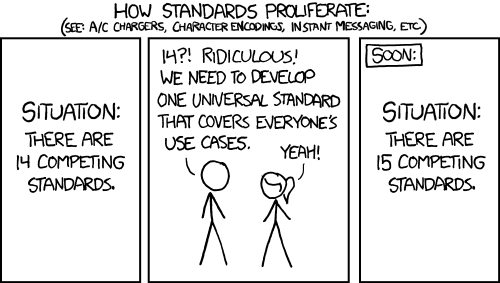
In this context, I often quote the following xkcd comic which shows two sides of the coin. First, the obvious one where one should indeed not create the 15th competing standards, which one may think it's easy but it isn't although there's also a positive aspect about this (see at the end of this blog post). Second, standards should only define the minimum to enable interoperability and leave out enough space for innovation and competition. However, it's not always clear from the beginning, where to draw the line in order to become a successful standard.
https://xkcd.com/927/
In the past couple of years I was heavily involved in the standardization of MPEG-DASH. In the beginning we've been in the situation with multiple competing formats (Adobe HDS, Apple HLS, Microsoft Smooth Streaming, etc.). MPEG-DASH was finally adopted by Adobe and Microsoft, leaving HLS as competing format/standard (i.e., informational RFC 8216) which now utilizes MPEG's Common Media Application Format (CMAF) to allow a common media segment format to be used by both DASH and HLS. Thus, we did not create the 15th competing standard and DASH/HLS/CMAF is an important step towards reducing market fragmentation although it's not yet the end of the path.

I'd like to conclude with two quotes related to standards. One is from one of my professor at university who was saying "if you have sleeping problems, read a standard", which is true - they are boring to read for an outsider - but it's exciting to work on standards as you basically define the path for future products and services. Finally, my favorite quote goes back to Andrew S. Tanenbaum's book on computer networks: "The nice thing about standards is that you have so many to choose from" which I interpret as a positive statement as competition leads to innovation which eventually leads to innovative products and services - that's what we want.

In this spirit: Happy World Standards Day!