Showing posts with label nossdav. Show all posts

Thursday, April 4, 2019

ACM NOSSDAV'19: Bandwidth Prediction in Low-Latency Chunked Streaming

Bandwidth Prediction in Low-Latency Chunked Streaming

[PDF]

Abdelhak Bentaleb (National University of Singapore), Christian Timmerer (Alpen-Adria Universität & Bitmovin Inc,), Ali C. Begen (Ozyegin University), and Roger Zimmermann (National University of Singapore)

Abstract: HTTP adaptive streaming (HAS) with chunked transfer encoding can be used to reduce latency without sacrificing the coding ef- ficiency. While this allows a media segment to be generated and delivered at the same time, it also causes grossly inaccurate band- width measurements, leading to incorrect bitrate selections. To overcome this effect, we design a novel Adaptive bitrate scheme for Chunked Transfer Encoding (ACTE) that leverages the unique nature of chunk downloads. It uses a sliding window to accurately measure the available bandwidth and an online linear adaptive filter to predict the available bandwidth into the future. Results show that ACTE achieves 96% measurement accuracy, which translates to a 64% reduction in stalls and a 27% increase in video quality.


Keywords: HAS; ABR; DASH; CMAF; low-latency; HTTP chunked transfer encoding; bandwidth measurement and prediction; RLS.

Acknowledgment: This research has been supported in part by the Singapore Ministry of Education Academic Research Fund Tier 1 under MOE's official grant number T1 251RES1820 and the Austrian Research Promotion Agency (FFG) under the Next Generation Video Streaming project "PROMETHEUS".

Tuesday, August 2, 2016

Review of ACM MMSys 2016 & NOSSDAV, MoVid, and MMVE

The 7th ACM International Conference on Multimedia System (MMSys 2016) was successfully held in Klagenfurt am Wörthersee, Austria from May 10-13, 2016 (http://mmsys2016.itec.aau.at) with the co-located workshops NOSSDAV, MoVid, and MMVE.
We'd like to thank our Gold Sponsors: Adobe and YouTube.
The ACM Multimedia Systems Conference (MMSys) provides a forum for researchers to present and share their latest research findings in multimedia systems. While research about specific aspects of multimedia systems are regularly published in the various proceedings and transactions of the networking, operating system, real-time system, and database communities, MMSys aims to cut across these domains in the context of multimedia data types. This provides a unique opportunity to view the intersections and the inter-play of the various approaches and solutions developed across these domains to deal with multimedia data types.
This year’s MMSys introduced a new format referred to as overview talks which have been held on May 10 starting in the afternoon and concluding in the evening with a get together event at the conference venue. The following overview talks have been given at MMSys: “Using Games to solve Challenging Multimedia Problems” by Oge Marques, ACM Distinguished Speaker, FAU, USA ; “More Juice Less Bits: MediaMelon Content Aware Streaming” by Ali C. Begen, MediaMelon Inc., USA, Ozyegin University, Turkey, IEEE ComSoc Distinguished Lecturer, “MPEG-DASH Spatial Relationship Description” by Omar Aziz Niamut, TNO, The Netherlands, “Mulsemedia: Novelty or Reinvention?” by Gheorghita Ghinea, Brunel University, UK ; and “Smart Camera Systems” by Bernhard Rinner, Alpen-Adria-Universität Klagenfurt, Austria .
ACM MMSys typically comes with keynotes from experts and leaders in industry and academy. The first keynote was about “Ten Thousand Channels to Ten Million Viewers: Technologies for Scaling Video Delivery over IP” by Neill A. Kipp, Comcast VIPER, USA addressing issues with video delivery at scale whereas the second keynote entitled “Advances and Trends in Augmented Reality Systems“ by Dieter Schmalstieg, Graz University of Technology, Austria was related to one of the special session. The third keynote was about “5G enabling the Tactile Internet” by Frank Fitzek, Technische Universität Dresden, Germany providing insights about next generation mobile networks.
Best Paper Award
Best Paper Award
In general, ACM MMSys 2016 attracted 71 full paper submissions from which 20 got finally accepted in the program which has been carefully selected from our experienced members of the technical program committee. In addition to the full paper submissions, MMSys 2016 hosted two special sessions, one on augmented reality and another on media synchronization. A demo session provided researchers, engineers, and scientist to present the opportunity to showcase their research prototypes, systems, and applications to MMSys attendees. An important aspect of MMSys is the dataset track which enables reproducible research thanks to the availability of common datasets across different application areas. In particular, the dataset track is an opportunity for researchers and practitioners to make their work available and citable.
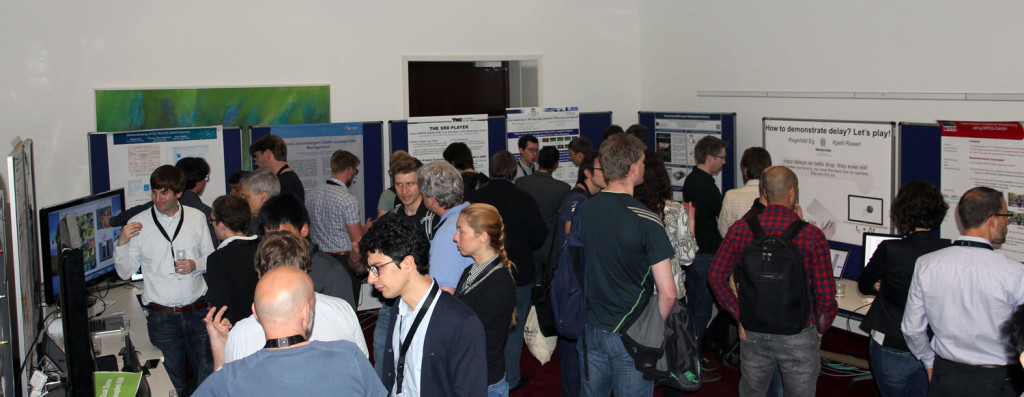
MMSYS26
ACM MMSys hosts three workshops: the 26th ACM Workshop on Network and Operating Systems Support for Digital Audio and Video (NOSSDAV), the 8th ACM Workshop on Mobile Video (MoVid), and the 8th ACM Workshop on Massively Multiuser Virtual Environments (MMVE). The operate with their own committees and review process but benefit from a single registration fee for all events co-located with MMSys.
The 7th ACM MMSys issued the following awards:
  • a best paper award,
  • a best student paper award, and
  • for the first time the excellence in DASH award sponsored by the DASH-IF.
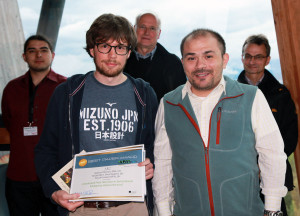
Best Student Paper
Best Student Paper
The best paper award goes to “Distributed Rate Allocation in Switch-Based Multiparty Videoconference” by Stefano D’bronco (EPFL), Sergio Mena (Cisco Systems), Pascal Frossard (EPFL) and the best student paper award goes to “Network-assisted Control for HTTP Adaptive Video Streaming” by Giuseppe Cofano (Politecnico di Bari, Italy), Luca De Cicco (Telecom SudParis, France), Thomas Zinner (University of Würzburg, Germany), Anh Nguyen-Ngoc (University of Würzburg, Germany), Phuoc Tran-Gia (University of Würzburg, Germany), Saverio Mascolo (Politecnico di Bari, Italy).
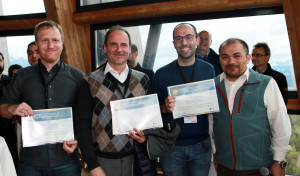
The excellence in DASH award was selected by members of the DASH-IF and instead of a first, second, and third place the DASH-IF concluded to give the first price to all three papers which are as follows: “ABMA+: lightweight and efficient algorithm for HTTP adaptive streaming” by Andrzej Beben, Piotr Wiśniewski, Jordi Mongay Batalla, Piotr Krawiec (Warsaw University of Technology, Poland ); “Delivering Stable High-Quality Video: An SDN Architecture with DASH Assisting Network Elements” by Jan Willem Martin Kleinrouweler, Sergio Cabrero, Pablo Cesar (Centrum Wiskunde & Informatica, Netherlands); and “SQUAD: A Spectrum-based Quality Adaptation for Dynamic Adaptive Streaming over HTTP” by Cong Wang, Amr Rizk, Michael Zink (University of Massachusetts Amherst, USA).
MMSYS35 MMSYS36 MMSYS34
We would like to congratulate all award winners of ACM MMSys 2016.
Finally, we would like to thank our gold sponsors Adobe and YouTube for their excellent support. In this context, it is worth mentioning the social events including coffee breaks, lunches, get together on the first evening, welcome BBQ on the second evening, and gala dinner on the third evening. These side events are as much as important as the technical papers, demos, and datasets and allow for networking, discussions, and possible future collaborations of conference attendees.
Finally, we’re happy to announce next year’s ACM MMSys (and NOSSDAV, MoVid, and MMVE) in Taiwan with Sheng-Wei (Kuan-Ta) Chen from Academia Sinica.

Thursday, March 19, 2015

MMSys 2016 - Preliminary Call for Papers


ACM Multimedia Systems 2016 (MMSys'16) [PDF]
co-located with NOSSDAV, MoVid, and MMVE

May 10-13, 2016
Klagenfurt am Wörthersee, Austria

The ACM Multimedia Systems Conference (MMSys) provides a forum for researchers to present and share their latest research findings in multimedia systems. While research about specific aspects of multimedia systems are regularly published in the various proceedings and transactions of the networking, operating system, real-time system, and database communities, MMSys aims to cut across these domains in the context of multimedia data types. This provides a unique opportunity to view the intersections and the inter-play of the various approaches and solutions developed across these domains to deal with multimedia data types. MMSys is a venue for researchers who explore:
  • Complete multimedia systems that provide a new kind of multimedia experience or systems whose overall performance improves the state-of-the-art through new research results in one of more components, or
  • Enhancements to one or more system components that provide a documented improvement over the state-of-the-art for handling continuous media or time-dependent services.
Such individual system components include:
  • Operating systems
  • Distributed architectures and protocol enhancements
  • Domain languages, development tools and abstraction layers
  • Using new architectures or computing resources for multimedia
  • New or improved I/O architectures or I/O devices, innovative uses and algorithms for their operation
  • Representation of continuous or time-dependent media
  • Metrics, measures and measurement tools to assess performance and quality of service/experience
This touches aspects of many hot topics: adaptive streaming, games, virtual environments, augmented reality, 3D video, immersive systems, telepresence, multi- and many-core, GPGPUs, mobile streaming, P2P, Clouds, cyber-physical systems. All submissions will be peer-reviewed by at least 3 members of the technical program committee. Full papers will be evaluated for their scientific quality. Accepted papers must reach a high scientific standard and document unpublished research.

Committee ACM MMSys
  • General chair: Christian Timmerer, AAU
  • TPC chair: Ali C. Begen, CISCO
  • Dataset chair: Karel Fliegel, CTU
  • Demo chairs: Omar Niamut, TNO & Michael Zink, UMass
  • Proceedings chair: Benjamin Rainer, AAU
  • Publicity chairs
    • America: Baochun Li, University of Toronto
    • Asia: Sheng-Wei Chen (a.k.a. Kuan-Ta Chen), Academia Sinica
    • Middle East: Mohamed Hefeeda, Qatar Computing Research Institute (QCRI)
    • Europe: Vincent Charvillat, IRIT-ENSEEIHT-Toulouse Univ.
  • Local chair: Laszlo Böszörmenyi, AAU
Important dates ACM MMSys
  • Submission deadline: November 27, 2015
  • Reviews available to authors: January 15, 2016
  • Rebuttal deadline:  January 22, 2016
  • Acceptance notification: January 29, 2015
  • Camera ready deadline: March 11, 2016
Committee ACM NOSSDAV (co-located with MMSys) [Prelim. CfP: PDF]
  • General chair: Hermann Hellwagner, AAU
  • TPC chair: Eckehard Steinbach, TUM
Important dates ACM NOSSDAV
  • Submission deadline: February 5, 2016
  • Acceptance notification: March 23, 2016
  • Camera ready deadline: April 8, 2016
Committees ACM MMVE (co-located with MMSys) [Prelim. CfP: PDF]
  • General chair: Jean Botev, Univ. of Luxembourg
Important dates ACM MMVE
  • Submission deadline: February 5, 2016
  • Acceptance notification: March 23, 2016
  • Camera ready deadline: April 8, 2016
Committees ACM MoVid (co-located with MMSys)
  • TPC chair: Pål Halvorsen, Simula/Univ. Oslo
  • TPC co-chair: Qi Han, Colorado School of Mines
Important dates ACM MoVid
  • Submission deadline: tbd
  • Acceptance notification: tbd
  • Camera ready deadline: tbd
Local organisation
  • Chair: Laszlo Böszörmenyi
  • Alpen-Adria-Universität Klagenfurt (AAU)
  • Institute of Information Technology (ITEC)
  • Universitätsstraße 65-67, A-9020 Klagenfurt
  • Email: mmsys2016@itec.aau.at