Showing posts with label media resource. Show all posts
Showing posts with label media resource. Show all posts
Friday, June 19, 2009
First Draft Published for Ontology for Media Resource 1.0
The Media Annotations Working Group has published the First Public Working Draft of Ontology for Media Resource 1.0. This specification defines an ontology for cross-community data integration of information related to media resources, with a particular focus on media resources on the Web. The ontology is supposed to foster interoperability and counter the current proliferation of video metadata formats by providing full or partial translation and mapping towards existing formats. Learn more about the Video in the Web Activity.
Thursday, June 4, 2009
Use Cases and Requirements for Ontology and API for Media Object 1.0 Draft Published
The Media Annotations Working Group has published a Working Draft of Use Cases and Requirements for Ontology and API for Media Object 1.0. This document specifies use cases and requirements as an input for the development of the "Ontology for Media Object 1.0" and the "API for Media Object 1.0". The ontology will be a simple ontology to support cross-community data integration of information related to media objects on the Web. The API will provide read access and potentially write access to media objects, relying on the definitions from the ontology. Learn more about the Video in the Web Activity.
This is the second version of this working draft and from the "Purpose of the Ontology and the API" section I've extracted the following:

This is the second version of this working draft and from the "Purpose of the Ontology and the API" section I've extracted the following:
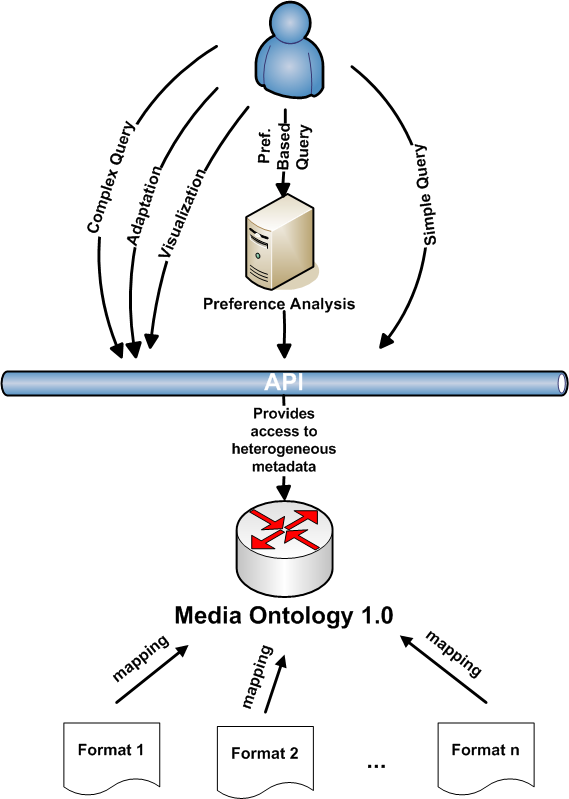
The ontology will define mappings from properties in formats to a common set of properties. The API then will define methods to access heterogeneous metadata, using such mappings. An example: the property createDate from XMP can be mapped to the property DateCreated from IPTC. The API will then define a method getCreateDate that will return values either from XMP or IPTC metadata.
An important aspect of the above figure is that everything visualized above the API is left to applications. For example.
languages for simple or complex queries
analysis of user preferences (like "preferring movies with actor X and suitable for children")
other mechanisms for accessing metadata
The ontology and the API provide merely a basic, simple means of interoperability for such applications.
Subscribe to:
Posts (Atom)