Wednesday, May 12, 2021

NetSoft2020: On Optimizing Resource Utilization in AVC-based Real-time Video Streaming

On Optimizing Resource Utilization in AVC-based Real-time Video Streaming

IEEE Conference on Network Softwarization

29 June-3 July 2020 // Ghent, Belgium

http://netsoft2020.netsoft-ieee.org

[PDF][Slides][Video]

Alireza Erfanian‡, Farzad Tashtarian†, Reza Farahani‡, Christian Timmerer‡, Hermann Hellwagner‡

‡ Christian Doppler Laboratory ATHENA, Institute of Information Technology (ITEC), Alpen-Adria-Universit ̈at Klagenfurt, Austria
† Department of Computer Engineering, Mashhad Branch, Islamic Azad University, Mashhad, Iran

Abstract—Real-time video streaming traffic and related applications have witnessed significant growth in recent years. However, this has been accompanied by some challenging issues, predominantly resource utilization. IP multicasting, as a solution to this problem, suffers from many problems. Using scalable video coding could not gain wide adoption in the industry, due to reduced compression efficiency and additional computational complexity. The emerging software-defined networking (SDN)and network function virtualization (NFV) paradigms enable re-searchers to cope with IP multicasting issues in novel ways. In this paper, by leveraging the SDN and NFV concepts, we introduce a cost-aware approach to provide advanced video coding (AVC)-based real-time video streaming services in the network. In this study, we use two types of virtualized network functions (VNFs): virtual reverse proxy (VRP) and virtual transcoder (VTF)functions. At the edge of the network, VRPs are responsible for collecting clients’ requests and sending them to an SDN controller. Then, executing a mixed-integer linear program (MILP) determines an optimal multicast tree from an appropriate set of video source servers to the optimal group of transcoders. The desired video is sent over the multicast tree. The VTFs transcode the received video segments and stream them to the requested VRPs over unicast paths. To mitigate the time complexity of the proposed MILPmodel, we propose a heuristic algorithm that determines a near-optimal solution in a reasonable amount of time. Using the MiniNet emulator, we evaluate the proposed approach and show it achieves better performance in terms of cost and resource utilization in comparison with traditional multicast and unicast approaches.

Keywords—Dynamic Adaptive Streaming over HTTP (DASH), Real-time Video Streaming, Software Defined Networking (SDN), Video Transcoding, Network Function Virtualization (NFV).

Acknowledgments: The financial support of the Austrian Federal Ministry for Digital and Economic Affairs, the National Foundation for Research, Technology and Development, and the Christian Doppler Research Association, is gratefully acknowledged. Christian Doppler Laboratory ATHENA: https://athena.itec.aau.at/.
Monday, May 10, 2021

DCC’20: Fast Multi-Rate Encoding for Adaptive HTTP Streaming

 Fast Multi-Rate Encoding for Adaptive HTTP Streaming

Data Compression Conference 2020, March 24 – 27, Cliff Lodge, Snowbird, UT

[PDF] [SigPort]

Hadi Amirpour, Ekrem Çetinkaya, Christian Timmerer, and Mohammad Ghanbari (University of Tehran, University of Essex)
Christian Doppler Laboratory ATHENA, Alpen-Adria-Universität Klagenfurt

Abstract: Adaptive HTTP streaming is the preferred method to deliver multimedia content on the internet. It provides multiple representations of the same content in different qualities (i.e., bit-rates and resolutions) and allows the client to request segments from the available representations in a dynamic, adaptive way depending on its context. The growing number of representations in adaptive HTTP streaming makes encoding of one video segment at different representations a challenging task in terms of encoding time-complexity. In this paper, information of both highest and lowest quality representations are used to limit Rate Distortion Optimization (RDO) for each Coding Unit Tree (CTU) in High Efficiency Video Coding. Our proposed method first encodes the highest quality representation and consequently uses it to encode the lowest quality representation. In particular, the block structure and the selected reference frame of both highest and lowest quality representations are then used to predict and shorten the RDO process of each CTU for intermediate quality representations. Our proposed method introduces a delay of two CTUs thanks to employing parallel processing techniques. Experimental results show a significant reduction in time-complexity over the reference software (38%) and state-of-the-art (10%) is achieved while quality degradation is negligible.

Keywords:  HTTP adaptive streaming, Multi-rate encoding, HEVC, Fast block partitioning

Acknowledgments: The financial support of the Austrian Federal Ministry for Digital and Economic Affairs, the National Foundation for Research, Technology and Development, and the Christian Doppler Research Association, is gratefully acknowledged. Christian Doppler Laboratory ATHENA: https://athena.itec.aau.at/.

Friday, May 7, 2021

PV’20: H2BR: An HTTP/2-based Retransmission Technique to Improve the QoE of Adaptive Video Streaming

H2BR: An HTTP/2-based Retransmission Technique to Improve the QoE of Adaptive Video Streaming

Packet Video Workshop 2020 (PV)
June 10-11, 2020, Istanbul, Turkey (co-located with ACM MMSys’20)

https://2020.packet.video/

[PDF][Slides][Video]

Minh Nguyen, Christian Timmerer, Hermann Hellwagner
Christian Doppler Laboratory ATHENA, Alpen-Adria-Universität Klagenfurt

Abstract: HTTP-based Adaptive Streaming (HAS) plays a key role in over-the-top video streaming. It contributes towards reducing the rebuffering duration of video playout by adapting the video quality to the current network conditions. However, it incurs variations of video quality in a streaming session because of the throughput fluctuation, which impacts the user’s Quality of Experience (QoE). Besides, many adaptive bitrate (ABR) algorithms choose the lowest-quality segments at the beginning of the streaming session to ramp up the playout buffer as soon as possible. Although this strategy decreases the startup time, the users can be annoyed as they have to watch a low-quality video initially. In this paper, we propose an efficient retransmission technique, namely H2BR, to replace low-quality segments being stored in the playout buffer with higher-quality versions by using features of HTTP/2 including (i) stream priority, (ii) server push, and (iii) stream termination. The experimental results show that H2BR helps users avoid watching low video quality during video playback and improves the user’s QoE. H2BR can decrease by up to more than 70% the time when the users suffer the lowest-quality video as well as benefits the QoE by up to 13%.

Keywords: HTTP adaptive streaming, DASH, ABR algorithms, QoE, HTTP/2

Acknowledgments: The financial support of the Austrian Federal Ministry for Digital and Economic Affairs, the National Foundation for Research, Technology and Development, and the Christian Doppler Research Association, is gratefully acknowledged. Christian Doppler Laboratory ATHENA: https://athena.itec.aau.at/.

MMSys’20: Cloud-based Adaptive Video Streaming Evaluation Framework for the Automated Testing of Media Players (CAdViSE)

CAdViSE: Cloud-based Adaptive Video Streaming Evaluation Framework for the Automated Testing of Media Players

ACM Multimedia Systems Conference 2020 (MMSys 2020)
https://2020.acmmmsys.org/
Babak Taraghi, Anatoliy Zabrovskiy, Christian Timmerer and Hermann Hellwagner
Christian Doppler Laboratory ATHENA, Alpen-Adria-Universität Klagenfurt

Abstract: Attempting to cope with fluctuations of network conditions in terms of available bandwidth, latency and packet loss, and to deliver the highest quality of video (and audio) content to users, research on adaptive video streaming has attracted intense efforts from the research community and huge investments from technology giants. How successful these efforts and investments are, is a question that needs precise measurements of the results of those technological advancements. HTTP-based Adaptive Streaming (HAS) algorithms, which seek to improve video streaming over the Internet, introduce video bitrate adaptivity in a way that is scalable and efficient. However, how each HAS implementation takes into account the wide spectrum of variables and configuration options, brings a high complexity to the task of measuring the results and visualizing the statistics of the performance and quality of experience. In this paper, we introduce CAdViSE, our Cloud-based Adaptive Video Streaming Evaluation framework for the automated testing of adaptive media players. The paper aims to demonstrate a test environment which can be instantiated in a cloud infrastructure, examines multiple media players with different network attributes at defined points of the experiment time, and finally concludes the evaluation with visualized statistics and insights into the results.

Keywords: HTTP Adaptive Streaming, Media Players, MPEG-DASH, Network Emulation, Automated Testing, Quality of Experience

Acknowledgments: The financial support of the Austrian Federal Ministry for Digital and Economic Affairs, the National Foundation for Research, Technology and Development, and the Christian Doppler Research Association, is gratefully acknowledged. Christian Doppler Laboratory ATHENA: https://athena.itec.aau.at/.

ACM Reference Format:
Babak Taraghi, Anatoliy Zabrovskiy, Christian Timmerer, and Hermann Hellwagner. 2020. CAdViSE: Cloud-based Adaptive Video Streaming Evaluation Framework for the Automated Testing of Media Players. In 11th ACM Multimedia Systems Conference (MMSys’20), June 8–11, 2020, Istanbul, Turkey. , 4 pages. https://doi.org/10.1145/3339825.3393581

Thursday, May 6, 2021

ACM TOMM: Performance Analysis of ACTE: a Bandwidth Prediction Method for Low-Latency Chunked Streaming

Performance Analysis of ACTE: a Bandwidth Prediction Method for Low-Latency Chunked Streaming

ACM Transactions on Multimedia Computing, Communications, and Applications

[PDF]

Abdelhak Bentaleb (National University of Singapore), Christian Timmerer (Christian Doppler Laboratory ATHENA, Alpen-Adria-Universität Klagenfurt), Ali C. Begen (Ozyegin University, Networked Media), Roger Zimmermann (National University of Singapore)

Abstract: HTTP adaptive streaming with chunked transfer encoding can offer low-latency streaming without sacrificing the coding efficiency. This allows media segments to be delivered while still being packaged. However, conventional schemes often make widely inaccurate bandwidth measurements due to the presence of idle periods between the chunks, and hence this is causing sub-optimal adaptation decisions. To address this issue, we earlier proposed ACTE (ABR for Chunked Transfer Encoding), a bandwidth prediction scheme for low-latency chunked streaming. While ACTE was a significant step forward, in this study we focus on two still remaining open areas, namely (i) quantifying the impact of encoding parameters, including chunk and segment durations, bitrate levels, minimum interval between IDR-frames and frame rate on ACTE, and (ii) exploring the impact of video content complexity on ACTE. We thoroughly investigate these questions and report on our findings. We also discuss some additional issues that arise in the context of pursuing very low latency HTTP video streaming.

Keywords: HAS; ABR; DASH; CMAF; low-latency; HTTP chunked transfer encoding; bandwidth measurement and prediction; RLS; encoding parameters; FFmpeg

Acknowledgments: The financial support of the Austrian Federal Ministry for Digital and Economic Affairs, the National Foundation for Research, Technology and Development, and the Christian Doppler Research Association, is gratefully acknowledged. Christian Doppler Laboratory ATHENA: https://athena.itec.aau.at/.


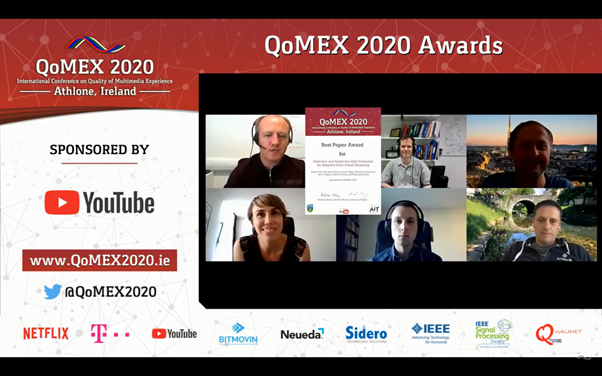
QoMEX’20: Objective and Subjective QoE Evaluation for Adaptive Point Cloud Streaming

 Objective and Subjective QoE Evaluation for Adaptive Point Cloud Streaming

*** Best Paper Award ***

International Conference on Quality of Multimedia Experience (QoMEX)
May 26-28, 2020, Athlone, Ireland
http://qomex2020.ie/

[PDF][Slides][Video]

Jeroen van der Hooft (Ghent University), Maria Torres Vega (Ghent University), Christian Timmerer (Christian Doppler Laboratory ATHENA, Alpen-Adria-Universität Klagenfurt), Ali C. Begen (Ozyegin University, Networked Media), Filip De Turck (Ghent University), Raimund Schatz (Alpen-Adria Universität Klagenfurt & AIT Austrian Institute of Technology, Austria)

Abstract: Volumetric media has the potential to provide the six degrees of freedom (6DoF) required by truly immersive media. However, achieving 6DoF requires ultra-high bandwidth transmissions, which real-world wide area networks cannot provide economically. Therefore, recent efforts have started to target efficient delivery of volumetric media, using a combination of compression and adaptive streaming techniques. It remains, however, unclear how the effects of such techniques on the user-perceived quality can be accurately evaluated. In this paper, we present the results of an extensive objective and subjective quality of experience (QoE) evaluation of volumetric 6DoF streaming. We use PCC-DASH, a standards-compliant means for HTTP adaptive streaming of scenes comprising multiple dynamic point cloud objects. By means of a thorough analysis, we investigate the perceived quality impact of the available bandwidth, rate adaptation algorithm, viewport prediction strategy, and user’s motion within the scene. We determine which of these aspects has more impact on the user’s QoE, and to what extent subjective and objective assessments are aligned.

Keywords: Volumetric Media; HTTP Adaptive Streaming; 6DoF; MPEG V-PCC; QoE Assessment; Objective Metrics

Acknowledgments: The financial support of the Austrian Federal Ministry for Digital and Economic Affairs, the National Foundation for Research, Technology and Development, and the Christian Doppler Research Association, is gratefully acknowledged. Christian Doppler Laboratory ATHENA: https://athena.itec.aau.at/.

Wednesday, May 5, 2021

ICME’20: Multi-Period Per-Scene Optimization for HTTP Adaptive Streaming

 Multi-Period Per-Scene Optimization for HTTP Adaptive Streaming

IEEE International Conference on Multimedia and Expo
July 06 – 10, London, United Kingdom
https://www.2020.ieeeicme.org/

[PDF][Slides][Video]

Venkata Phani Kumar M, Christian Timmerer and Hermann Hellwagner
Christian Doppler Laboratory ATHENA, Alpen-Adria-Universität Klagenfurt, Austria

Abstract: Video delivery over the Internet has become more and more established in recent years due to the widespread use of Dynamic Adaptive Streaming over HTTP (DASH). The current DASH specification defines a hierarchical data model for Media Presentation Descriptions (MPDs) in terms of periods, adaptation sets, representations, and segments. Although multi-period MPDs are widely used in live streaming scenarios, they are not fully utilized in Video-on-Demand (VoD) HTTP adaptive streaming (HAS) scenarios. In this paper, we introduce MiPSO, a framework for Multi–Period per-Scene Optimization, to examine multiple periods in VoD HAS scenarios. MiPSO provides different encoded representations of a video at either (i) maximum possible quality or (ii) minimum possible bitrate, beneficial to both service providers and subscribers. In each period, the proposed framework adjusts the video representations (resolution-bitrate pairs) by taking into account the complexities of the video content, with the aim of achieving streams at either higher qualities or lower bitrates. The experimental evaluation with a test video data set shows that the MiPSO reduces the average bitrate of streams with the same visual quality by approximately 10% or increases the visual quality of streams by at least 1 dB in terms of Peak Signal-to-Noise (PSNR) at the same bitrate compared to conventional approaches to video content delivery.

Keywords: Adaptive Streaming, Video-on-Demand, Per-Scene Encoding, Media Presentation Description

Acknowledgments: The financial support of the Austrian Federal Ministry for Digital and Economic Affairs, the National Foundation for Research, Technology and Development, and the Christian Doppler Research Association, is gratefully acknowledged. Christian Doppler Laboratory ATHENA: https://athena.itec.aau.at/.